Qinghai-Tibet Plateau adopts measures to address climate change









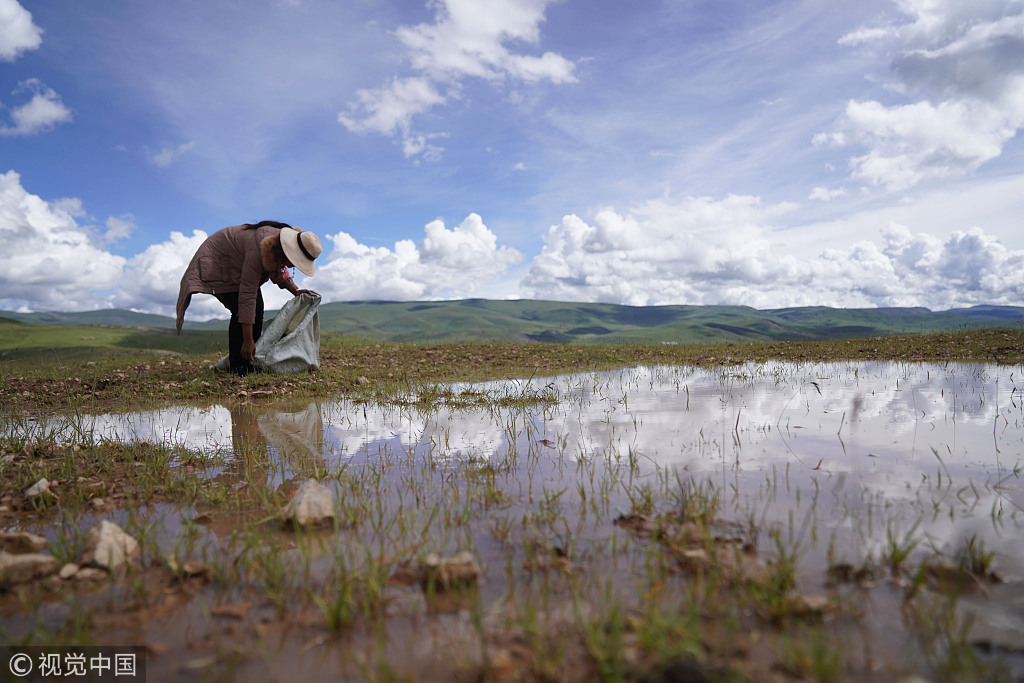
XINING -- When Nyima Cering left for the Polish city of Katowice to attend the UN Climate Change Conference, he was well aware of the importance of protecting the ecology in the Qinghai-Tibet Plateau.
It was the first time he attended such an important international meeting. He felt a sense of mission.
Nyima Cering, secretary of the CPC Committee of Chengduo County in west China's Qinghai Province, was invited as a representative from a special ecological area with a unique culture during the pavilion events of the ongoing Katowice Climate Change Conference.
An ethnic Tibetan, He shared his ideas about the adaptation to climate change on the Qinghai-Tibet Plateau and grassland management.
Located in western China, the Qinghai-Tibet Plateau is about 2.6 million square kilometers in area, and most of it lies at an altitude of more than 4,000 meters above sea level. The Plateau covers the entire Tibet Autonomous Region and Qinghai Province, in addition to parts of Sichuan, Yunnan, Gansu, and Xinjiang.
Also hailed as the "roof of the world" and the "water tower of Asia," the Plateau contains the headwaters of three major rivers: the Yangtze River, the Yellow River and the Lancang (Mekong) River. It is also a natural habitat for rare animals and a gene pool of plateau life.
Nyima Cering's hometown sits at the headwaters region on the Plateau.
"The ecosystem of the Qinghai-Tibet Plateau is highly vulnerable. Rising temperatures and rainfall changes caused by global climate change can have impacts on grassland productivity and water conservation. Therefore, the local government and herdsmen work together to protect the grassland," he said.
Chengduo County has 1.5 million hectares of natural grassland, which has been well-preserved since 2005. He brought his successful experiences to the attendees.
"We worked out a solution with a combination of grassland construction, ecological protection and poverty alleviation," he said.
Over the past few years, the county has been making efforts to restore overgrazed grassland, increased the return of grazing land to grassland and encouraged more and more herdsmen to participate in the protection of the ecological system on the Plateau.
A growing number of herdsmen in the county, as well as on the Plateau, have been given subsidies and bonus for their efforts, while many have been provided new jobs after giving up grazing.
"We discovered a way of grassland protection in areas with high altitudes and extremely cold climates. And what is more important is that we realized grassland management scientifically and on the basis of traditional ideas of Tibetans about protecting the environment," he added.
According to a white paper issued by the Chinese government in July, the Plateau is still one of the cleanest regions on earth.
However, Chinese experts believe that the Plateau is facing a series of ecological challenges due to increasing climate change and human activities, such as glacier retreat and permafrost degradation.
"The glaciers on the Plateau have been melting because of greenhouse gas and black carbon emissions, which are also global issues and can transmit without boundaries," said Kang Shichang, a researcher with Northwest Institute of Eco-Environment and Resources of Chinese Academy of Sciences (CAS).
To protect glaciers on the Plateau, China has been reducing emissions and carrying out international cooperation, Kang added.
In 1994, China's first Global Atmosphere Watch (GAW) baseline station was launched at the top of Mt. Waliguan in Qinghai. It is one of the world's highest GAW observatories at an altitude of over 3,800 meters above sea level. The observatory has been sharing its data with international meteorological organizations since its operation.
"Dealing with global climate change on the Qinghai-Tibet Plateau will be a long-term task. The government should enhance top-level system designs and overall coordination, promote scientific, technological and institutional innovation in order to build a better ecological environment on the Plateau," said Shen Yongping, a researcher with CAS.




- Shenzhen logs milestone in green shipping progress
- China's icy regions attract Southeast Asian tourists
- Century-old TCM pharmacy pivots to become fashionable wellness brand
- Agri sector reaps fruit of tech advances
- Central government appoints new foreign ministry commissioner in Macao SAR
- Winter camp solidifies cross-Strait youth ties