



The place where nothing is ever lost in translation









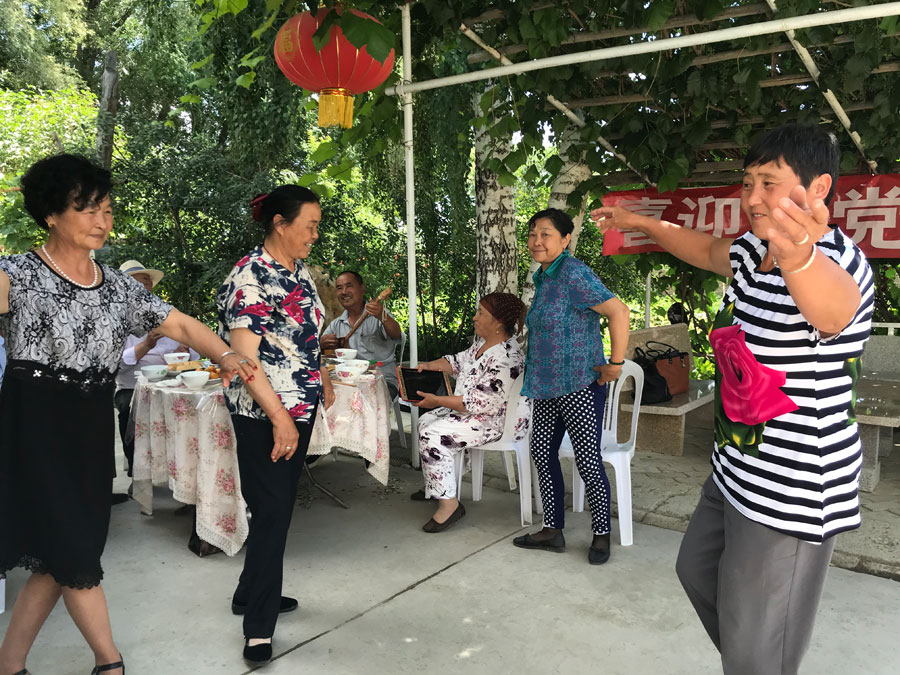
A remote settlement has long been a crucible of multiethnic friendships. Zhang Yi reports from Hongdun in the Xinjiang Uygur autonomous region.
In the 1950s and '60s, a group of 46 translators of Kazakh all hailed from Hongdun in Altay, a remote city in the northwest of the Xinjiang Uygur autonomous region.
The translators were Han, but they were all fluent in Kazakh and some even spoke Mongolian. They worked for the government in Xinjiang or Beijing, and some held high office.
"My father was a farmer in Hongdun, and he could speak Kazakh and Mongolian. It was convenient in our lives and also prompted emotional ties with people from other ethnic groups," said Yang Zizhi, who started work as a translator of Kazakh in the Altay government in 1964.
"The language was not taught in school but learned in our daily lives because our neighbors were from different ethnic groups," said the 72-year-old.
The translators were all descendants of the Huerjia, a group of Han people who arrived in Hongdun in the 1860s. The name is a phonetic translation of khorzha, which means "settlement" in the Kazakh language.
Their ancestors came from the provinces of Shanxi, Shaanxi and Gansu. Fleeing poverty, they moved to the frontier town and started new lives alongside Mongolian and Kazakh nomads on the northern bank of the Khran River, a branch of Irtysh River which rises in the Altay Mountains.
The original 45 families, which shared 28 family names but had no previous connection, formed a small but special group in Hongdun.
They dug canals, grew crops, cultivated wasteland and introduced new production models.
Unlike their nomadic peers, the Han people built houses that the local residents dubbed khorzha, so they gradually became known by the name.
Symbiosis
The grassland's environment and resources on the south side of the mountains were multilayered, which had a lasting impact on the distribution of ethnic groups, according to Luo Yi, deputy professor at the School of History and Sociology at Xinjiang Normal University in Urumqi, the regional capital.
From north to south at the southern foot of the mountain, the land changes top-down from mountain meadows to river valley wetland and plain grassland.
The nomads moved with the changing seasons, settling temporarily in areas with adequate grass and water.
Every April, they entered the valley before leaving for the mountain grassland in May, as the Han farmers began sowing crops. After the September harvest, the nomads returned to the valley and fed their livestock with the wheat stubble piled up along field ridges.
In return, the animals' droppings became fertilizer for the fields, and the nomads exchanged livestock or related products for grain with the farmers.
During their stay in the valley, the herdsmen visited Altay to buy provisions such as salt and tobacco, staying overnight at the Han farms.
"In my childhood, my grandfather had a Kazakh friend named Ahkhan. He visited us every fall, riding a red horse and followed by two camels," Yang recalled.
"My grandpa treated Ahkhan as a guest. They talked and laughed on the kang (a heated brick bed), and we fed his horse. Ahkhan went to the market to buy tea, salt and other necessities, leaving his camels at our house.
"When he returned, we watered the horse. After dinner, Ahkhan slept at our home. The next day, he left with the camels, carrying some of the potatoes and cabbages we grew. He usually left us meat and yak butter."
According to Luo, this reciprocal land use prevented competition for resources, and prompted important forms of economic exchange. "Thus, a symbiotic and complementary relationship was formed between the two groups," he said.
Integration
This symbiotic partnership promoted other exchanges and integration between the ethnic groups, mainly manifested by the Han people's adoption of other cultures, he added.
The Han picked up the herdsmen's customs and habits, wearing clothes made of fur and drinking milk tea. Beef and mutton were a large part of their diet, but no one ate pork out of deference to the beliefs of their Muslim Kazakh neighbors.
The Han learned the Kazakh and Mongolian languages. They also performed aken, the Kazakh folk art of impromptu singing on the grassland, and joined in with Mongolian entertainment such as horse races and wrestling.
"The important thing is that they know how to respect each other's habits and differences," said Luo, adding that this symbiotic mechanism encourages integration but also maintains some boundaries.
The relationships cultivated in daily life have been important for the Han community, and helped it to survive turbulent times.
In the 1920s, the Altay grassland was invaded by "white" Russians, refugees from the Soviet Union, which led to conflict. The nomads often informed the farmers of worrying developments and provided shelter if necessary.
On three occasions the Han fled Hongdun, but returned when the danger had passed. Every time, the nomads welcomed them with provisions and helped rebuild their homes.
Development
In the past 158 years, the ethnic composition of Hongdun has changed as a result of Han immigration and the arrival of new ethnic peoples from other provinces to farm the land and make new lives.
Hongdun now has a population of about 15,000, including 48 percent Kazakh and 41 percent Han. The remainder consists of other groups, including Mongols, Uygurs, Hui people and ethnic Russians.
Nowadays, in the villages along the northern bank of the Khran River, the houses of various ethnic groups are dotted among those of the Han. Luo said the people are just as intimate as their ancestors because they live side by side, rather than in distinct ethnic groups.
"Every newcomer to Hongdun, regardless of their background, voluntarily acknowledges and follows the community's spirit and traditions - namely, mutual respect," he said.
Economically, the complementary relationship between the old herdsmen and farmers has become weaker because most people now grow cash crops and raise animals to make a living.
According to Luo, there is little competition. Instead, the Han have taught their neighbors planting skills and they work together as teams.
There was frequent communication between the groups, and as production models changed, the non-Han groups started using Mandarin to adapt to modern society.
Hongdun is changing, but the harmonious symbiotic relationship between the different groups has developed continuously in modern times, Luo said.
Inheritance
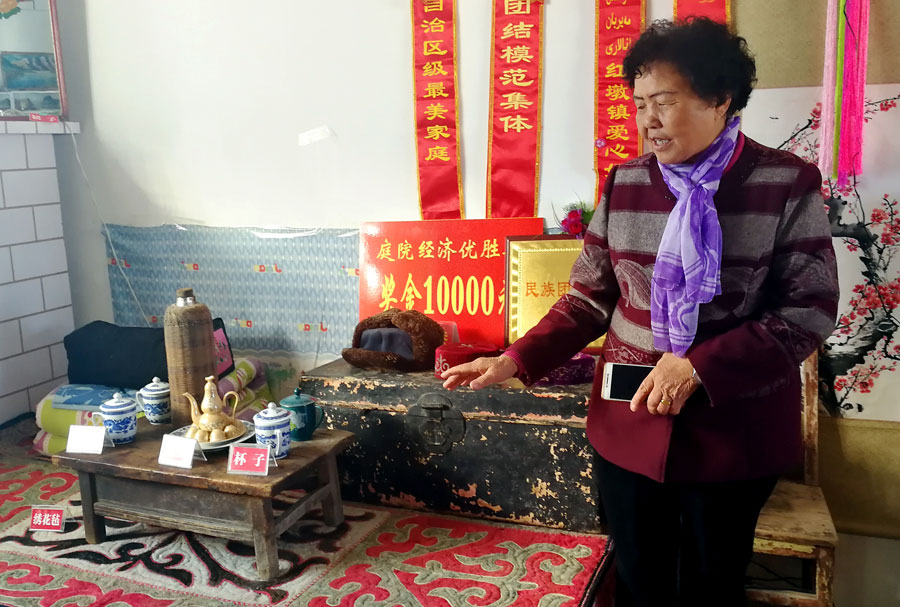
Visitors walking through several grape trellises in a courtyard in Saya Telik village will see a single-story building of about 200 square meters that acts as a museum of the Huerjia people.
Hanging on a wall are dozens of photos of their forefathers and the renowned translators. On the opposite wall, farming tools and other items used by the Han and their neighbors are displayed on several shelves.
A TV hanging on the central wall plays a drama performed by the villagers relating how their ancestors settled down in Hongdun.
In addition to the TV, there is a kang covered by a Kazakh-patterned blanket.
The kang belonged to Cao Guangyou, the third generation of a Huerjia family named Cao. He was the grandfather-in-law of Li Hongxiu, the owner of the folk museum.
"After I married and moved in with the Cao family, grandfather told me many stories about the Kazakhs," said Li, who moved from Qinghai province to Hongdun in 1966 at age 12 and married Cao Zhongwei, a fifth-generation Cao, in 1972.
Cao Zhongwei's grandfather was a renowned figure in the village. During the invasions in the 1920s, he evaded capture by hiding in the home of a local Kazakh.
As a result, the two became good friends. When the Kazakh man died, Cao Guangyou helped raise his three sons, treating them as his own children, building houses for them and helping them find wives.
The three Kazakh sons are recorded in the Cao family genealogy, which starts with the first generation in Hongdun.
"Grandfather often told us that it was the protection offered by the Kazakh man that allowed us to survive in this land," said Li, 65, who also helped to raise several orphaned Kazakh boys in the area.
Li came up with the idea of collecting old items in the 1990s, when she noticed a saddle that had been used by grandfather Cao.
"He learned horse riding from the Kazakh man, and it is a family treasure," she said.
The second item in her collection was the manual sewing machine that belonged to her grandmother-in-law. "She was the village tailor; she made clothes for the Kazakhs and they sent us legs of lamb in return," she said.
When other villagers heard of Li's idea, they brought old items to her. Now she has 300 pieces.
Li leads every visitor to Hongdun through the grape trellis in her yard to the museum and relates the distant stories behind the collection.
Aybek Askhar and Mao Weihua contributed to this story.


- Jimmy Lai sentenced to 20 years in prison
- Beautiful Hebei episode 11: Discover red tourism destinations
- Various extracurricular activities available for students across China during winter vacation
- Jimmy Lai sentenced to 20 years in prison
- Hong Kong court opens session to sentence Jimmy Lai
- Leveraging Hong Kong's strengths to serve national needs: HKSAR financial chief












