



Reforms will stay the course in new era









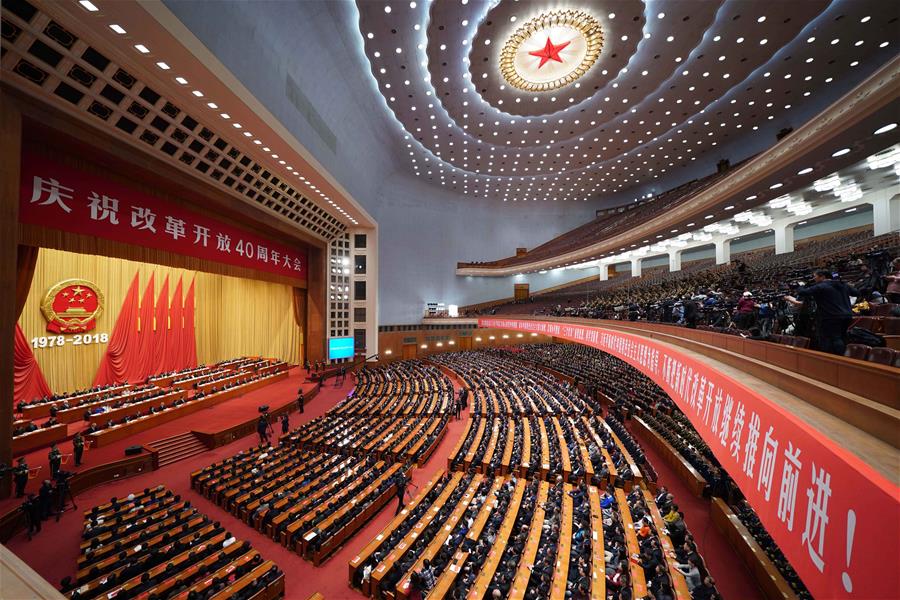
As President Xi Jinping gave his highly-anticipated speech on Tuesday to mark the 40th anniversary of reform and opening-up, it was closely watched internationally in light of the 90-day truce in the Sino-US trade dispute from Dec 1.
Xi called the pursuit of reform and opening-up, and socialism with Chinese characteristics “a milestone in realizing the Chinese nation’s rejuvenation”. He emphasized the importance of innovation, which has been prominently displayed by world-class productivity in the Greater Bay Area of South China, and international cooperation, as evidenced by the Belt and Road Initiative that’s fueling globalization.
In particular, Xi’s speech was clear about China’s historical debt to Deng Xiaoping and other reformers — and the need to go further.
China’s pragmatic transitions
In Chinese modern history, it was Sun Yat-sen, the founding father of republic China, who paved the way for sovereignty with his “three principles” . But following imperial disintegration and Western colonialism, these efforts could be started only after world wars, the War of Resistance Against Japanese Aggression and a civil war.
It was only after Mao Zedong finally declared on Oct 1, 1949, that “the Chinese people have stood up” that China began the march to a new future. In the early 1950s, Mao’s economic policies unleashed State-led industrialization, which started promisingly but stagnated amid the Cold War polarization. In historical view, Mao’s crucial contribution was the establishment of Chinese sovereignty.
Already by the early 1960s, then premier Zhou Enlai called for the “Four Modernizations” in agriculture, industry, defense, and science and technology. These reforms started in the late 1970s when Deng Xiaoping initiated the “reform and opening-up” era, with the special economic zones (SEZs) first in southern China, then in Shanghai and elsewhere.
It was Deng’s bold pragmatism — “It doesn’t matter if the cat is black or white as long as it catches the mice,” as he put it — that finally led to the inflow of foreign investment and technology, business success, and parallel price structures. With extraordinary foresight, Deng understood the opportunities of globalization, but also knew the risks of the international environment in the Ronald Reagan-Margaret Thatcher era when “one had to cross the river by feeling the stones” — a phrase that Xi quoted approvingly in his speech.
As former president Jiang Zemin pushed the role of the private sector – “the Three Represents” doctrine – and then premier Zhu Rongji began the struggle against corruption in the 1990s, China became the member of the World Trade Organization in 2001. That paved the way to a decade of export-led double-digit growth, which the former president Hu Jintao characterized as “China’s peaceful development”.
The fourth great transition – the shift to post-industrialization – has been intensified by the leadership with President Xi as its core.
Reforms in the 21st century
Just as the WTO membership allowed China to execute tough reforms, the ongoing trade conflicts with the United States may actually accelerate Chinese reforms, so as to meet the needs of the economic transformation and people’s growing need for a better life, as long as compromise makes pragmatic sense.
Xi’s reform speech offered clarity in a difficult international environment that is often overshadowed by ideological misinterpretations of economic fundamentals. Recently, The New York Times reported that China was amid “a steep downturn”. Yet the growth forecast for the year remains 6.5- 6.6 percent, after a strong first half. Moderation will ensue in the second half and especially in 2019, depending on US tariffs and slower demand worldwide.
The US may be navigating toward a correction by 2019-20, which will prove challenging to all major economies. Indeed, many Americans oppose the White House’s policies and the word “impeachment” is getting louder in Capitol Hill.
Besides, a bipartisan group of senators – Rob Portman (Republican-Ohio), Doug Jones (Democrat-Alabama) and Joni Ernst (Rep-Iowa) – seeks to claw back trade power from the US administration with legislation. The group hopes to “better align” Section 232 of the US Trade Expansion Act of 1962 with its “original intent,” which was to respond “to genuine threats to national security”. Foreign cars and car parts are not exactly a typical geopolitical threat.
In his speech, Xi also emphasized the role of the Communist Party of China in the reforms. Historically, when China has thrived, it has been attributed to “Westernization” in the West, and when China has ailed, it has been attributed to the CPC policies.
The West has not yet come to terms with the inconvenient truth that China’s economic miracle has been possible because of the Party’s leadership, not despite it. Unlike the West where middle classes continue to shrink at the expense of the ultra-wealthy, the middle-income group is expanding in China, and the country is fighting corruption and fostering sustainability.
Irrespective of Washington’s trade actions, the pressure and challenges from the outside will not change the course of Chinese reforms which will continue to broaden and deepen. China will “stay the course”, as Xi put it, while stressing that “no one is in a position to dictate to the Chinese people what should or should not be done”.
Chinese reformers are determined to complete by the late 2020s the rebalancing of their economy, which is rapidly moving toward consumption and world-class innovation.
The author is the founder of Difference Group and has served at the India, China and America Institute (USA), Shanghai Institutes for International Studies (China) and EU Centre (Singapore).





