Tech takes teachers to remote classrooms










Chengdu program illustrates one way educational resources can be shared
Livestreaming of school classes from high-quality city schools to classrooms in remote areas is being touted as a possible long-term solution to the educational disparity between China's urban and rural areas. Students score better in their schoolwork when they receive the livestreams.
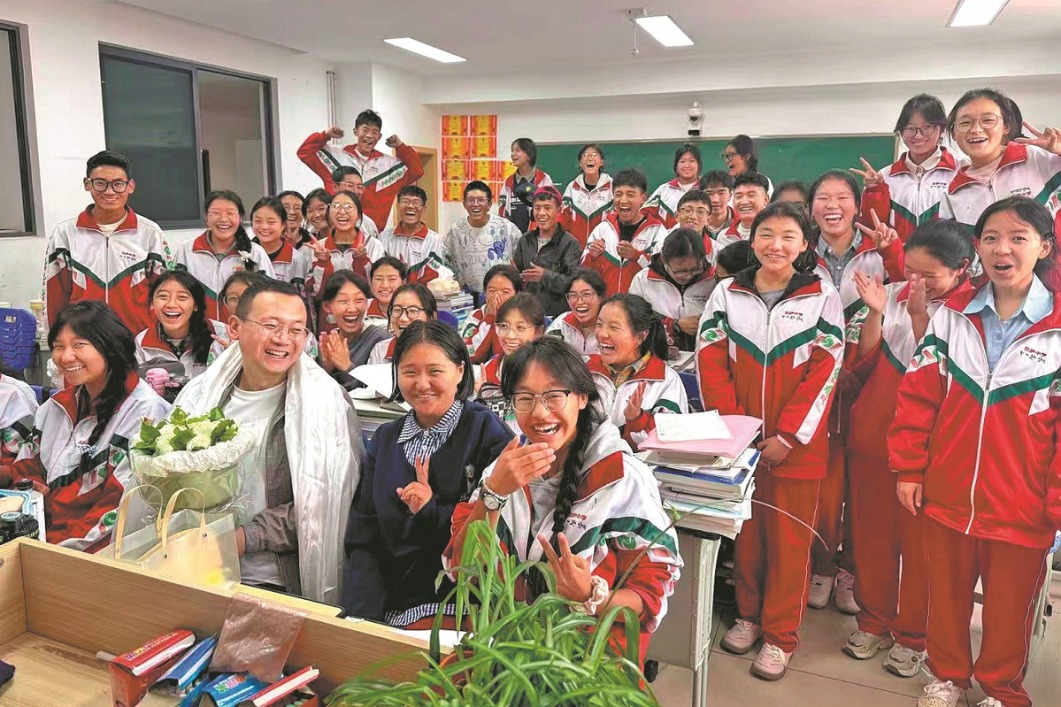
A key disparity between urban and rural schools is the quality of teachers. Rural schools struggle to attract high-quality talent. To remove this obstacle, a range of subjects taught at Chengdu No 7 High School - considered one of the best in Sichuan province - have been broadcast daily for the past 16 years via an interactive video link to hundreds of classrooms in remote, impoverished areas.
According to China Youth Daily, which cited figures provided by the school, the system has benefited about 72,000 pupils at 248 rural schools, with many choosing to pursue higher education. Eighty-eight of them were admitted to premier institutions, such as Peking University and Tsinghua University.
Promising results
The livestream sharing has sparked much discussion among industry analysts and on social media, where many have called for more public and private investment to promote similar high-tech projects.
Yan Feng, a professor of Chinese literature at Shanghai's Fudan University, said distance-learning technology has brought new hope for education equality.
Ding Lei, CEO of tech giant Net-Ease, has pledged 100 million yuan ($14.5 million) to fund initiatives that improve rural education. Of the program in Chengdu, he said: "Two hundred schools are far from enough. There should be 2,000."
Luquan Yi and Miao autonomous county in a poverty-stricken area of Yunnan province introduced the livestreaming program at two schools, No 1 High School and Minzu High School, in 2006. Both now have four classes using the service.
"The results have been astonishing," according to Wang Kaifu, head of the county's education bureau, who said 42 students from the classes scored at least 600 out of 750 in this year's gaokao, or national college entrance exam, up by a factor of seven year-on-year.
Some 152 students were admitted to top-level universities, a 55 percent increase year-on-year, while the two students who performed best in the gaokao were accepted at Peking and Tsinghua universities. The last time that happened was in the 1980s, Wang said.
Part of the credit can be attributed to massive investment by the local government, he said. The county spent 822 million yuan to boost education last year, more than 200 million yuan more than its annual GDP.
"We offer 12 years of free education, while most places in China offer nine," he said, adding that the county has recruited 572 college graduates as high school teachers since 2015, while each student receives an annual subsidy of 5,000 yuan.
"Education is the best and most fundamental way to get rid of poverty," Wang said. "Receiving a good education means students have the opportunity to see the outside world and realize their dreams."
Yet, some observers caution against relying on livestreaming, saying that video screens cannot make up for the shortage in quality teachers in the countryside. Chu Zhaohui, a senior researcher at the National Institute of Education Sciences, said the majority of rural children are not benefiting from livestream classes because the classes are open only to top-performing students.
In addition, the fact more young people from rural schools are moving on to universities can just as easily be attributed to the students' hard work and favorable admission policies for disadvantaged applicants, he said.
Other views
Xiong Bingqi, vice-president of the think tank 21st Century Education Research Institute, said, "It's inaccurate to say that online education is the reason more students from rural areas are going to top universities. Online education needs to be reinforced by local teachers. With no guidance from a teacher, there will be little effect on students, even if they take online courses."
Concerns were also raised over the price charged by the Chengdu service provider, Oriental Wendao, a private company. It costs schools 60,000 to 70,000 yuan per class per year to livestream lessons, depending on the curriculum.
In most cases, that cost is covered entirely by the local education authority.
In 2015, the State Council released the Rural Teachers' Support Plan to boost education in rural areas. The plan said the developmental imbalance - including poor transportation and low-quality equipment at rural schools - means that teaching in underdeveloped areas remains an unappealing job.
"This blueprint is aimed at attracting talented teachers to rural schools," it said.
In an attempt to narrow the gap in 2012, the central government ordered top Chinese universities to accept more students from disadvantaged areas, mainly by lowering entry test scores. This year, 37,000 students from impoverished regions were admitted by China's 140 top universities, accounting for around 10 percent of the total number of students admitted.
Yang Zekun contributed to this story.



- Beijing West Railway Station marks 30th anniversary
- Taiwan compatriots will see more opportunities
- Xinjiang reports highest foreign trade growth in China
- Harbin authorities demand return of pensions paid out to deceased
- Global research project on AI guardrails launched in Beijing
- Partnering with China, embracing opportunities