


I recently learned how to sensory evaluate China's top-end tipple and joined an assembly line to package booze bottles while exploring the country's "liquor river" in Guizhou province.
The Chishui River, which takes its name from its reddish color, in Renhuai city's Maotai town has long remained underdeveloped - serendipitously, it turns out. The dearth of other industries has safeguarded the water's purity.
Indeed, the Yangtze tributary's superb quality is hailed as the magical ingredient that conjures China's most-famous firewater.
The air throughout the town is soaked with the smell of alcohol. It's almost like you can feel it on your skin.
A growing number of tourists are visiting the mountainous settlement to sample its spirits, enjoy its pristine environment and view its splendid scenery.
I watched children scuttle in and out of a massive sculpture of a brewing urn near the Chishui's banks. An elderly man rode a robotic panda with wheels that blasted music nearby.
The shore is lined with traditional-style wooden buildings plated with black-tile roofs ending in eves that curl upward like talons.
Moutai liquor is an 800-year-old type of baijiu ("white" spirits) that's celebrated as China's national tipple.
US president Richard Nixon and Chinese premier Zhou Enlai raised a glass when the US leader made his historic visit to China in 1972. Moutai is still served to foreign heads of state during banquets.
The brand is internationalizing as its exports increase. It's now even being used to concoct cocktails.
I sampled some in the bar lounge of the local Moutai museum, where displays show recipes for versions of Manhattans, martinis and mojitos made with Moutai. Some of these inventions have won awards in international competitions.
Hundreds of ceramic bottles are exhibited in a two-story glass wall in the lobby that displays different varieties produced over the years. Some are designed in shapes like lighthouses. Others are printed with brocade patterns from Chinese ethnic groups.
A specialist taught me how to sensory evaluate the liquor. Turns out, the process is much the same as sampling wine.
First, you sniff the aroma.
Then, you assess the color. The longer the booze brews, the darker yellow it is.
You next swirl the glass to examine the tears dribbling down the side.
And, finally, you taste it to detect such notes as fruit, honey and flowers.
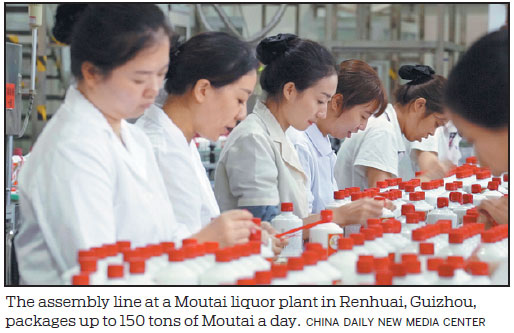
I later joined the assembly line at a plant that packages up to 150 tons of Moutai a day.
It's harder than it looks, I found.
I messed up the first time. And the second. And the third.
The workers coaching me giggled as I alternatingly folded the wrong cardboard flaps or got them right but forgot to put the shot glasses in the box first.
I got it right on the fourth try.
After successfully packaging one bottle, I officially retired from my factory gig.
It takes workers an average of two minutes. (I took much longer.)
They operate with a machine-like speed and precision. The plant hopes to automate and is currently trialing a giant robotic arm used to lift crates onto carts.
But the company has already adopted other new technologies, such as big data. For instance, it places sensors in bottle caps that can be scanned with phones to prevent forgeries.
We later visited a Moutai distillery that uses ancient methods to ferment the liquor. About 300 glazed clay urns are housed in a windowless room built in the 1970s.
My colleagues' eyes watered at the strong smell inside.
Improved transportation and development have accelerated Maotai's liquor industry.
Travel from the town to Zunyi city now takes an hour compared with eight a decade ago. And increased disposable incomes following the reform and opening-up have enhanced demand for luxury liquor.
Renhuai issued the first regulations to protect the Chishui in 2011, the city's environmental protection bureau office director, Ding Junjie, told me at a water-treatment plant.
It has built 22 treatment facilities in 20 towns and villages, including nine specifically dedicated to purifying water used for liquor, he says.
About 200 distilleries operate in the area.
"Protecting the Chishui equals protecting Renhuai's economic development," he says.
Certainly, I found my visit to the "liquor river" intoxicating - in every sense.








