


Fujian Tulou









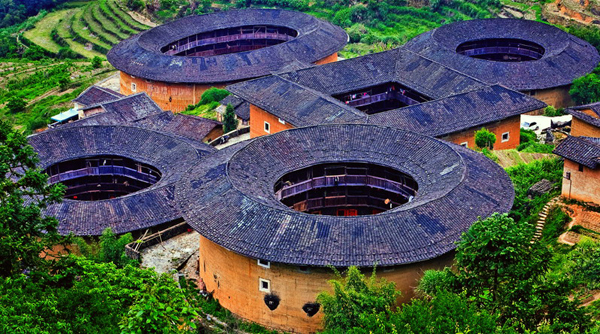
Category of site: Cultural site
Brief introduction
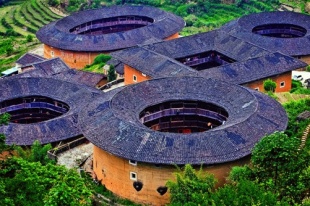
Fujian tulou consists of 46 buildings constructed between the 15th and 20th centuries over 120 kilometers in the south-west of Fujian province, inland from the Taiwan Strait. Set amongst rice, tea and tobacco fields the tulou are earthen houses. Several stories high, they were built along an inward-looking, circular or square floor plan as housing for up to 800 people each. They were built for defense purposes around a central open courtyard with only one entrance and windows to the outside only above the first floor. Housing a whole clan, the houses functioned as village units and were known as "a little kingdom for the family" or "bustling small city". They feature tall fortified mud walls capped by tiled roofs with wide over-hanging eaves. The most elaborate structures date back to the 17th and 18th centuries. The buildings were divided vertically between families with each disposing of two or three rooms on each floor. In contrast with their plain exterior, the inside of the tulou were built for comfort and were often well decorated. They are inscribed as exceptional examples of a building tradition and their function exemplifies a particular type of communal living and defensive organization. In terms of their harmonious relationship with their environment, they are an outstanding example of human settlement. Tulou was added to the World Heritage list on July 6, 2008.
Outstanding universal value
The Fujian tulou are the most representative and best preserved examples of the tulou of the mountainous regions of south-eastern China. The large, technically sophisticated and dramatic earthen defensive buildings were built between the 13th and 20th centuries. In their highly sensitive setting in fertile mountain valleys, they are an extraordinary reflection of a communal response to settlement which has persisted over time. The tulou, and their extensive associated documentary archives, reflect the emergence, innovation, and development of an outstanding art of earthen building over seven centuries. The elaborate compartmentalized interiors, some with highly decorated walls, met both their communities' physical and spiritual needs and reflect an extraordinary development of a sophisticated society in a remote and potentially hostile environment. The relationship of the massive buildings to their landscape embodies both feng shui principles and ideas of landscape beauty and harmony.
The tulou are exceptional evidence of a long-standing cultural tradition of defensive buildings for communal living that reflect sophisticated building traditions and ideas of harmony and collaboration, well documented over time.
The tulou are exceptional in terms of size, building traditions and function, and reflect society's response to various stages in economic and social history within the wider region.
The tulou as a whole, and the nominated Fujian tulou in particular, are a unique reflection of communal living and defensive needs, and in terms of their harmonious relationship with their environment, an outstanding example of human settlement.
The authenticity of the tulou is related to sustaining the tulou themselves and their building traditions as well as the structures and processes associated with their farmed and forested landscape setting. The integrity of the tulou is related to their intactness as buildings but also to the intactness of the surrounding farmed and forested landscape, into which they were so carefully sited in accordance with feng shui principles.
The legal protection of the nominated areas and their buffer zones is adequate. The overall management system for the property is adequate, involving both government administrative bodies and local communities, although plans for the sustainability of the landscape that respect local farming and forestry traditions need to be better developed.