Family proud of long, strong bond with China










The first piece of furniture visitors see when they enter Hugh Cantlie's Oxfordshire house is a magnificent antique coat hanger with wooden elephant decorations.
Sun Yat-sen, a founder of modern China, once hung his coat on these hangers when visiting the London residence of his teacher, James Cantlie, more than a century ago. James passed the furniture on to his son, Kenneth, and Kenneth, in turn, gave it to his son, Hugh.
"It is an important reminder of our family history and strong bonds with China," Hugh Cantlie, 86, said with a reminiscent smile.
The Cantlie family's connection with China is a moving story of strong friendship, tested by turbulent times and maintained across four generations.
James Cantlie was a Scottish doctor who ventured into Hong Kong in 1887 to co-found the Hong Kong College of Medicine for Chinese, which later became the University of Hong Kong

Sun, the founder of Chinese Kuomintang (KMT), was one of Cantlie's first students, qualifying with distinction as a doctor in 1892. He soon turned to revolutionary politics and, in October 1895, launched an uprising from Guangzhou against the Qing Dynasty (1644-1911).
Not long after, Cantlie returned to London in 1896, and Sun was also drawn to the British capital in search of funds to support his cause. Sun arrived in England on Oct 3, 1896, and was soon in trouble. On his way to visit Cantlie, he passed the Chinese legation in Portland Street in London and found himself a prisoner of the legation, locked in an upstairs room with the windows shut.
Fearing he would be taken back to China, tortured and even executed, Sun persuaded a British servant of the legation to smuggle a message to Cantlie.
Cantlie tried everything to secure Sun's release. He made a threat to the legation and contacted police and the British Foreign Office. Cantlie's efforts caused The Globe newspaper to spread the news about what had happened in an article, and that led to Britain's then prime minister, Lord Salisbury, insisting upon Sun's release.
Sun returned to China, but never forgot his friend's help. Cantlie was one of the first to receive a letter from Sun when he became president following the 1911 revolution.
"It makes me feel more grateful to you when, from the present position, I look back on my past of hardships and strenuous toil, and think of your kindnesses shown me all the while that I can never nor will ever forget," he wrote to the Cantlie family from Nanjing on Jan 21, 1912
Cantlie died a few months after Sun, in 1925, but ties between the two families continued. His son, Lieutenant Colonel Kenneth Cantlie, became technical adviser to the Chinese Ministry of Railways in the 1930s, during which period the Cantlie family lived as expats in Shanghai and Nanjing.
One of Kenneth Cantlie's achievements was a new steam locomotive design, tailored to efficiently pull long trains through China's steep mountainous terrain and across weak bridges. Twenty-five of these steam locomotives were manufactured in England in 1935 and transported to China. One such steam locomotive was gifted from the Chinese government to the British government in 1980 to commemorate this history, and it is now kept in the National Railway Museum in York.

Hugh Cantlie was born in 1932, in Shanghai, and subsequently moved with his parents to Nanjing, the Chinese wartime capital, where the family lived until 1937 when the Japanese invasion made it too dangerous for them to stay.
"As I was born in China, the country has always been close to my heart," Cantlie said. In search of childhood memories, he has revisited family homes in Shanghai and Nanjing, and the Shanghai hospital where he was born.
And he fondly remembers a happy childhood in Nanjing, including the exhausting experience of climbing up the steps of the Sun Yat-sen Mausoleum as a little boy, and the way his mother kept a beautiful garden near their family house, and the gentle care he received from his nanny, whom he called Ama.
Items among his most valued possessions today include an oil painting that used to hang on the wall of the family's Shanghai residence, a wooden model boat that once belonged to his Ama's husband, a folder of letters from Sun to James Cantlie, and many more photos of his childhood in Nanjing.
Like treasured possessions, many anecdotes about Sun and China have also been passed down the generations in the Cantlie family.
"I have great respect for Dr Sun. He had a clear vision for the future of China, which he never gave up no matter what difficulty was in his way," Cantlie said.
And he has vivid memories of the day when his mother hurried him to pack up and leave for England in 1937, but little did he know that saying goodbye to China would mean he would not return for another 50 years
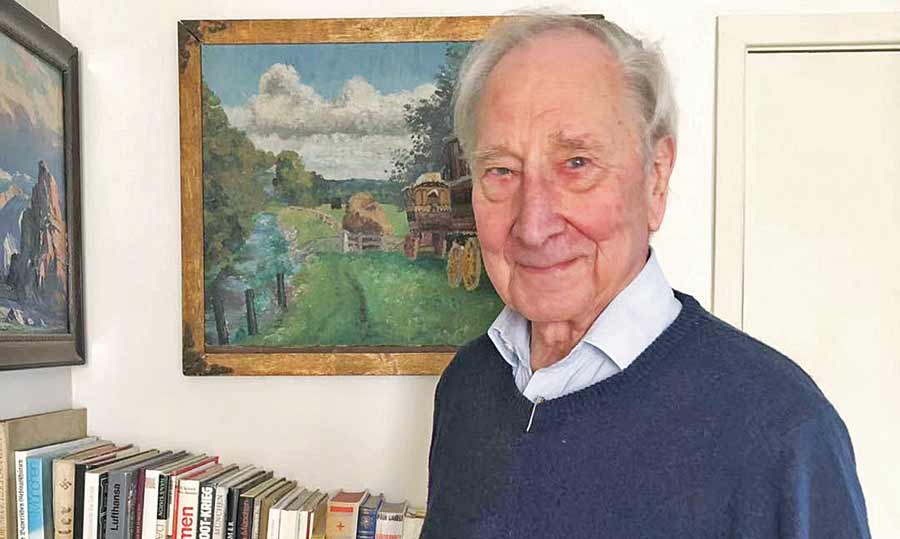
Soon after his father died in 1986, the Chinese government contacted Cantlie with an invitation to maintain a strong connection. At the invitation of the Chinese government, Cantlie revisited China in 1987, and marveled at the changes in the country.
"On that trip, and throughout my subsequent visits, I saw the country change beyond recognition. I am so happy to see China becoming such a strong and modern country, and standing up for itself in the world after experiencing difficult times of war and invasion its recent history," Cantlie said.
In his footsteps, Cantlie's son, Charles, ventured to China to study Mandarin in 1998, at the age of 32.
"It happened shortly after my mother's death. I wanted to understand more about myself and my family, so I thought the most logical place to look for these answers is China, where my father was born," said Charles.