



Official learns language of compassion to aid families









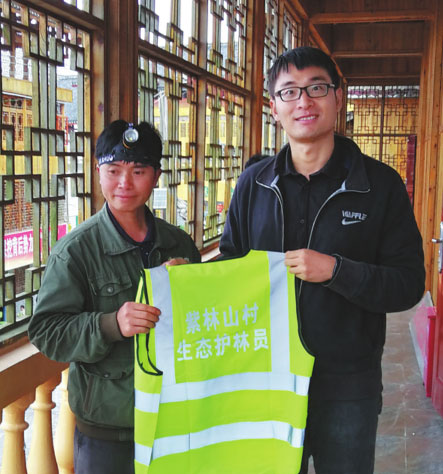
Regular home visits and attending important occasions help enhance ties with impoverished villagers
When asked to sum up his life as a grassroots cadre tasked with eradicating poverty, Qu Jia thought for a moment and then said it was tough but rewarding.
Since being appointed as the Party secretary of Zilinshan, an impoverished village in southwestern China's Guizhou province, in August 2017, Qu has experienced a fair share of stress and success.
Over the past 17 months, the 35-year-old official has come up against a language barrier and struggled to get families to change their lifestyles, with some flatly refusing to cooperate with government officials or take part in poverty alleviation programs.
Yet in that time, he has managed to help more than 100 impoverished households find ways out of poverty through forestry development, resulting in him receiving an award on Oct 30 from the central government for his outstanding work in poverty relief.
Qu was a researcher for the National Forestry and Grassland Administration based in Beijing before his two-year appointment to Zilinshan. He is among nearly 200,000 officials assigned to villages nationwide by the end of 2017 to lead anti-poverty efforts.
"The first step in my job was to visit impoverished families and get to know their economic situation," Qu said. "This usually takes a lot of time and energy because the village is spread across 4,360 hectares, with scattered houses and bumpy, dangerous roads."
As he is not native to the area, Qu is unable to speak the language used by the local Sui ethnic group, making communication difficult.
"Usually, a local will accompany me and help me translate. Just a brief chat is not enough to help me totally understand these families," he said. "When I'm not busy, I attend the weddings and funerals in the village. These occasions make it easier to talk with them and enhance our emotional ties."
The most challenging task, he said, has been persuading villagers to change their mindset, such as their resistance to moving to safer housing in a nearby county and joining projects initiated by the government.
"They don't want to move because they have land to cultivate in the village and are worried they couldn't find jobs in the county. Some elderly people in particular won't resettle because they love their hometown, even if the houses they are living in are dilapidated."
For those unwilling to move, Qu said he would visit their homes more than 10 times. So far, 67 out of 85 families he has visited have resettled.
"There were some villagers unwilling to strive for a better life through working hard," Qu said. "There was even someone who asked me to give them money directly. I was speechless. Some people believe that poverty relief has nothing to do with them."
To tackle traditional thinking, Qu and his team held meetings to persuade residents to resettle or join a project to plant sphagnum moss, a plant suitable for growing in the village that can be sold at a higher price than other crops.
Li Zuyou, who works alongside Qu as the village's long-term Party secretary, said that 80 percent of households have joined the planting project and each earns an average of 20,000 yuan ($2,910) a year by selling the moss.
Qu said he plans to invest in processing machines for sphagnum to ensure people who join the project can make more money.
"In the fight against poverty, we must be down-to-earth and get the results step by step," he said. "We don't need slogans. What we need is hard work and responsibility, and to be daring in the face of difficulties."
Li Hanyi contributed to this story.


- Building of rare earth hub highlighted
- China comes a step closer to crewed moon mission
- Beijing, a perfect location for 'set-jetters'
- United front work urged to pool strength
- Xi sends festive greetings to all service personnel
- Hainan's 1st batch of daily consumer goods duty-free shops for island residents opens











