



Housing takes huge share of urban families' assets









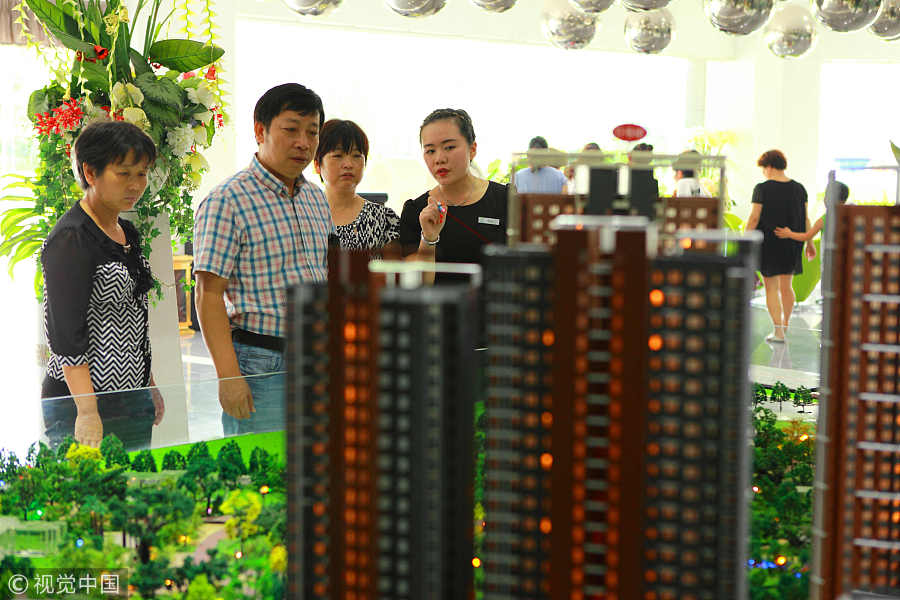
The asset allocation of urban households in China is unbalanced, with nearly 80 percent of family wealth spent on housing in 2017, although these families' average total assets grew fairly quickly, a report said.
The average total assets of urban households reached 1.5 million yuan ($221,000) per family in 2017, up by a compound annual growth rate of 7.6 percent from 970,000 yuan in 2011. The figure is expected to have increased to 1.62 million yuan in 2018, according to a report jointly issued by China Guangfa Bank Co Ltd and Southwestern University of Finance and Economics.
The report was based on a survey on nearly 10,000 urban households with an average annual family income exceeding 67,817 yuan in 23 cities across China.
Housing assets took a large part, or 77.7 percent, of the total wealth of China's urban households in 2017, whereas financial assets only accounted for 11.8 percent, the report said.
The proportion of financial assets to total assets for urban households in China was much lower than that of families in many developed economies, such as Japan (61.1 percent), Singapore (56 percent), and the United Kingdom (52.2 percent), the report said.
There was also imbalance in the allocation of the households' financial assets, of which 42.9 percent were bank deposits, compared with wealth management products (13.4 percent), equities (8.1 percent), funds (3.2 percent) and bonds (0.7 percent).
Lack of diversity is another problem for Chinese households' asset allocation. The report found that 67.7 percent of Chinese families invested in a single type of product, while only 10.6 percent of the families had at least three types of investment products.
In spite of seeking high returns, Chinese investors have a low tolerance for risk. More than half of the families surveyed were not willing to bear any loss on their principal while making investment in wealth management products offered by banks, and 12.9 percent of them were willing to accept a 5 percent or even lower loss on principal.
Inadequate financial knowledge is the crux of these household asset management problems, said Zong Lexin, vice-president of China Guangfa Bank. Financial institutions should popularize financial literacy, apart from offering products and services that meet household demand, he added.
Xu Shu, deputy director of the Survey and Research Center for China Household Finance at Southwestern University of Finance and Economics, advised those families that lack investment experience to improve their risk response capabilities with the help of professional wealth management institutions.
"We encourage investors to diversify across multiple asset classes including equities, bonds, cash assets and alternative assets, as the capital market volatility will increase this year," said Ethan Wang, head of investment strategy at Standard Chartered Bank China Wealth Management.
Standard Chartered takes a bullish view on US dollar-denominated cash assets, dollar-denominated emerging market bonds, as well as domestically listed and overseas-listed Chinese stocks.
"If the US dollar declines, starting from the second quarter of this year, we may see that capital will flow back to Asia, pushing up Asian stock market prices," said Wang.
Jason Yu, head of multi-asset products for North Asia at Schroders, said investors may see an upward trend in US equities this year and find Asia and emerging market stocks attractive after valuation adjustments.



















