



Canberra clings to outdated alliance









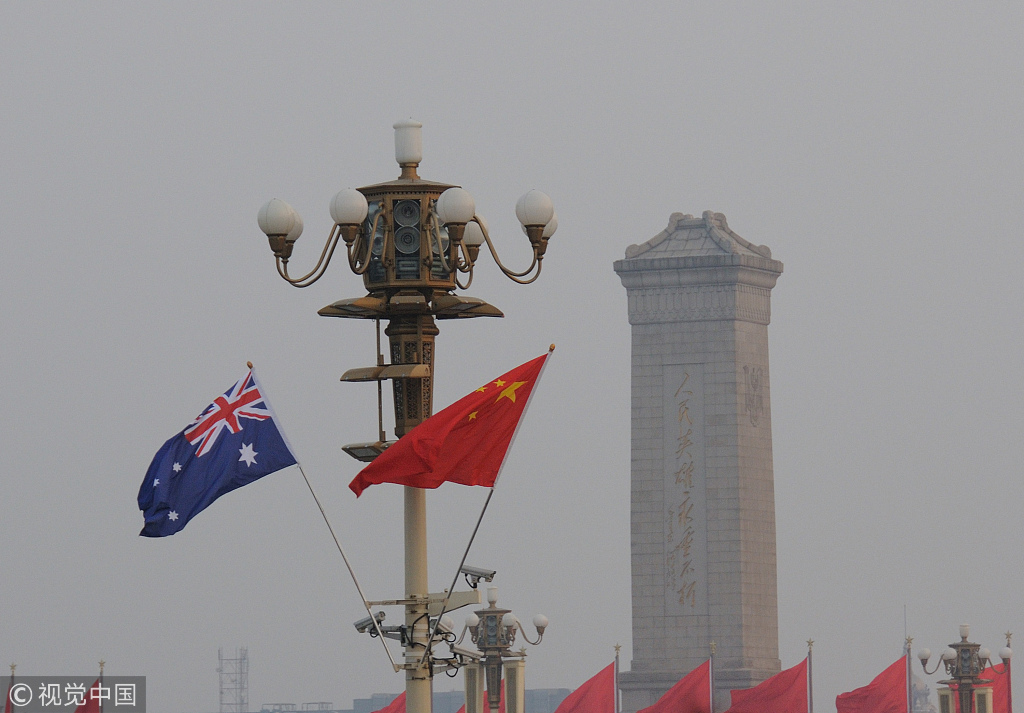
The problem for Australia is that its foreign policy is guided by its military and intelligence agencies, which, in turn, have close links with their counterparts in Washington. Any deviation from the accepted line puts that alliance at risk.
The Australian federal government has been reluctant to give its support for the Belt and Road Initiative, primarily on the grounds that it is not in the national interest. Yet the northern city of Darwin and the state of Victoria have signed up, and so did more than 60 countries, including New Zealand.
Canberra would rather cling to an outdated security alliance with the United States than take part in an ambitious initiative that could deliver huge economic benefits to millions and enhance ties with Australia's largest trading partner-China.
The ban on Chinese technology giants Huawei Technologies and ZTE Corp taking part in Australia's rollout of a fifth-generation, or 5G, cellular communications network, due to "security concerns", is another case in point.
The Australian move follows those of the US and several other close allies in locking Huawei and ZTE out of the 5G race, a race in which the US dictates all the rules.
Huawei is probably the world leader in 5G technology, and the irony here is that the US offers no competitive alternative to fill the gap. Europe's Nokia and Ericsson are both struggling to catch up with Huawei, while South Korea's Samsung is investing heavily in the technology but is still way behind China.
Another example of Canberra's fractured foreign policy is the blocking of Hong Kong-based Cheung Kong Infrastructure's A$13 billion ($9.3 billion) takeover of Australia's largest gas network operator APA Group, on the grounds that it was "not in the national interest". What makes this move even more contradictory is that CKI owns some of the biggest energy companies in Australia.
Throughout 2018, there were other cases in which Canberra parroted the Washington line against China-involving accusations of technology and intellectual property theft, cyberattacks and unfair trade practices.
Canberra, however, cannot have it both ways. The rhetoric that emanated from the Australian capital last year did little to enhance it as a "true friend" of China. Rather, it highlighted the need for Australia to develop a foreign policy that is relevant to the 21st century and not one that grew from the ashes of World War II and evolved during the Cold War with the former Soviet Union.
Unlike the old Soviet Union, China is a global economic power and the largest contributor to global growth, and it accounts for about one-third of global output.
China has also accepted globalization and free trade and is a major player within the World Trade Organization.
In addition, China is emerging as a firm proponent of a global rules-based order that allows countries to prosper and engage with other countries on equal terms.
But links such as Canberra's with Washington have caused problems in the region.
A good example of this was in 1987, when New Zealand's then Labour government turned policy into law with the New Zealand Nuclear Free Zone, Disarmament, and Arms Control Act 1987. The result: New Zealand was effectively frozen out of the Australia, New Zealand and United States Security Treaty, or ANZUS Treaty, by the US.
In an interview last year, New Zealand's former foreign minister Sir Donald McKinnon said what seemed like a good idea at the time was a disaster for New Zealand and it took years to repair the damage to the country's ties with the US.
The problem for Australia is that it appears reluctant to draw from its Asian neighbors, such as Singapore, on how to work with China while at the same time retaining its security ties with the US.
Despite its Anglo-Saxon roots, Australia is fast becoming an Asiacentric, multicultural nation.
With a population of just 25 million people, Australia is home to more than 1.2 million people of Chinese ancestry. Of these, 41 percent were born in China. Over the past 20 years, the number of Chinese-born residents has overtaken the number of those born in other countries such as Italy, Vietnam and Greece.
The country's foreign policy does not reflect that change. Former prime minister Paul Keating believes Australia is failing to grasp "the new power realities in the Asia-Pacific".
He said in an interview in 2017 that the Australia-US relationship has been "suborned" by a ceding of foreign policy to the US.
Despite what the current government says and does, businesses and universities continue to forge closer links with China.
Perhaps the politicians should take note of what is going on in the academic and private sectors, rather than being led by an outdated alliance.
The author is a China Daily correspondent based in Sydney.










