



Profits, air-dropped!









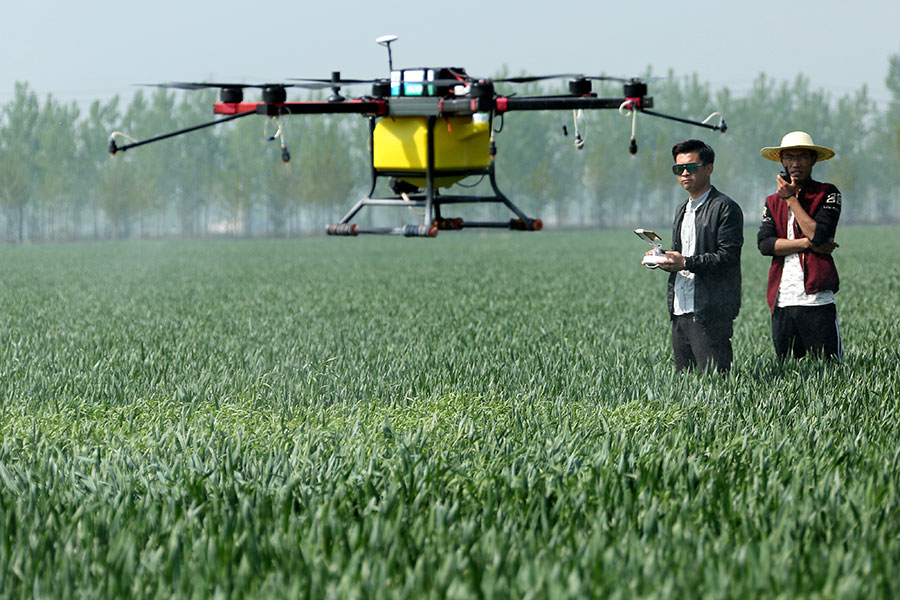
Drones evolve rapidly to enhance all walks of life, create a lucrative industry
Unmanned aerial vehicles or UAVs, which are more popular as drones, are evolving from specialist gadgets to consumer electronics items on the one hand and industrial tools on the other.
In the process, they are spawning an industry that is promising huge revenues and global scale, redefining smart mobility and enhancing all walks of life.
In the consumer electronics sector, civilian drones are mainly used in aerial photography.
Their industrial applications are seeing huge demand in China as a range of sectors-agriculture, geological surveying and mapping, electricity, oil and petroleum pipeline inspection, transportation, construction, public security and disaster relief-are using them.
The consumer drone market took off in 2015, but grew slowly, and seemed to reach the saturation point last year. Media reports said drone makers such as EHang and Zerotech had cut jobs and other costs, and sought to diversify.
Data from the Shenzhen-based Qianzhan Industry Research Institute said the industrial drone segment is now growing rapidly, with total sales revenue in 2020 expected to reach 16.5 billion yuan ($2.5 billion).
Experts said this segment is expected to see its market value surge in the future. Expectedly, major drone makers have ratcheted up efforts to develop a variety of drones, aspiring to take a lead amid fierce competition.
Shenzhen, Guangdong province-based DJI, which currently accounts for 70 percent of the global consumer drone market, is devoting a great deal of attention to farming sector drones.
DJI plans to further invest 10 million yuan in agricultural drones and on cultivating drone operators this year-it will open 1,000 brick-and-mortar retail stores, train over 20,000 professional drone operators and establish more than 600 training branches across the nation.
In December, it launched its latest agricultural drone, the T16, which features an upgraded loading capacity, as well as dynamic systems to increase working efficiency and accuracy.
Drone operators who use such drones can spray pesticides on about 10 hectares of farmland an hour.
"We don't focus only on profits but also on training people to operate the agricultural drones in the short term, as well as helping them develop a business model, which is in accordance with our corporate culture and medium-and long-term strategies," said Luo Zhenhua, president of DJI.
The company is bullish about the prospects for agricultural drones as the demand for such gadgets is huge and the whole industry is still in exploration mode.
In November 2015, DJI launched its first agricultural drone, the MG-1, marking its diversification into the industrial segment. It unveiled an upgraded agricultural drone, the MG-1S, in 2016 and the MG-1S Advanced in 2017, with upgraded flight control system, radar and sensors.
It also provided consumer loans so that buyers could afford drones; its financial services sought to enable operations and related training.
With the modernization of agriculture, the demand for advanced farming devices has been growing significantly. Qianzhan forecast that the value of the domestic agricultural drone market will exceed 12.8 billion yuan by 2021, at an annual compound growth rate of 38 percent.
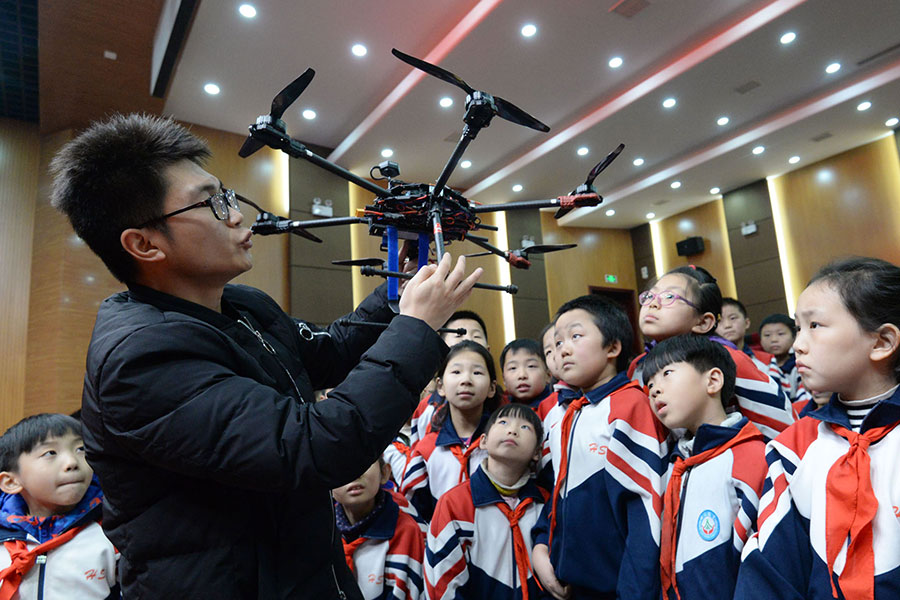
The government has also announced policies to promote the use of modern agricultural machinery. These include subsidies to encourage the use of drones in agriculture.
Apart from farm-sector drones, DJI has unveiled the Matrice 200 drone series, designed for professional use. Its applications are in aerial inspections and data collection from offshore oil rigs, wind turbines, power lines, telecommunication towers and bridges.
"Drones have quickly become a standard part of the enterprise toolkit for sophisticated tasks such as bridge inspections, land surveys and search-and-rescue missions," said Paul Guo, director of Enterprise Solutions at DJI.
"Applications in industry are beneficial for DJI to improve its technology, and its success in the consumer drone market will help the company to further widen its industrial application fields," said Pan Xuefei, a senior analyst at market research firm International Data Corp.
Xaircraft Technology Co Ltd, a Guangzhou, Guangdong province-based company, launched its latest agricultural drones-the P20 and P30-in December. Peng Bin, CEO of Xaircraft, said China's agricultural drone market will grow rapidly within two to three years, with the number of such drones reaching 500,000 to 1 million units.
Data from Qianzhan also showed the whole domestic civilian drone market will reach more than 96.8 billion yuan by 2023, at compound annual growth rate surpassing 60 percent.
A series of incidents involving low-flying drones in restricted areas around major Chinese airports in 2017 had led to tighter usage regulations, which had an adverse impact on product sales.
The Civil Aviation Administration of China said commercial UAVs weighing more than 250 grams had to be registered under the owner's real name from June 1, 2017.
Other domestic drone manufacturers are investing heavily in industry drones. EHang impressed the world with its concept of a passenger drone already at the Consumer Electronics Show in Las Vegas in 2016. The 184, which is the world's first autonomous aerial vehicle, can fly for up to 30 minutes at a maximum cruising speed of 160 km/h, and has an average cruise speed of 100 km/h.
In 2017, the company announced a partnership with Dubai's government to use its Ehang 184 passenger-carrying drone in the city's smart transportation system.
Derrick Xiong, co-founder of EHang, said with the rise in labor costs and rapid growth of smart delivery systems, EHang is poised to empower companies across industrial segments like courier services, logistics, retail and e-commerce, with its smart drones that offer safe and efficient functionality.
In 2018, it teamed up with supermarket chain Yonghui Superstores Co in smart retail and aerial drone food delivery. With the help of drones, the delivery time was reduced from at least 30 minutes to about 15 minutes, which ensures freshness of food and efficiency in delivery.
EHang said its automatic, intelligent and networked drone technology provides an integrated drone delivery solution for Super Species, Yonghui's fresh food store.
EHang has also partnered with the government of Shaoguan city in Guangdong province, to build a smart city with a UAV command center and systems.
Hu Huazhi, Ehang's founder and CEO, said: "In the future, the real value of UAVs will lie in intelligence, integration, digitalization and networking, which are exactly the core technical advantages of Ehang."
Based in Guangzhou, EHang announced last year it would establish its first European research center in Lyon, France. In November, the company inked a strategic partnership with Austrian aerospace group FACC to jointly develop new solutions for autonomous flying.
Pan from IDC said the exploration of application scenarios for drone products has encountered a bottleneck, and at present, the application of industrial drones is still at an initial stage and "we still need time to see large-scale application of drones in various sectors".
Jason Low, an analyst from market intelligence firm Canalys, said large drone companies are focusing on professional and industry-level drones, spending a large part of their investment on developing their software and hardware platforms, and in attracting developers to create apps and new use cases for their drones.



















