



Methanol automobiles set to hit the road









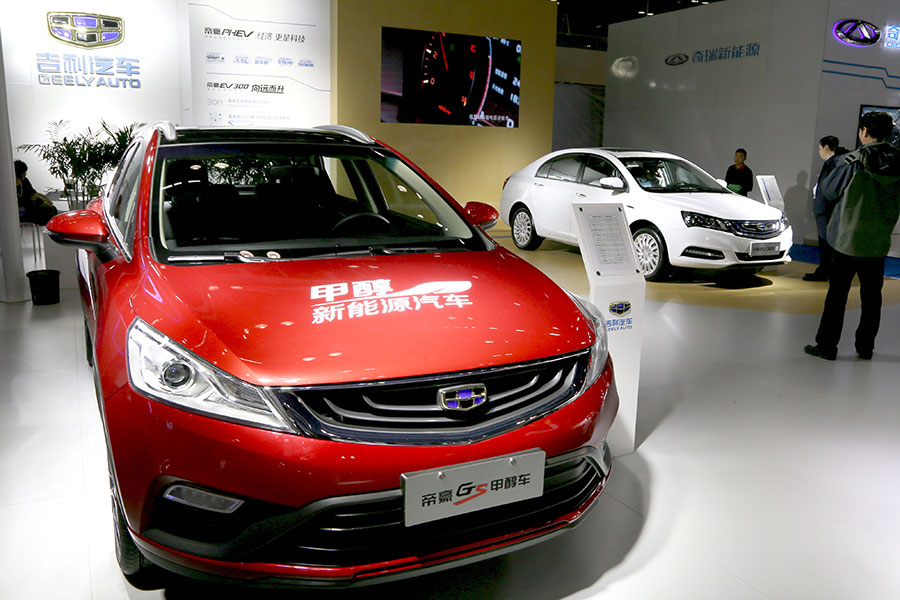
Cars running on cleaner source of energy near commercialization amid environmental push
With methanol-fueled vehicles approaching commercialization, China is set to wrest the early-mover advantage in the field worldwide, industry insiders said.
"China has gained new momentum in the commercialization of methanol vehicles and already leads the world in both scale and technology," said Wei Anli, secretary-general of the group responsible for the country's methanol vehicle trial work under the Ministry of Industry and Information Technology.
"The country has already mastered mature technologies in developing and producing methanol vehicles, and is also exploring new ways," added Wei, who is former deputy secretary-general of the China Internal Combustion Engine Industry Association.
"Also, the foundation of promoting such vehicles has been laid solidly as tests and trials have all been carried out."
Southwest China's Guizhou province has set a goal of launching 10,000 methanol vehicles by the end of this year, among which 7,000 will run in Guiyang, the provincial government told China Daily.
The Guizhou government said it will introduce fresh policies including subsidies that encourage government departments, taxi companies and driving schools to use methanol vehicles.
Currently, there are more than 5,000 methanol-fueled taxis in Guizhou, which account for 75 percent of the total methanol vehicles in the country. The government has also established 13 methanol filling stations.
With these advantages, Guizhou has already surpassed other regions in China to become the pioneer in utilizing methanol vehicles.
"Like new energy vehicles, we will also offer preferential policies related to buying methanol vehicles, such as applying for licenses and loosening the odd-and-even plate driving ban rule," said a Guizhou government official, who did not disclose his name.
Local authorities also plan to build new stations that offer methanol filling.
"Methanol, with the lowest carbon content and highest hydrogen content, is a clean burning fuel," Wei said, adding that it produces fewer pollutants when burned.
Also, as it is made from carbon monoxide and hydrogen from oil and coal, it can be made from coal or biomass resources that are rich in China, he added.
Based on these advantages, China has been looking to use methanol as a replacement of gasoline for years, especially as the nation contends with air pollution.
"Methanol has a significance in protecting China's energy safety," said He Guangyuan, director of the group responsible for the country's methanol vehicle trial work under the MIIT, and also then minister of the former Machinery Industry Ministry of China.
"China, as the second-largest energy consumer globally, has a huge demand for energy. Thus, promoting methanol fuel as an alternative is important to reduce the country's dependency on imported resources," He said.
He pointed out that in 2017 alone, 70 percent of China's petroleum was imported, which he said was not a reasonable level.
"On a global scale, 50 percent is a warning line," he said.
To step up commercialization of methanol cars, since 2012, the MIIT has started trials of methanol vehicles in 10 cities across China including Guiyang, Shanghai, Xi'an in Shaanxi province, Jinzhong and Changzhi in Shanxi province, as well as Lanzhou in Gansu province.
Yang Tiesheng, deputy head of the energy conservation and utilization department of the MIIT, said at a symposium on methanol vehicle development that the ministry, along with related central government departments, is pushing forward top-level policies on promoting methanol vehicles.
"We have already finished the design of a guideline, which, once it comes out, will be an important document guiding the development of such vehicles in the country," said Yang, adding that the guideline will be launched soon.
In line with the country's call, Zhejiang Geely Holding Group has been striving to independently develop methanol vehicles.
It invested a total of $45.5 million in Iceland's Carbon Recycling International Inc, which is known as the world leader in methanol technology.
Geely's investment in CRI will expand carbon recycling in China as well as Europe. It will also accelerate the deployment of our technology in China and Europe, and facilitate the development of methanol fuel cars, according to CRI.
Geely is also the first automaker in China that has engaged in M100 methanol research and development, as well as the industrialization of the process.
Earlier last month in Peru, a fleet of Geely's methanol cars participated in an international competition, which was the first time that 100 percent methanol-fueled cars took part in the race.
The company has a Blue Geely plan, which aims to turn 90 percent, or 1 million vehicles, of its total production into new-energy cars, and to take the lead in new energy, intelligence and ultra lightweight technologies by 2020.
According to the China Association of Automobile Manufacturers, China is now the world's largest new energy vehicle market, with 777,000 electric cars and plug-in hybrids sold in 2017. It is estimated that at least 1 million such cars were sold last year.
"To step up new energy development, methanol vehicles should be promoted," said Li Shufu, chairman of Geely, who is a pioneer entrepreneur advocating methanol cars.
"Methanol vehicles should enter the market as soon as possible. Restrictions should be prudently loosened to reduce barriers to developing related technologies," he added.
According to Geely's plan, electric cars will account for 35 percent of its new energy car sales in 2020, while hybrids and plug-in hybrids will account for 65 percent.
By now, the company has developed five methanol engine systems and 14 methanol car models. It owns nearly 100 technology patents related to methanol fuels.
As methanol vehicles see a promising future, doubts are also rising. Some are worried that methanol contains toxic substances, which could be harmful to humans and the environment.
Wei from the MIIT said it is a misconception that methanol is poisonous and cannot be used as an alternative fuel.
"Methanol indeed has some toxic substances, but the percentage is low. It is so minor that it won't have bad influence on human health," Wei said.
He added that scientific research showed that pollution from methanol is lower than that of gasoline and ethanol.
According to the MIIT, in the past five years, the ministry has collected hundreds of millions of pieces of data and organized 2,500 related staff to have health checks.
The emissions of methanol vehicles meet the national standard and there is no case showing that methanol has negative effect on people using methanol vehicles, the MIIT noted.
Another challenge of developing such vehicles in the near future is to make more companies and groups understand the value of methanol vehicles so that the sector can be promoted nationwide, he added.
"For the time being, many companies still hold a wait-and-see attitude. More publicity work should be done to raise people's awareness of methanol cars," he said.



















