



Time to lift sanctions on DPRK









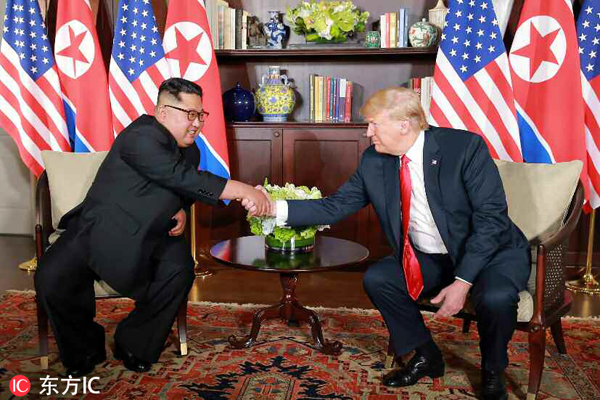
We are on the eve of the second historic summit between US President Donald Trump and the Democratic Republic of Korea Chairman Kim Jong-un, on February 27-28 in Hanoi, Vietnam. Expectations range from optimistic to sceptical. Let’s begin by looking at what could be the ideal outcomes from such a meeting.
For the Washington, the best deal would include complete denuclearisation of the Korean Peninsula immediately. For Pyongyang, removal of economic sanctions is their ultimate goal. The best outcome would be immediate removal. Unfortunately, both best-case scenarios are not realistic in the upcoming round of meetings in Hanoi. Limited by the negotiation lines, already drawn in the sand by both, leaving each side unable to back down from their previous position. So any negotiations occurring on the sidelines of the summit will amount to a catch-22.
The problem for both Trump and Kim, is that both heads of state need to appeal to their own home constituencies, look tough while finding ways to compromise – not an easy act for either. Trump now needs a firm commitment to denuclearize DPRK, with definitive milestones that can measure actual achievement. But how can Kim trust that Trump will keep his words if it actually does denuclearize? So Pyongyang needs to find an alternative leverage to nuclear capability, in order to assure its security, from a negotiating counterpart who simply cannot be trusted.
Regardless of Trump’s real agenda, DPRK is already gearing up into market mode. It has been preparing for the switch from centralized planning to economic reform and the emergence of its own market economy. Signals are clear and consistent. There have been continuous references to economic development throughout DPRK’s official press and in all major speeches of Kim Jung-en, commencing with his 2018 Annual New Year’s Address by the chairman. This tone has remained unchanged as we move into 2019. In fact, it has gone viral across DPRK.
“Economy First,” is the new national slogan in DPRK that has replaced “Military First.” “North Koreans have now bought in to the idea of a market economy,” said Rudi Sirr, special economic advisor to the DPRK and chairman of the Daegian Pte Ltd incubating key infrastructure and communications projects such as the strategic Rajin Port, while advising the leadership on investment strategies and economic reforms.
“The idea of economic reform is on everyone’s lips,” Sirr said from the lobby of a Beijing hotel after one of his recent visits to Rajin Port, which will eventually have rail links to both Pyongyang and Seoul. “Overtures from across the southern border are clear. South Korean media is plastered with stories each day heralding the potential opportunities that will benefit everyone through continued North-South collaboration that could one day lead to economic integration through infrastructure connectivity.”
Clearly, South Korean companies are scrambling to be first with a foothold in the North, realizing their own competitive advantage against other countries. With this momentum and mood of rush, both sides have decided to go it alone, with or without America. Rapprochement between North and South Korea has evolved into near full-blown collaboration in many business sectors that could lead to integration in the future. However, the hard-core reality is that unless the US lifts sanctions, nothing will really progress, as everyone’s hands will be tied. The problem here is that stale American ideology is holding up Asia progress and pragmatism.
Regardless of whether it was Iraq, Libya, or now Iran -- previously blacklisted countries included Vietnam -- Washington nags with threat-promises such as ‘disarm and investments will follow.” Maybe, but not from Washington. Likewise, promises such as: “Peace, then Prosperity” will not sell. For DPRK, “Prosperity will underwrite Peace” meaning that economic development is key. Removing sanctions must be the next step.
So when the two leaders meet in Hanoi, how might they come to some compromise that allows both to maintain face with their constituencies back home? One solution could be for Washington to offer limited easement of sanctions on strategically approved projects, sequencing a gradual almost seamless lifting of sanctions. Such a process would some mechanism of neutral oversight. The question is whether such appointment should be political or non-political. The answer is they must be accepted by all, supported with regular reporting possibly to a UN appointed body or envoy. The reality is that DPRK is already well advanced on its plans to open its border to South Korea for increased trade and investment. The US could use its recently strengthened relationship to gently ease sanctions through South Korea.
The US-DPRK Summit between President Trump and Chairman Kim will ironically occur in Vietnam, a nation that once suffered from US sanctions. When the trade embargo was finally lifted in 1994, as part of a long and dragged normalization process, Vietnam’s economy took off and it became a global trade power. The nation still has a communist party and socialist market system, borrowed heavily from China’s experience and modelled after its institutions. It has not adopted American systems. The only thing that held Vietnam back and prevented its growth from poverty to development were American sanctions imposed largely for ideological reasons. Sanctions are one of the worst violations of human rights. It is time to put sanctions into museums. See what happens when economy is first rather than military. Maybe Trump could learn from Kim.
Laurence Brahm is the founding director of the Himalayan Consensus and a senior international fellow at the Center for China and Globalization.
The opinions expressed here are those of the writer and do not necessarily represent the views of China Daily and China Daily website.





