State lenders keep bad debts under control









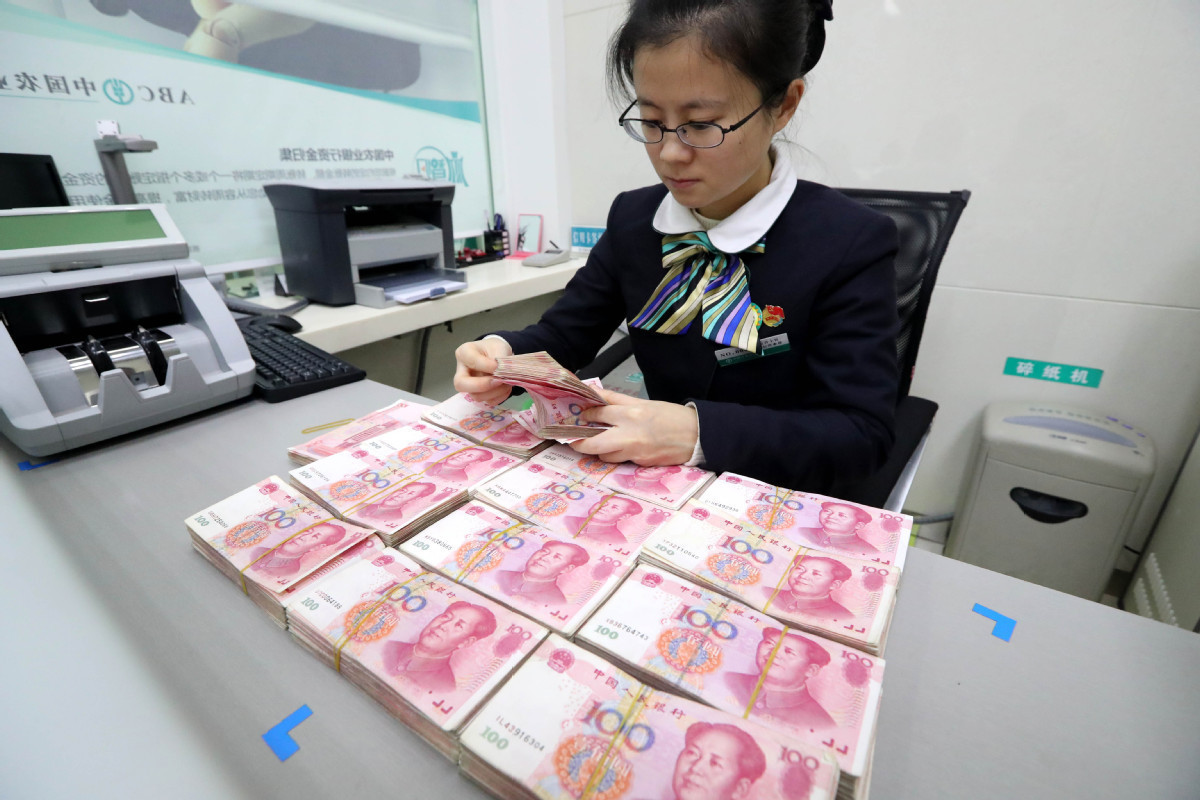
Credit structure optimization, better risk management steps boost operations
Asset quality of China's large State-owned commercial banks remained stable last year as the banks continued to optimize their credit asset structures and enhanced risk management capabilities, industry insiders said.
"We are in pursuit of prudent operations that could resist economic cycles," said Gu Shu, president of Industrial and Commercial Bank of China Ltd (ICBC), the country's largest commercial lender by assets.
The non-performing loan ratio of ICBC dropped 3 basis points year-on-year to 1.52 percent at the end of 2018, falling for eight consecutive quarters.
Special mention loans, or potentially weak loans that may spark unwarranted credit risks, decreased by more than 111 billion yuan ($16.5 billion) last year.
The difference between overdue loans and non-performing loans dropped by 46 percent, substantially relieving the pressure of deterioration on asset quality.
The bank has significantly improved asset quality management capabilities through the adoption of financial technologies or fintech.
Using big data technology, it built nearly 100 models, using which it established a strong risk monitoring system. The system ensures the bank would not extend total loans in excess of 120 billion yuan at the initial stage by strictly examining the client's loan access eligibility, said Wang Bairong, chief risk officer of ICBC.
In the past few years, the bank put greater emphasis on a top-level design. Each year, it has a plan for the direction and volume of new loans in terms of geographical and industrial layout. As a result, the NPL ratio of its new loans issued since 2015 was only 0.42 percent at the end of last year.
China Construction Bank Corp (CCB) also adopted stringent risk management and strived to optimize credit asset structure last year. As at the end of 2018, its NPL ratio stood at 1.46 percent, a decrease of 3 basis points from 2017.
Xu Yiming, chief financial officer of CCB, said: "Although our NPL ratio is still very low, we feel that it is hard to keep our bad assets at a fairly low level due to many reasons, including the overall economic environment, our own problems, and the problems associated with various levels of local government.
"Once the macro environment changes, our NPL ratio may rise. So we must adhere to prudent operations as if we are walking on thin ice."
Last year, the bank increased the ratio of allowance for loan impairment losses to NPLs by 37.29 percentage points year-on-year to 208.37 percent.
John Qu, a senior partner at McKinsey, said: "To achieve high-quality development, banks should promote transitions to comprehensive risk management and build strategy-oriented risk management systems based on refined management instruments, while they accelerate the application of financial technology in this area."
In a recent report on the Chinese financial sector, McKinsey advised financial institutions to implement such transitions by making strategies for risk preference and management, ensuring high effectiveness of risk governance mechanisms, providing relevant infrastructure support, and building a strong risk culture.
Liu Jiandong, chief risk officer at Bank of China Ltd (BOC), said the bank continuously strengthened credit risk management, proactively identifying and resolving potential risk.
In addition, the commercial lender used a combination of measures, including cash collections, restructuring and write-offs, to step up the resolution of non-performing assets.
Its domestic branches resolved 152.5 billion yuan of NPAs last year, up 13.45 percent year-on-year.
"We estimate that our bank's asset quality will remain stable this year, with good momentum for improvement," he said.
At the end of 2018, the NPL ratio of BOC dropped by 3 basis points year-on-year to 1.42 percent.
Its counterpart Agricultural Bank of China Ltd (ABC) recorded continued declines in both the ratio and balance of NPLs last year.
ABC's NPL ratio fell 22 basis points from the previous year to 1.59 percent, and the NPL balance decreased by 4.03 billion yuan to 190 billion yuan.