



Pet owners seek recourse in traditional cures









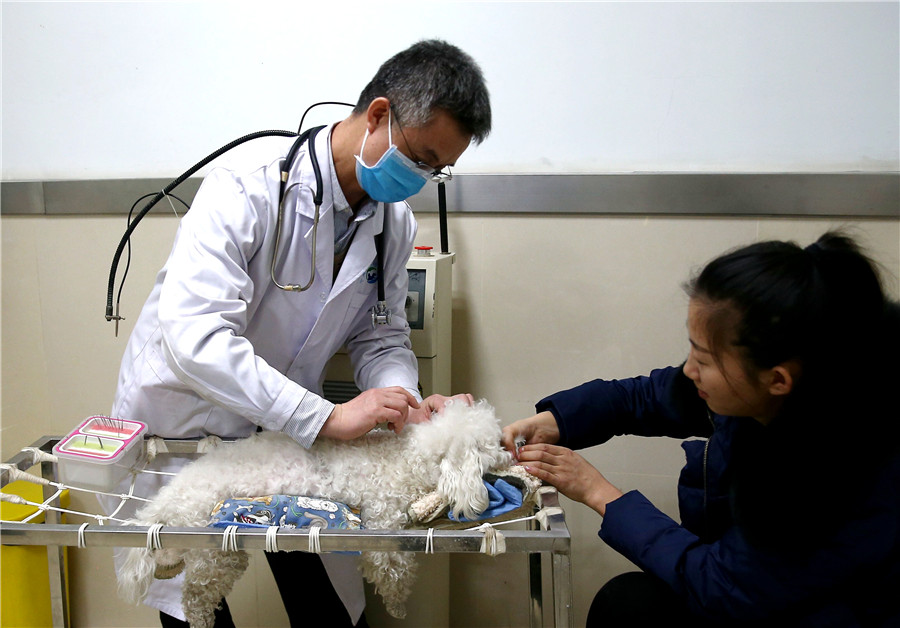
TCM has proved effective in treating animals when Western medicine has failed. Yao Yuxin reports.
One morning in mid-January, Wang Na discovered that her 2-year-old bichon frise dog Anbei couldn't stand up.
When three injections failed to make any improvement, a veterinarian in Shijiazhuang, capital of northern China's Hebei province, suggested surgery, but warned there was only a 50-50 chance of success.
Fearing Anbei was dying, Wang and her sister decided to drive over 300 kilometers to Beijing to give traditional Chinese veterinary medicine a try after learning online that it could be effective.
Before Anbei got sick, Wang had never thought dogs could benefit from TCM.
At China Agricultural University Veterinary Teaching Hospital in northwestern Beijing's Haidian district, Pang Haidong, a vet in the traditional Chinese veterinary medicine department, quickly diagnosed a fibrocartilaginous embolism in Anbei's spine, which had paralyzed her right side. He recommended acupuncture treatment.
For neurological damage, including paralysis, and certain other diseases, traditional Chinese veterinary treatments involving acupuncture, herbal medicine and massage, have worked well when Western medicine has been ineffective.
Two weeks after first being seen by Pang, Anbei lay on her stomach for a fifth acupuncture session.
"It's amazing," Wang said with a sigh of relief, explaining that after the third acupuncture session, her dog was able to walk and run again.


- Chinese premier stresses safety in key sectors, services for Spring Festival travel rush
- From farm to festive table: Inside Changsha's global wholesale hub
- Flowers bloom on a rare ancient tree in Shaanxi
- 162nd joint patrol of Mekong River ends
- Fuzhou farm awash in sea of vibrant cherry blossoms
- Expats celebrate Spring Festival in Meili Ancient Town








