



IMF chief calls for caution









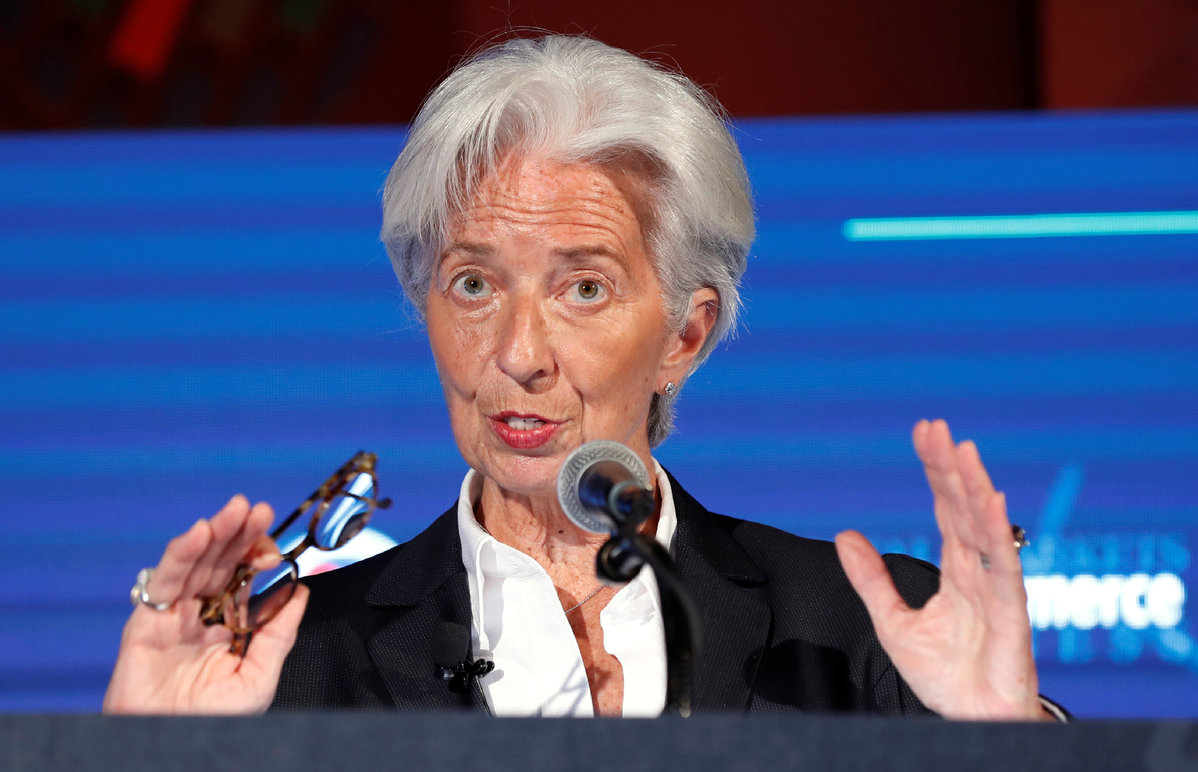
Lagarde warns against 'policy missteps' as global economy navigates 'precarious' times
As the global economy is at a "delicate moment" with a "precarious" rebound in growth expected later this year, countries need to work together to reduce barriers and promote integration in trade, the head of the International Monetary Fund said on Tuesday.
In a speech ahead of next week's spring meetings in Washington with the World Bank, IMF chief Christine Lagarde cautioned that at a time when trade tensions could further damage investment, it is all the more important to avoid "policy missteps".
In January, the IMF forecast global growth to linger around 3.5 percent for this year and next. Rising trade tensions and financial tightening slowed growth in the second half of 2018, Lagarde said.
"But, to be clear, we do not see a recession in the near term. In fact, we expect some pickup in growth in the second half of 2019 and into 2020," she said, adding that the growth is set to benefit from the now more-patient pace of monetary normalization by major central banks led by the US Federal Reserve and "from increased stimulus, in China for example".
But she said the hoped-for rebound later this year is "precarious", vulnerable to downside risks, including country-related uncertainties.
"So indeed, this is a delicate moment that requires us to 'handle with care",' she said. "This means that we must not only avoid policy missteps, but also be sure to take the right policy steps."
She said trade integration has, for many decades, helped to increase prosperity, reduce poverty, spread new technologies and boost productivity, but at the same time not everyone has benefited, and there are "distortions" in the trade system that need to be addressed.
"We also know that trade barriers are not the answer. More new research from the IMF — about to be released — shows just how important it is to avoid policy missteps in this sphere," she said.
By analyzing the experiences from 180 countries over the past six decades, the IMF has found that trade integration clearly boosts investment — in plant, machinery, and many other high job-creating areas. Conversely, trade barriers clearly damage investment and employment, she said.
"This finding is of particular relevance now, at a time when trade tensions could further damage investment—and at a time when investment is already weak," she said.
Lagarde said new IMF research shows that an increase in tariffs of 25 percentage points on all goods traded between the world's top two economies would shave up to 0.6 percent off of annual growth in the US and trim growth in China by as much as 1.5 percent.
"These are potentially self-inflicted wounds that should be avoided," she said.
She said discussions about trade distortions or unfair practices are often bound up with the concept of bilateral trade deficits and surpluses—and tariffs.
"The fact is that, historically, bilateral trade balances have been driven mostly by macroeconomic factors, not bilateral tariffs," Lagarde said.
In other words, the most effective way to reduce a bilateral trade deficit is to steer clear of tariffs —because tariffs on the goods of one country only divert trade flows to other countries, she added.
"Nobody wins a trade war," Lagarde said. "That is why we need to work together to reduce trade barriers and modernize the global trade system so that we all win."
As Lagarde was speaking, the ninth round of high-level trade talks, headed by Chinese Vice-Premier Liu He and United States Trade Representative Robert Lighthizer, were scheduled for this week in Washington to address differences on outstanding issues.
In an interview with CNBC on Tuesday, Mark Zandi, chief economist of Moody's Analytics, said, "Businesses are really on edge, and I think it's because of this trade war. And if it's not settled in the next couple (to) three months, I think a global recession is highly likely."










