Americans seek Chinese roots









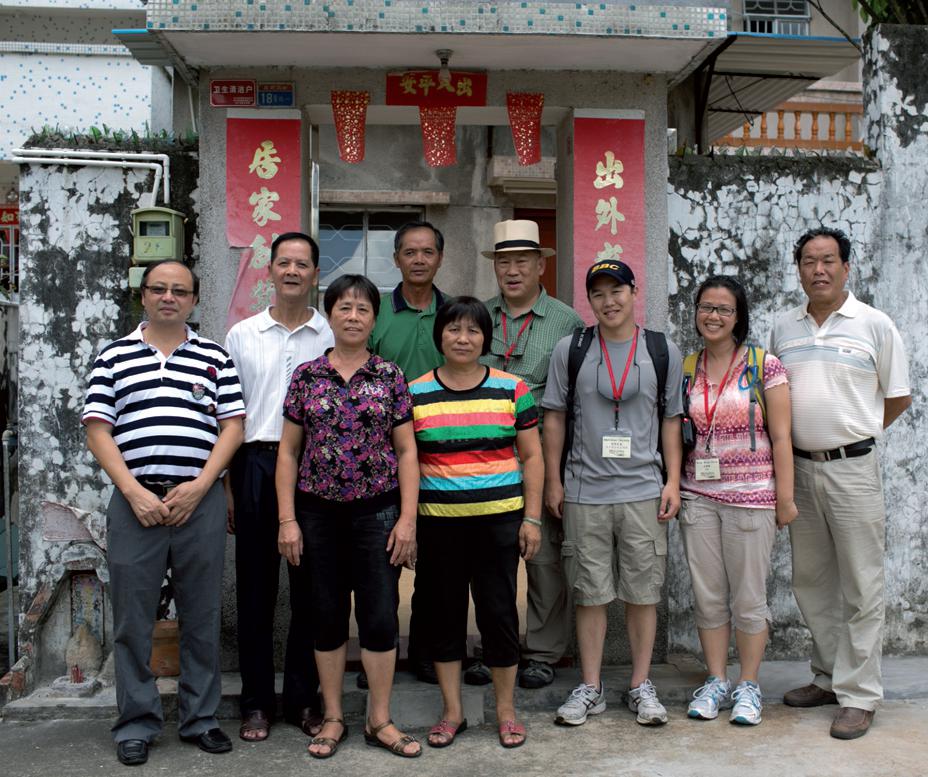
Assuming kung fu stances, playing mahjong with villagers, singing karaoke with children, hanging out with strangers in a Chinese village they'd never been to before, a group of San Franciscans felt like they'd "come home".
"It's a very moving and emotional experience for people to go back to their ancestral village. It's a way that overseas Chinese can learn more about their connections to China, and at the same time learn more about their family history," said Steven Owyang, an staff member of Friends of Roots.
For nearly three decades, the San Francisco-based organization has taken around 40 groups, involving about 400 Chinese descendants, to their ancestral villages in Guangdong province, from where many Chinese Americans have historically migrated.
Owyang, a retired judge from California, said he still remembers his first visit to his ancestral village in Zhongshan, Guangdong, where everybody shared the same family name — Owyang.
In one house, he saw the old photos that his family had sent back 50 years earlier. "To see pictures of my own family and relatives upon the wall in some village that I'd never been to before, that's very moving," he said.
"It showed me that people in China still feel very connected to their family even though the family had left the village two or three generations ago," said Owyang, whose family left Guangdong for the US in the 1870s.
In November, he chaperoned a Roots Plus (for people age 30 and above and their families) trip to Guangdong, where the 37 participants visited their ancestral villages, a martial arts school, as well as historically and culturally significant sites, such as the Sun Yat Sen Memorial Hall, the Overseas Chinese Museum and the Canton Tower.
Another Roots Plus group just returned from China last month, and a Roots group for young adults age 18 to 30 of 11 people will embark on in June, said Owyang.
"Every family has their own story about why they left China and how they got to the US. I think curiosity about that and trying to understand what it means to be Chinese American is the main thing that draws them to the program," said Owyang, who has been involved with the program for the last 12 years.
Founded in 1991 by Chinese-American historian Him Mark Lai and educator Albert Cheng, the In Search of Roots program intends to help the participants, who call themselves "Rooters", better understand their heritage and identity as Chinese Americans through genealogical research.
America's postwar prosperity fostered the growth of a Chinese-American middle class of professionals, technical personnel and businesspeople, and this middle class showed an increased interest in the history and culture of the common ethnic community and the deeds of their forebears, Lai and Cheng explained in the 2002 book The Chinese in America: A History from Gold Mountain to the New Millennium.
Through a partnership with the Chinese Historical Society of America, Chinese Culture Foundation and the Overseas Chinese Affairs Office in Guangdong province, the program involves a year-long commitment to researching one's Chinese-American family history and genealogy.
After constructing a family tree and exploring related family histories in America, participants explore their roots in China, then they create an exhibit of writings, photographs and videos, and conduct a presentation summing up their experience for families, friends and the community.
During the course of searching for their family heritage, the Rooters become "much more appreciative of the older generations and everything they had to go through to establish a life in the US", said Owyang.
The program has now expanded from the original Pearl River Delta region to other parts of Guangdong in response to participants' demand.
"The program is the first step in their quest," he said. "After the program, one Rooter settled in Beijing and started a business. Another Rooter decided to stay and study Chinese at Zhongshan University. Two sisters are going back to their village again by themselves. They just want to keep in touch and learn more and more about their history in China."