



Pork lovers encounter a change in taste









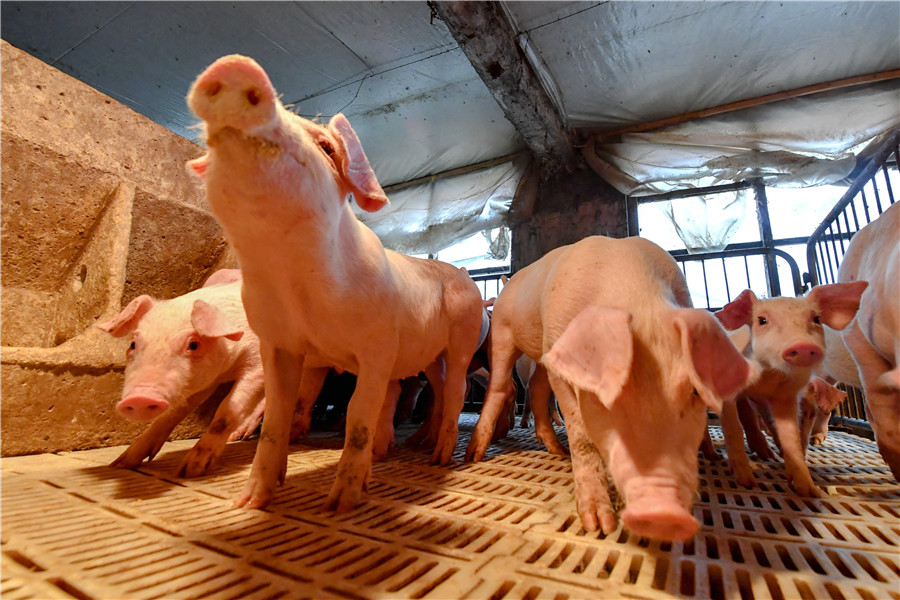
More efforts urged to protect local pig species
Like most Chinese, Wang Yu looks to pigs to provide a major part of his diet. He is particularly fond of popular dishes such as Dongpo braised pork and twice-cooked pork slices.
Wang, 37, a middle school teacher in Beijing from Anhui province, has eaten pork since childhood, but he finds the meat tastes different today compared with the past, whether cooked at home or in restaurants.
"I find that all meat now tastes differently and has no flavor," he said. "Maybe it is because of intensive breeding today."
Wang's sentiments are shared by many Chinese, but they may be unaware that the main ingredient for their favorite pork dish today is highly likely to be different to what it was 20 years ago.
The Chenghua pig, a stout-bodied, short-legged animal with a higher fat content than other species, originated in Sichuan province, but its numbers have declined sharply in the past three decades, leaving it on the brink of extinction. The introduction of more-productive animals from overseas has led to pork produced from these species being used to prepare dishes.
Yang Hongjie, division chief for animal industry development at the National Animal Husbandry Services affiliated to the Ministry of Agriculture and Rural Affairs, has called for efforts to protect local species, including the Chenghua pig.
In addition to meeting the diverse demand for meat from different species, protecting locally bred pigs is a major part of conserving biodiversity in China, and has great scientific significance and economic value, he said.
Compared with foreign species, which dominate the pork market in China and globally, locally bred indigenous pigs can be found in a variety of species, have different flavors and are especially suitable for traditional Chinese cuisine, Yang said.
"For example, most authentic double-cooked pork slices can only be made from meat produced from the Chenghua pig, while Jinhua ham, a well-known traditional local delicacy from the city in Zhejiang province, is sourced from the meat of a locally-bred species with black skin on the head and buttocks," he said. "The Jinhua pig has a thin skin, tender meat and is ideal for producing Jinhua ham."
Although locally bred species have been in China for thousands of years, in recent decades they have been a minority in the market, with some facing extinction, according to figures from the Ministry of Agriculture and Rural Affairs, which has also called for more protection efforts to be made.
Of the 90 local pig species in China, 29 are either endangered or on the brink of extinction, according to the ministry. Eight species once raised in the country have become extinct and 74 are now under national or provincial protection, the ministry added.
In recent years, authorities have taken a number of measures to increase protection of local animal species such as pigs, poultry, cattle and goats.
The measures include preserving DNA and setting up species conservation farms nationwide. Nineteen species of pig have been saved from extinction.
China ranks No 1 in the world for genetic diversity of farm animals and poultry, with a total of 545 species identified, accounting for more than 16 percent of the world's total, the ministry said.
Despite heightened public awareness of the need for protection measures, and increased private investment in the sector in recent years, the decline in the number of local species has not been effectively checked, and conservation efforts face many challenges, according to the ministry.
With more-intensive agriculture, many farmers have quit husbandry and poultry farming, resulting in reduced scope for the survival of indigenous species and increased difficulties for their conservation, it said.
Wang Haiming, a veterinarian in Chengdu, capital of Sichuan province, home of the Chenghua pig, said the number of male Chenghua pigs used for reproductive purposes was fewer than 100 at the lowest point a few years ago, but the figure has risen to just over 200 after intensified conservation efforts.
"Almost all the species are concentrated on one conservation farm in Chengdu, and can rarely be seen elsewhere," he said.
Wang Lixian, a researcher at the Institute of Animal Sciences affiliated to the Chinese Academy of Agricultural Sciences, said the decline in the number of local pig species is largely the result of market choice. The introduction of three major species to China in the 1970s and '80s from the United States, Canada and the United Kingdom has met the rising demand for meat, he said.
"Compared with local species, the foreign ones that have been introduced have grown much faster and require less feed, which greatly reduces costs. As a result, they are favored by producers," he said. "In addition, foreign species produce leaner meat, which is favored over fat by wealthier consumers."
Indigenous pigs in China generally grow by 400 grams a day, and leaner meat only accounts for between 40 and 45 percent of their total weight, Wang said.
In comparison, the species introduced to China from the US, Canada and the UK grow by up to 900 grams a day and produce 65 percent lean meat, he said.
"Some indigenous pigs only weigh between 30 and 40 kilograms on reaching adulthood, but adults among the foreign species raised in China weigh 120 kg."
"Many pigs raised in China are a mix of indigenous and foreign species, and feature characteristics such as higher growth rates."
In 1978, China introduced reform and opening-up, heralding the start of an economic boom that has lasted for four decades. Since then, food consumption - including pork - has increased rapidly, making China the biggest producer and consumer of the meat globally.
Yang, from the National Animal Husbandry Services, said the country produced nearly 700 million pigs in 2017, with an output of more than 53 million metric tons of pork, accounting for almost half of the world's total.
With the increasing dominance of pigs introduced from overseas, the number of local animals or those interbred with overseas species raised in China now accounts for less than 10 percent of the total, he said.
Yang said the conservation of local pig species is an important part of preserving biodiversity and cultural diversity in China, and called for more efforts from the government and the public to protect the animals.
"Although the dominant species in the market have merits such as fast growth and can produce leaner meat, many local species also have valuable attributes, such as being resistant to disease," he said, adding that the creation of higher-quality species is only possible through genetic selection.
Wang, from the Institute of Animal Sciences, agreed with Yang and said conservation of indigenous species is also key to scientific research.
"Once a species is lost, it will never be recovered," he said. "We still lack sufficient knowledge of indigenous pig species. Some of these may not seem that valuable at present, but with further research we may find more value in them in the future."
Despite the challenges of preserving locally bred pigs in China, new opportunities may emerge from the increased demand among the rising middle-class population for "the right meat", Wang said.
"Meat produced by many indigenous pigs tastes better and is more suitable for traditional Chinese cuisine. An increasing number of Chinese consumers are willing to pay higher prices for the right pork," he said.
More agricultural companies are also investing heavily in the production of indigenous pigs or mixed breeds to meet increasing demand, Wang added.
"Although indigenous pork still only accounts for a small proportion of that sold in the market, the proportion has risen gradually in recent years," he said.
"I think the market will be an effective regulator, and more indigenous pigs will be raised in China in view of the diverse public demand."
Yang said that although more efforts are needed to preserve local pig species, it is not realistic for them to dominate the pork market - despite the taste meeting the demands of many Chinese - as they also have shortcomings. For example, local species grow much more slowly than others, meaning they eat more feed and produce more waste.
"People like the meat from locally bred pigs largely because it contains more fat, which makes the meat more tender," he said. "But nutritionally, there is no significant difference between the meat from local and foreign species."


- Spotted seals seen giving birth on land for the first time in China
- Nation's satellite data reception coverage reaches new heights
- Central govt to help build Shanghai into a green global shipping hub
- Grand community banquet attracts 2,600 guests in Chongqing
- Giant pandas filmed enjoying their meals at Shaanxi conservation base
- Smart Dragon 3 rocket lifts off at sea with seven satellites











