BRI can be a converging point for China-US cooperation









In a period of international uncertainty and transition, building connectivity among countries turn out to be the most challenging yet meaningful task in ensuring global development. China and the United States, as the largest developing and developed country, should work together in this regard. The Belt and Road Initiative (BRI) can be a converging point for China-US cooperation.
Over the past years, China and the U.S. have been engaged in projects to help underdeveloped countries with economic growth, food security, disaster relief, public health, etc. The BRI shares the same goal of addressing development issue. By promoting connectivity in trade, policy, infrastructure, finance and people-to-people ties, the BRI will help improve uneven development across the world, and boost countries' confidence in finding a bright prospect with globalization.
Six years since its inception, the BRI has evolved into a popular international platform of immense public goods. A total of 126 countries and 29 international organizations have signed BRI cooperation documents with China. The latest studies by the World Bank and other international institutions suggest that the BRI cooperation will cut the costs of global trade by 1.1 to 2.2 percent. What is more, it will contribute at least 0.1 percent of global growth in 2019.
Many tangible benefits have been made for the BRI parties. Kazakhstan, the world's largest landlocked country, has gained access to the Pacific Ocean through the Lianyungang port in China. Indonesia has been building its first high speed railway in Southeast Asia. Belarus has developed its own car industry, and Montenegro has built its first super highway through BRI cooperation.
In Africa, the Ethiopia-Djibouti railway, Mombasa-Nairobi railway, and Abuja-Kaduna railway, are now in full operation. Hydropower station in Cote d'Ivoire, gas plant in Tanzania, and sports stadium in the Republic of Congo have been improving the local energy supply and the people's life every day. Tourist growth at Victorian Falls in Zimbabwe has increased by many times, thanks to the local airport expansion project completed by Chinese workers in 2016. With all this, Africa now has got 20,000 megawatt electric energy, 85 million tonnes of port handling capacity, and 900,000 jobs.
Besides hardware connectivity, the BRI pays equal attention to software connectivity. There has been a growing policy coordination between the BRI and other development plans, such as the UN 2030 Agenda for Sustainable Development, Master Plan on ASEAN Connectivity, and the Europe-Asia Connectivity Strategy of the European Union.
With people-to-people ties, the BRI parties have been actively engaged in tourism, cultural exchange, oversea studies, sister city relations, and many other kinds of communication. It may take years of systematic study to illustrate the profound impact of software connectivity. But it is certain that by connecting different societies and civilizations, the BRI offers more opportunities of mutual learning and understanding.
Some US critics still tend to cast a suspicious view on the BRI. Common misconceptions include the so-called 21st century "Marshall Plan" and China's debt trap. But we need to be clear that the "Marshall Plan" was born and aimed at the Soviet Union in the Cold War era. However, the BRI was born in the Millennium when the bi-polar system no longer exists, and the world is embracing multilateralism, free trade, and great power responsibilities.
Guided by the principle of consultation and cooperation for shared benefits, the BRI is not predominated by one or some countries. It was initiated by China, but jointly executed by all parties involved. Decisions made under the BRI framework, whether project selection or investment cooperation, are based on full consultation among the parties and on the basis of due risk assessment and feasibility study.
To ensure debt sustainability in project financing, China and other 27 countries have jointly adopted the Guiding Principles on Financing the Development of the Belt and Road. As a matter of fact, no country has gotten trapped in a debt crisis since its participation in the BRI. On the contrary, through participating in BRI cooperation, many countries have gotten out of the trap of "no development".
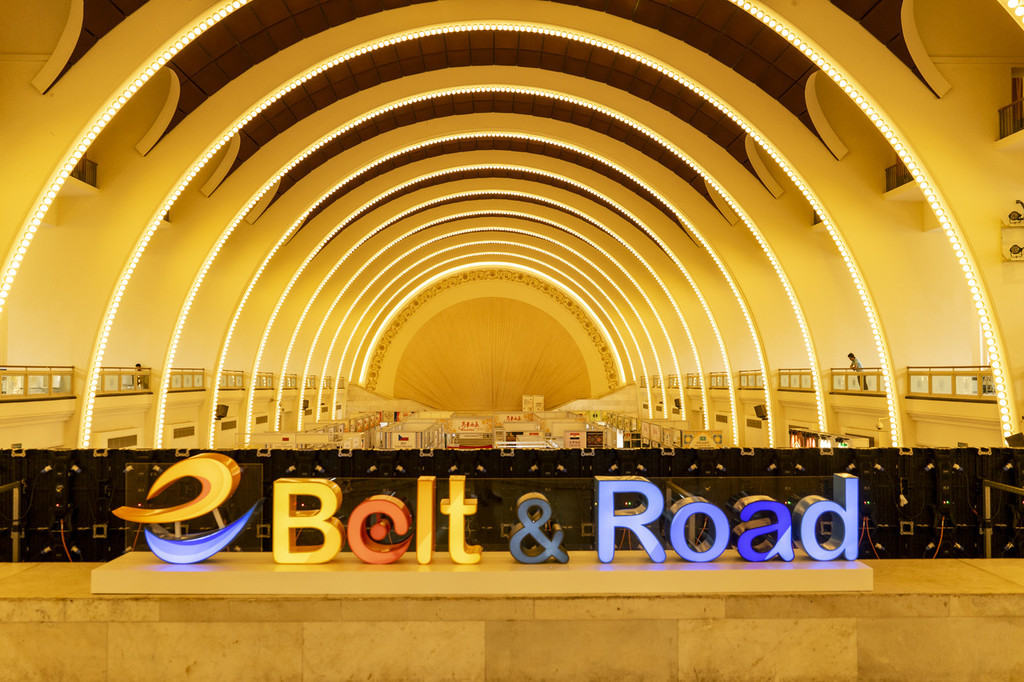
On Thursday, the second Belt and Road Forum for International Cooperation (BRF) has opened in Beijing. 37 foreign heads of state and government join 5000 delegates from 150 countries and 90 international organizations in this forum. France, Germany, Great Britain, Spain, Japan, South Korea and EU send senior representatives on behalf of their leaders. Diplomats from the US embassy, leaders of some states and American enterprises also participate in this event. China welcomes all participants, and looks forward to a full exchange of views on ensuring high-quality BRI cooperation in the future.
As an important partner of China, the United States has all reasons to join the BRI, and make the best out of this initiative. Some US companies such as Honeywell, which is based in New Jersey, are already working with partners along the Belt and Road. It is the right time for the U.S. to ride on tides of the global economy, when a vast of developing countries have entered into accelerated industrialization. It is also a good opportunity to share knowledge, standards, and demonstrate real leadership. The BRI enjoys great potential for being a new spot light in China-US cooperation, and bringing new momentum to the growth of our bilateral relations.
The author is Consul General at the Chinese Consulate General in New York