



Kenyans reap development rewards from new rail link









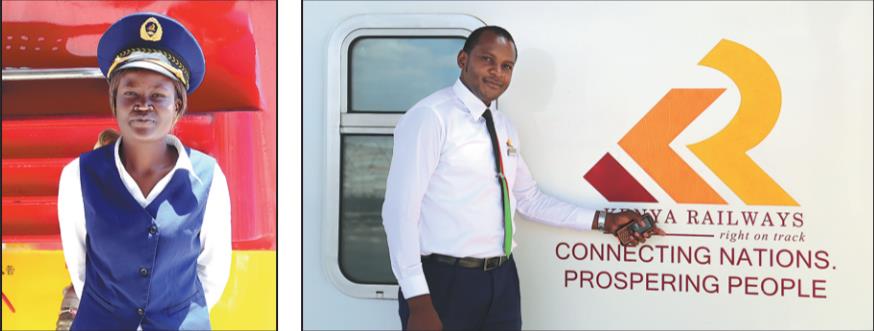
When former cabin crew member Kennedy Mugo told his friends and relatives that he was leaving his familiar Kenya Airways job to join a new train services company in town, many of them questioned his decision.
But Mugo was confident of his move. The services of the Chinese-operated Mombasa-Nairobi Standard Gauge Railway were due to start in a few months' time and he saw many opportunities in that rollout. He had worked in the airline industry for five years and was ready for a new challenge. He saw a bright future offered by the major rail link.
Mugo now works at the Nairobi Terminus passenger service management office and he is proud that he made the decision. The job is more fulfilling and stable, Mugo said. He has also gained more skills and the opportunities for career development are immense, he said.
"I'm grateful to the Chinese government for the finance and construction of the railway, and for the China Road and Bridge Corporation for giving me an opportunity to work in the company. I'm happy that I was one of the pioneer employees of the Mandaraka Express," Mugo said, referring to the railway's passenger train service commissioned by Kenya's President Uhuru Kenyatta on June 1, 2017.
Mugo himself is just one of the many Kenyans who have benefited from the railway project, one of the first major infrastructure achievements of the Belt and Road Initiative made in Africa. Besides helping them secure crucial jobs, the initiative has also helped locals acquire important skills.
The railway has provided 46,000 job opportunities to local residents and contributed 1.5 percent to Kenya's gross domestic product, according to China Road and Bridge Corporation external communications officer Zhao Yang.
The railway, stretching 480 km between Kenya's coastal city of Mombasa and its capital, was built at a cost of $3.8 billion, with 90 percent of financing provided by China. It shortens rail travel from 15 hours on an outdated railway built over a century ago to 4.5 hours.
Zhao said 27,000 local employees have received training and 100 college students have attended programs in China under the project. All of them have received training in areas such as locomotive technology, rolling stock engineering, signaling, telecommunications, control and transport management.
Mugo himself was trained at the Railway Training Institute in Nairobi, where he acquired skills such as passenger service and train scheduling management techniques, under the guidance of Chinese specialists.
Peterson Gitonga, one of the team leaders of the passenger operations at the link's Nairobi Terminus, is also happy that he was offered an opportunity to work for the railway. Gitonga, who was previously employed at the management department in one of Nairobi's leading hotels, said he is particularly grateful for being part of the team that ushered in the era of the major railway in the country.
"Here, I interact with so many people on daily basis and I appreciate it. I have also learned a lot and acquired new skills," he said.
Similar to Mugo's experience, Gitonga went through a three-month training program on train operations and customer service, among other subjects offered by the training institute.
"At the institute, I was appointed the team leader and when we joined the workplace, I was retained as a team leader. Working with SGR has been very exciting," he said.
Concilia Owire, one of the railway's locomotive drivers, said 15 Kenyan drivers can independently drive the locomotive from Nairobi to Mombasa, with four of them being women.
"We have 24 intermediate drivers, 35 junior drivers and 128 trainees. To fully qualify as a locomotive driver, it takes five years of training," she said.
"It feels good to drive a locomotive. I'm grateful for the opportunity," she said.
The railway is currently in a second phase of development. At the site of the latest construction, young men were busy working as they shared stories in Swahili, a language mostly spoken in East Africa. Many of them expressed gratitude for the opportunity to earn a living.
Charles Maina, one of the workers at the construction site, said he was grateful for securing a job in the project.
"This job has helped me to feed my family. I have also gained skills on railway construction. Most of these people were previously jobless, we thank CRBC for employing us," he said.
Kenyan passengers are also some of the major beneficiaries of the railway. Juma Maleve, who hails from the eastern part of Kenya and works in Mombasa, said that the train has become his favorite form of transportation.
"Prior to the launch of the SGR, I rarely traveled to my rural home in Kitui county because the journey by bus was long and tiresome. But now I travel frequently. The train is comfortable, convenient and secure, compared to motor vehicles," he said.
Maleve said the journey that used to take him 8-10 hours by bus now takes him fours hours by train. The cost is also reasonable as its economy class ticket costs 1,000 Kenyan shillings ($10) compared to 1,500 Kenyan shillings for the bus trip.
"The first class ticket goes for 3,000 Kenyan shillings, which is still quite reasonable," he said.
Sofia Hamisi, who runs small businesses in both Nairobi and Mombasa, said it is easier to travel to both cities to monitor her work, thanks to the railway.
"My businesses are currently doing well, because I give attention to both. Previously, I had to take flights, which were a bit expensive, or take a bus, which involved a long and tiring journey. But with the railway, I can travel even three times a month. I'm grateful to the Chinese government for giving us that," she said.



















