Ambassador Liu Xiaoming contributes an article to the Financial Times entitled The US's wrong-headed decision to pull out of the nuclear arms treaty









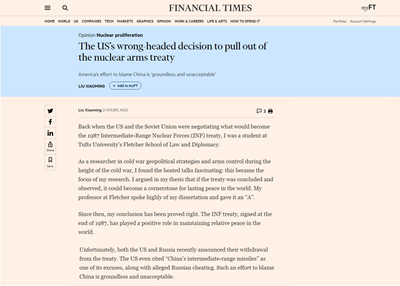
On 5 May 2019, the Financial Times published an article by Ambassador Liu Xiaoming entitled The US's wrong-headed decision to pull out of the nuclear arms treaty, in which he expounded China's position on the Intermediate-Range Nuclear Forces (INF) treaty. The full text is as follows:
Back when the US and the Soviet Union were negotiating what would become the 1987 Intermediate-Range Nuclear Forces (INF) treaty, I was a student at Tufts University's Fletcher School of Law and Diplomacy.
As a researcher in Cold War geopolitical strategies and arms control during the height of the Cold War, I found the heated talks fascinating: this became the focus of my research. I argued in my thesis that if the treaty was concluded and observed, it could become a cornerstone for lasting peace in the world. My professor at Fletcher spoke highly of my dissertation and gave it an "A".
Since then, my conclusion has been proved right. The INF treaty, signed at the end of 1987, has played a positive role in maintaining relative peace in the world.
Unfortunately, both the US and Russia recently announced their withdrawal from the treaty. The US even cited "China's intermediate-range missiles" as one of its excuses, along with alleged Russian cheating. Such an effort to blame China is groundless and unacceptable.
The INF treaty is, in nature, bilateral rather than multilateral. It was a deal between the world's two largest military powers to avoid an endless arms race. It has resulted in the destruction of 2,692 missiles, played an important role in easing tensions between major countries, safeguarding regional and world peace, and maintaining strategic balance and stability.
Even now, the US and Russia still hold about 92 per cent of the world's 14,500 nuclear warheads. These two countries should continue to shoulder the major responsibility for arms control and disarmament.
China is committed to peaceful development and exercises the utmost restraint in developing strategic forces. All of its land-based short- and intermediate-range missiles are deployed within its borders.
If the US is right when it claims that more than 90 per cent of China's nuclear missiles have a range between 1,000 and 5,500 kilometres and would be covered by the treaty if it were a party to it, these are absolutely no threat to America, which is nearly 10,000 kilometres away from China. China's nuclear capability is limited and only meets the minimum needs of China's national security. Furthermore, China, unlike the US, is publicly committed to no-first-use of nuclear weapons.
Although the US complains about other countries, its real goal appears to be breaking free from the INF treaty and its prohibitions on arms expansion.
What will happen in a world without the INF treaty? The US does not seem to be planning to deploy intermediate-range missiles on its own territory. The more likely scenario would be forward deployment to maintain an American military presence around the globe.
In these circumstances, limits or prohibitions that focus only on land-based short- and intermediate-range missiles fall short of the universally-accepted arms control principle of "undiminished security for all".
Rather than being abandoned, the INF treaty should be strengthened. The likely redevelopment and redeployment of missiles would undermine strategic stability across the world, trigger regional tension and hamper the global cause of arms control and disarmament.
So, in the interest of upholding the international system of arms control treaties and maintaining regional and world security, the top priority should be to rescue the INF treaty and make sure it is observed by both Russia and the US, rather than making it multilateral and including other countries.
Peace is like air and sunshine, whose presence is easily taken for granted but whose absence is life-threatening. The INF treaty is a milestone in international arms control and disarmament. There can be no going back. Russia and the US should strive to address their differences properly through constructive dialogue, observe the treaty and continue to be a positive force in maintaining world peace.