The story behind Beijing's annual tree fluff









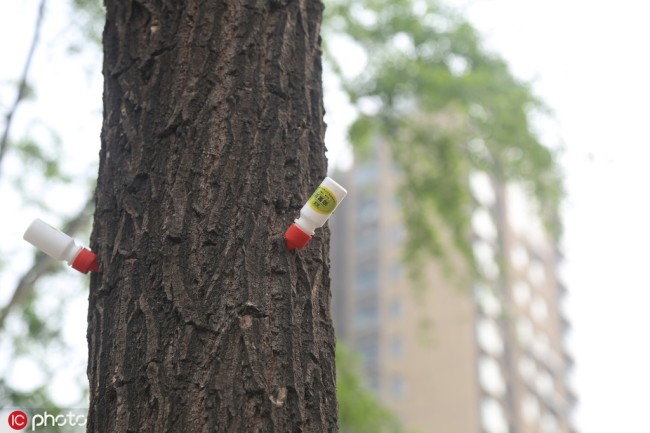
But why there are so many poplar catkins in Beijing?
Poplar and willow trees played a pivotal role in combating sandstorms in Beijing 50 years ago.
In the 1950s, sand and dust was much more prevalent in Beijing, with an average of 26 days each spring seeing either a dust or sand storm. The United Nations Environment Program declared at the time that Beijing was a "city on the edge of desertification."
This prompted massive greening efforts through the 1960s and 1970s, in Beijing and other parts of the country.
However, many of the trees selected for the programs failed to survive into maturity.
Poplar and willow trees were eventually selected as the main way to combat desertification in Beijing, due to their adaptability, alkali and drought tolerance, fast growth time, dense crown and low cost.
However, researchers neglected to consider the spring molting of the catkins. Thus, authorities approved the planting of tens-of-thousand of poplar and willow trees in Beijing.
And in the beginning, the move was very effective.
The average dust days in Beijing decreased from 26 days in the 1950s, fluctuated between 10 and 20 days in the 1960s and 1980s, and was reduced to less than 5 days in the 1990s, eventually decreased to around about 3 days after 2010.
But in the 1990s, the catkin problem became much more clear.
Beijing's municipal authorities decided in 2015 that the planting of of female poplar and willow trees in landscaping and greening projects would be prohibited.
But as changing out the existing trees isn't very practical, the alternatives devised at the time included grafting in male trees or injecting inhibitors into the female trees. However, neither step has proven very effective.
Beijing Forestry University has been tasked with creating a new breed of trees which don't shed their dander.




- Xinjiang reports highest foreign trade growth in China
- Harbin authorities demand return of pensions paid out to deceased
- Global research project on AI guardrails launched in Beijing
- Partnering with China, embracing opportunities
- China's cyberspace regulators announce measures for protection of minors
- Beijing's 'Rocket Street' promoted at aerospace conference