



Rural village reaps plentiful harvest from agritourism









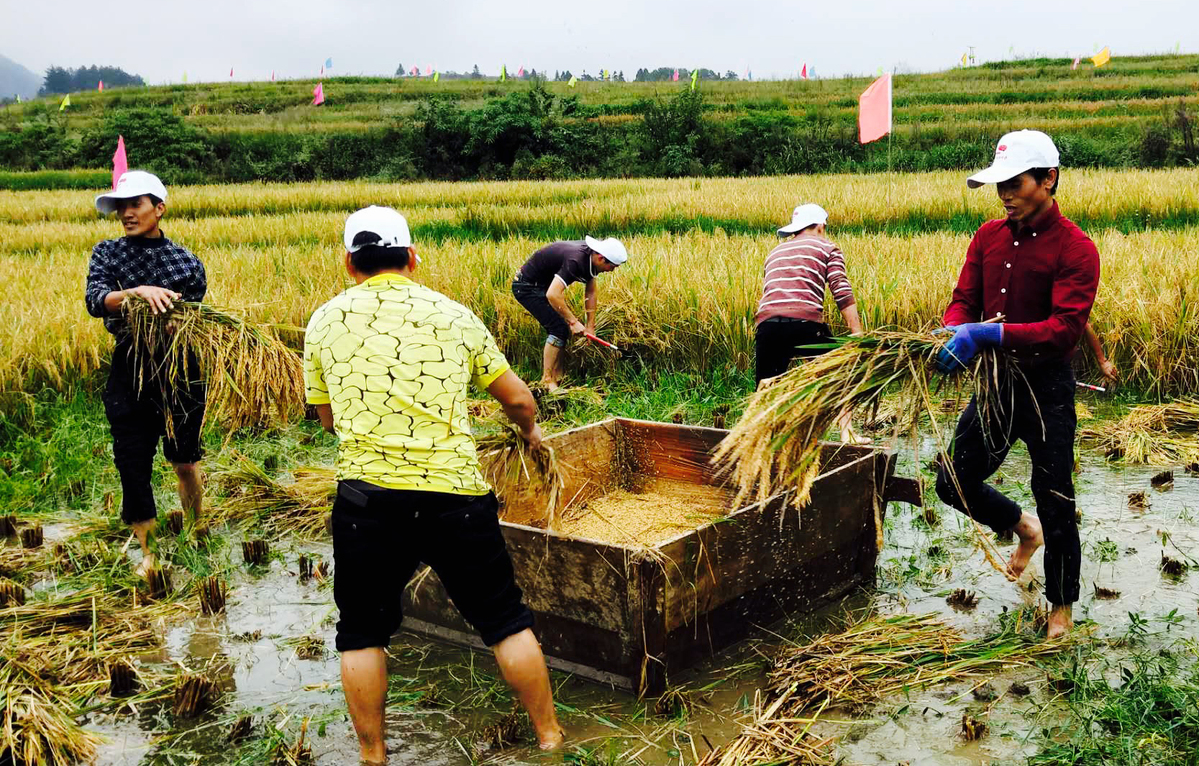
Residents of Huamao, Guizhou province, turn homes into inns, improve farming efforts
When Wang Zhiqiang returned in 2014 to Huamao, his home village in Zunyi, Guizhou province, after leading what he called "a vagrant life", he made a life-changing move.
He decided to fix up his vacant home, which was in poor condition, and turn part of it into an inn serving home-cooked dishes.
"I had tried to make ends meet all those years," Wang recalled at his home. He had left the village in the 1980s in search of jobs inside and outside the inland province, and ended up working in many cities in South China.
The decision to turn his home into an inn proved to be fortuitous.
Wang's home, the first family-run lodge in the village, did good business as people flooded in from nearby cities for farmer's food and rustic scenery.
While inspecting Huamao in June 2015, President Xi Jinping visited Wang's home and asked detailed questions about his family and business.
Xi's visit made Wang's inn even more popular, and now the village has 18 farm inns that cater to tourists from nearby cities.
The experience of Wang and his fellow villagers reflects how agritourism, in which tourists visit farms or ranches for recreational or educational purposes, has developed in many parts of China in recent years.
Peng Longfen, who is village head of Huamao, said farm inns are one way the villagers have found to improve their livelihoods.
Huamao had long been known as an extremely impoverished, nearly inaccessible village, with dirt roads and not enough electricity, drinking water or natural gas.
"The voltage was so low in those days that our electric thrashers could not work properly," said Peng, who was born and grew up in a mountainous region in Guizhou and married a Huamao villager in 1993. "Also, we had to carry water for drinking, cooking meals and other purposes."
Thanks to an ambitious campaign to revitalize rural areas, launched by the Chinese government under President Xi, Huamao has improved its public infrastructure, including roads. Wi-Fi now covers every home in the village of 1,345 households, or 4,950 people.
In 2014, Huamao invited a modern agriculture company in Shandong province to help the village improve its farming.
The company, Lvdong Jiufeng, established several cooperatives that involve planting fruit trees, vegetables or grain. It also built greenhouses and eco-friendly restaurants in Huamao.
The villagers have become company shareholders by leasing their farmland to it, and they also work for the company and get a year-end bonus.
The rental, which was originally 10,500 yuan ($1,550) per hectare, increases 3 percent every year, so the arrangement has turned out to be a stable source of income for most of Huamao's residents. Only the land on the slopes is not taken by the company, Peng said.
"The cooperatives have changed the village a lot," said Peng. "Some 2,000 people, or almost half of the village's population, used to leave their families to work in other places. Now they don't have to go far away but are making a living on the cooperatives or from agritourism."
In 2018, 1.85 million people visited the village, which brought in more than 50 million yuan in revenue, Peng said. While the Huamao villagers' disposable income was 6,478 yuan on average in 2012, the figure has risen to 17,456 yuan, she added.
Chen Yibing, who is in his 20s, opened a guesthouse in the village. His business, which employs 22 villagers, brought in more than 2.6 million yuan last year.
Peng said, "When people don't have to look for jobs in urban areas, we have no 'left-behind' children or'empty nests'."
When China's rural people leave their land to work in cities, they often leave their children with grandparents or elderly relatives.
In 2014, Shu Changying, 46, came back to the village from Guangdong province, where she had stayed as a migrant worker for more than 20 years, for her daughter's wedding. She leased her land to Lvdong Jiufeng Co and worked as a waitress at its restaurant.
"Though I don't earn as much as what I got in Guangdong, I can stay with my family now," Shu said.
Before Shu and her husband had left behind their two daughters when they went to Guangdong, her family grew melons and tobacco on their land. They could hardly make ends meet because of the poor harvest on the infertile land.
"We had to go because we wanted to earn enough money to pay for the two girls' schooling," Shu said.
Peng, the village head, said: "We are committed to helping the last 14 families, or 38 people, who still lead a bare-bones existence, to get rid of poverty. These people are still poor because they are either physically or mentally challenged, or too old to work."
She said the village authorities will give allowances to residents who are considered poor - those who have an annual income of less than 3,936 yuan - to ensure that they can live above the poverty line.
Meanwhile, He Wanming, president of the vegetable cooperative, said, "We have built greenhouses ...where we are growing pollution-free farm produce."
The vegetables it produces include eggplant, cucumbers, tomatoes, balsam pears and chili peppers - favorite ingredients for dishes in Southwest China.
Boosting agriculture is key to revitalization of the countryside, He said. In so doing, farmland use is optimized and farmers have a stable source of income. "Also, our community is safe and happy, since children and old people are not left alone anymore," he added.
The cooperative has also offered training on how to improve farming, such as greenhouse construction and pest control.
Through such changes, Huamao has provided a good example of a village that has shaken off poverty and improved livelihoods.
Guizhou province has said it will lift all of its 1.55 million poor people out of poverty by 2020. This year it is committed to lifting 1.1 million people out of poverty, according to Guizhou's poverty alleviation department.
The Chinese government has also set 2020 as the target for eliminating poverty nationwide.
Addressing a symposium on poverty alleviation problems in April in Chongqing, President Xi urged all-out efforts to achieve the nation's goal of eliminating poverty.
Xi said food and clothing have been mostly guaranteed, while there remain some difficulties in access to education, medical care and proper housing.
Rural people should not be left behind while pursuing a moderately prosperous society in all respects, Xi said. Poor people's basic needs must be guaranteed along with the country's development, he said at the meeting, adding that poverty alleviation measures must reach each and every person.
Poverty reduction measures, such as building industries and offering training, should be used to ensure that people in impoverished areas have jobs, he said.


- Nation intensifies crackdown on telecom, online fraud
- Fudan University president suggests 'Lego thinking' to transform academic disciplines
- Mainland criticizes Taiwan official's visit to Japan
- Emirates resumes daily Dubai-Hangzhou flights
- F1 fan festival opens in Shanghai
- NPC deputy promotes ethnic unity education in Xinjiang school





