Scientists find rare dinosaur with wings









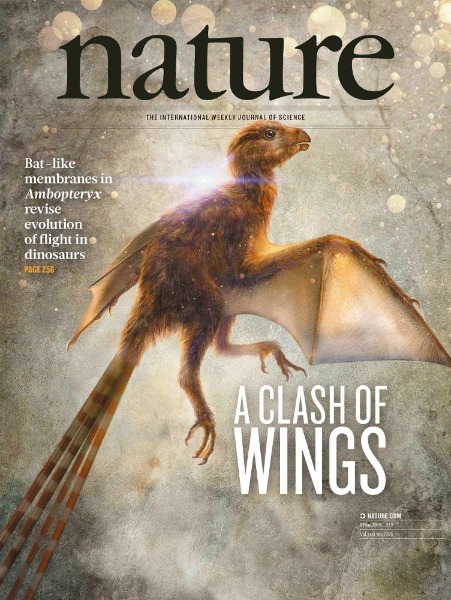
Chinese scientists have discovered an "extremely rare" and "fantastical" Jurassic Period dinosaur species in Liaoning province that roamed China's ancient forests with batlike wings attached to its tiny feathered body some 163 million years ago.
The discovery of this new species suggests these pioneering flyers glided like bats with membranous rather than feathered wings like birds.
The research was conducted by scientists from the Institute of Vertebrate Paleontology and Paleoanthropology of the Chinese Academy of Sciences. The findings were featured on the cover of the journal Nature on Thursday.
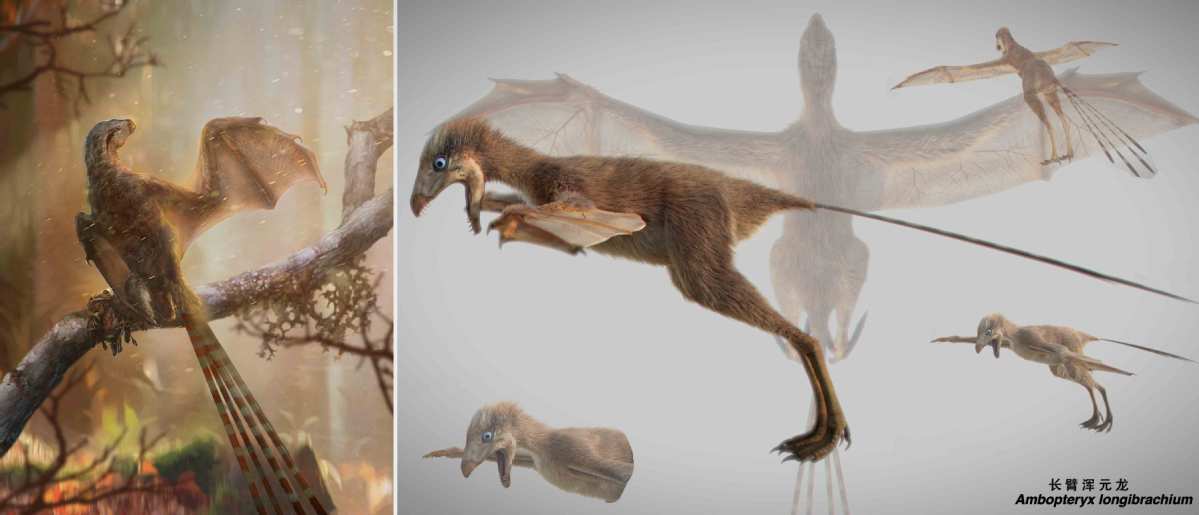
The new species, Ambopteryx longibrachium, belongs to the Scansoriopterygidae, one of the most bizarre groups of non-avian theropods.
"It is like a weird chimera of flying reptile, dinosaur and bird," said Wang Min, a researcher at the institute and lead author of the research paper.
From fossil records, scientists estimated that the new dinosaur species was around 32 centimeters long and weighed about 306 grams. "It is around the same size as a small magpie or a squirrel, but far more rare and fantastical," he said.
The Scansoriopterygidae are so rare that only three fossil species have previously been discovered. In 2015, Chinese scientists added the third entry to the list, Yi Qi, the first ever dinosaur discovered with batlike wings, which caused scientists to review their theories on the evolution of flight.
"We previously thought the evolutionary path from dinosaur to flying birds followed a linear path, with incremental changes to skeletal structure, feathers and soft tissue that ultimately made flight possible," Wang said.
"Now we are not so sure, because new fossil records show there are other ways in which flight evolved," he said. However, these alternative methods were likely short-lived and unsuccessful, as all known Scansoriopterygidae were from the late Jurassic period, and their unique membranous wing structure did not survive into the next Cretaceous age.
Scansoriopterygidae differs from other theropods, with its high skull, slim limbs, short tails and extra-long third toe. "They closely resemble some birds rather than dinosaurs, and when we first acquired the fossil, we thought it was from an early bird," Wang said.
"But as we began cleaning and analyzing the fossil, we discovered weird proportions, membranes and a bizarre wing structure that was first found in Yi Qi," Wang said.
Unlike other flying dinosaurs, which were the predecessors of birds, these two species have membranous wings supported by a rodlike wrist bone called the "styliform element" that is not found in any other dinosaur, yet it is present in flying squirrels and the extinct flying reptiles.
Wang said the newly discovered fossil is the most completely preserved and intriguing specimen of its group because it was from a fully grown adult with distinguishable features, unlike the first discovered member of the group, which was a juvenile.
In addition, scientists found the first remnants of undigested stomach matter in the new fossil, and they predicted this group of ancient flyers may have been omnivorous.
"There are still many unanswered questions, and our discovery might just be the tip of the iceberg," Wang said. "We need to conduct more fieldwork, and use new methods to examine the fossils further.
"Luckily, China has a wealth of impressive dinosaur fossil sites, and related research has progressed rapidly in the past two decades, despite our relatively late start," he said.
The city of Heyuan in Guangdong province currently holds the world's largest collection of dinosaur eggs, with more than 10,000 as of November 2004, according to the Guinness Book of Records. In 2015, 43 new eggs were dug up by construction workers engaged in roadwork in the city.
Paleontologists often discover new dinosaur fossils in Yunnan, Liaoning, Sichuan, Shandong, Hebei and Zhe-jiang provinces and the Inner Mongolia autonomous region. "China is truly a real-life Jurassic Park," Wang said.






- School launched for interstellar travel
- Deepening of Sino-Finnish ties stressed
- Over 7.3 million people recorded as registered organ donation volunteers in China
- China says Nipah outbreak poses limited risk
- PLA's aerobatic jets arrive in Singapore to take part in air show
- China's garbage sorting drive still has a long way to go in many cities