



Spreading prosperity, and consumer demand, throughout China









Domestic consumption will have to be the primary demand-driver for the products of China's factories and businesses. For, the nation is transitioning from an economic model based on infrastructure investment and exports made by low-cost labor toward one based on higher wages, upgraded industry, and technology development.
In the prosperous big cities, demand for such goods as cars, appliances, electronics and clothing is already high. Many government policies are designed to spread this prosperity and consumer demand throughout the countryside and to smaller cities.
Throughout history, megacities have been the engines of growth and productivity. But no nation can succeed if its regional cities and its countryside are not prospering as well. In the 1990-2010 period, China's growth was concentrated in a few large eastern cities. These cities attracted migrants in search of jobs and a better life.
At that time, China struggled to get high-quality medical care and education to rural areas and even to smaller cities. Well-paying jobs or opportunities to start businesses were few. So, despite the expense and family-separation involved, many workers felt they had little choice but to try their luck in Beijing, Shanghai, Shenzhen, or Guangzhou.
This view of China is outdated by at least a decade. Extensive infrastructure investment has allowed the development of large regional cities throughout the country. Personally, I've spent a good bit of time in Chengdu, Sichuan province, Kunming, Yunnan province, and Hangzhou, Zhejiang province. They are all very pleasant and productive cities with great infrastructure offering good opportunities to the people in surrounding areas.
In many ways, life in these cities is now better than in the top-tier cities. But still, many people in the countryside and in some county-level towns remain poor.
As part of an ongoing policy of promoting productive urbanization and rural revitalization, the State Council, China's Cabinet, on May 5 announced a set of urban-rural integration measures, including relaxing hukou (household registration) barriers, reforming zoning regulations, marketing collective land in rural areas for development purposes and increasing infrastructure spending in the countryside.
One way the government is working to spread urban prosperity is creating infrastructure to integrate three major megaregions - Beijing-Tianjin-Hebei, known as Jing-Jin-Ji in the North, the Yangtze River Delta centered on Shanghai, and, in the South, the Greater Bay Area, including Hong Kong and Macao plus Guangzhou, Shenzhen and other parts of Guangdong province.
For example, the National Development and Reform Commission announced plans to build 1,100 kilometers of new high-speed rail at a cost of 237 billion yuan ($34.3 billion) by 2030 to integrate Jing-Jin-Ji.
Economists and urban planners see huge economic returns from the so-called "agglomeration effects" of integrating such regions, which are larger than many European countries. The idea is to allow people throughout these areas to build businesses or careers that share in the prosperity of the region, without actually having to move to the core city.
Technology is also a key tool for integrating megacities, smaller cities, and rural areas. China was quick to deploy 4G throughout the country and is expected to deploy 5G more rapidly than any other country.
Even today, I'm surprised to get good 4G coverage and broadband availability in rural areas or small towns. According to 2018 data from China Telecom, 83 percent of administrative villages have broadband, and fiber-optic cable has been extended to 500,000 mountain villages.
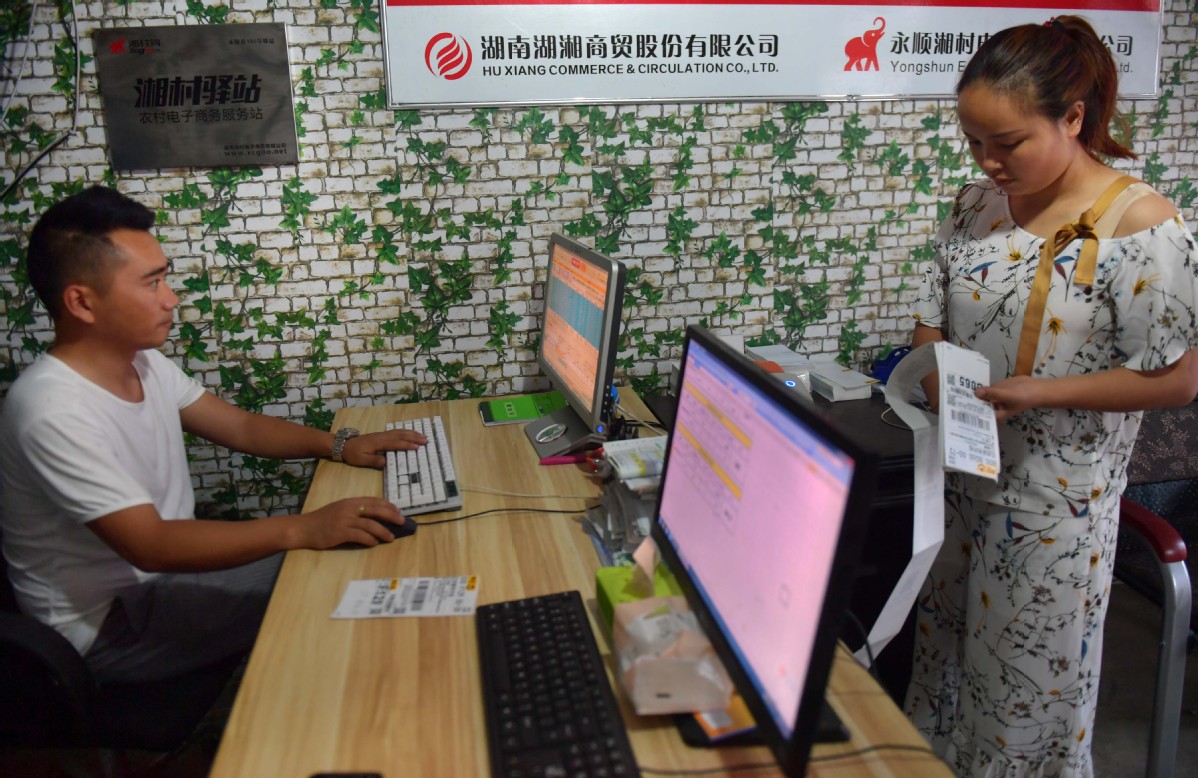
The purpose of this investment in internet infrastructure is not, or at least not primarily, to allow people to watch videos and look at WeChat Moments. The internet and infrastructure connections create business opportunities in remote areas that are luring ambitious young people to return from the big cities to their homes.
More than 5.7 million people, including 4.5 million migrant workers, have moved to rural areas to start businesses, according to the Ministry of Agriculture and Rural Affairs. All these people, plus their workers and suppliers are key sources of increasing domestic demand.
For example, I talked with a young man who had returned from working in Shenzhen to start a company in his small home village in a mountainous area of Jiangxi province. By growing Chinese yew trees and selling them online, he's now making good money and has a very nice house.
Similarly, another enterprising young man saved money selling flowers in Guangzhou, then moved to Kunming and started what is now a prosperous flower-wholesaling company. Such business would have been impossible just a few years ago before the good physical and electronic infrastructure was built.
Though big institutional and business model changes are needed, 5G technology holds great potential to improve medical care and educational quality in China's countryside and small towns. Remote medical consulting or surgery and remote teaching and tutoring could offer first-class education and healthcare to children outside the big cities. Combined with investments in brick and-mortar hospitals and schools, this new technology can be a key enabler for upgrading life outside the big cities.
China's farms are very small - less than a hectare in most areas. Such small plots are not able to generate incomes that can match rising wages in other industries. So, the farm population will continue to drop as young people move to urban areas or start non-farming businesses in their hometowns.
The falling farm population will push the remaining farmers to adopt productivity-enhancing technologies. At the China Development Forum in March, James Collins, CEO of Corteva Agriscience, a large US agriculture technology company, said he was amazed that farmers even in remote areas of China are already using drones to gather detailed information and optimize the delivery of water and fertilizer to each plant. 5G will be the key to making this "precision agriculture" work throughout the country.
China's urbanization process has been very rapid. In 1980, less than 20 percent of its people were urban dwellers, rising to 58 percent in 2017, according to the World Bank. This is a huge transformation in the lives of hundreds of millions of people.
And, the urbanization is still not complete. "City clusters are key to the development of a country. The United States, the UK and Japan all have major city clusters that represent 60 percent of the country's GDP, but for China the Pearl River and Yangtze River delta regions and the Jing-Jin-Ji region contribute only 38 percent to GDP," Shao Chunfu, professor at Beijing Jiaotong University, told the website railprofessional.com.
As people continue to move to cities, their incomes will rise, driving up consumer demand. Additional infrastructure spending to support these people will also be needed.
China has followed a development path similar to that of Japan and South Korea. For all three, exports and imports played a key role during their early, fast-growth periods. Exports were a critical source of demand for their newly developing industries.
Plus, the need to compete in international markets forced industries in all three countries to upgrade their products, processes and technologies. Imports and foreign investment were sources of capital and technology.
However, China is a much larger economy than Japan and South Korea. In the long term, it cannot rely on foreign demand or foreign technology to drive its economy. Once a country passes into middleincome status, the low-wage, export-driven development model does not work anymore. Wages are too high (a good thing), plus the exports become too significant for trading partners.
Long-term growth in China depends on raising the incomes of people throughout the country, thus allowing them to buy consumer goods, which then creates more jobs in a productive development cycle. Policies designed to spread urbanization throughout the country and to revitalize rural areas are key to allowing this cycle to continue.
- Faster and cheaper internet services to benefit Chinese economy
- Beijing district offers free legal services in communities
- Fast internet service, lower rates coming
- Chinese electronics company Xiaomi arrives in Chile with technology at affordable prices
- Lenovo takes the foldable plunge with prototype debut in Florida



















