Cosmologist Brian Cox on the meaning of life









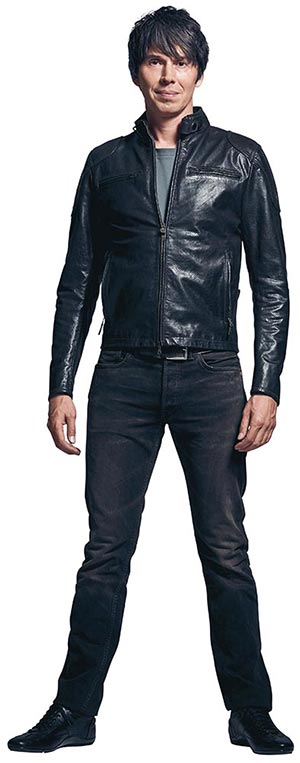
Are you more underwhelmed or overwhelmed by the public's general knowledge of science?
What's interesting is that the questions are very often the same ones I would ask. That's what we do with the show. We go straight to heart of the matter and take on very central questions – like why are we are, how did we get here and what should we be doing? And the answer is that we don't fully know, but we have a vague idea. I can talk about the edge of our knowledge and that raises the questions that we all ask. The important thing about science is that it shouldn't be separated from other aspects of human endeavour. I think science can be described as a human reaction to nature, and that's the motivating factor. There's only one interesting question really, in my view, which is: What does it mean to be small, fragile and finite – to live a small, fragile and finite life in an infinite universe? That, ultimately, is the only question that I'm interested in.
Physics is like a rule book for the building blocks we encounter, compartmentalising why and how things happen, and establishing reason and fact. But probability seems like the devil's advocate; it comes along and stirs it all up in ways that are unknowable and unanswerable. Isn't the very random nature of our existence here what makes our presence on Earth an ecstatic one to celebrate?
There's a sequence where I say exactly that in the show. Why is the Earth the way it is? It's a very complex mixture of the simple laws of nature and chance, and separating the two is important if you're trying to think about our place in the universe. You have to understand there's a lot of chance involved, which we can't make sense of. It's just like blind chance. For example, the asteroid that wiped out the dinosaurs – had that flicked one speck of dust a different way in relation to the solar system, we might not have happened. We wouldn't be here. About one billion other things might not have happened, either. [laughs]
So you can't define a human being through the laws of nature, but you can extract from the laws of nature a framework that allows you to think. You're not allowed to stray outside it. For example, we do know we are very small. But there's nothing we can do about that. I struggle with that sometimes.
One of your BBC programmes begins with a lovely moment where you examine the beauty of a snowflake.
The inspiration for that came from the 17th century and an incredible work called The Six-Cornered Snowflake by [Johannes] Kepler. It is absolutely brilliant. It's considered the first book to ever describe the structure of crystals or snowflakes, and I would recommend it anyone and everyone. A courtier is charged by his king to bring the most valuable gift he can find that is close to nothing. So the courtier considers some water, some dust and then the snowflake. "I'll give you the most valuable gift, which is the closest thing to nothing I can find," he says.
Kepler is a great genius, with the most amazing mind. Every single question he asks about the universe so long ago is correct.
Do you think of space as having dimensions we can't conceive of yet?
There are plenty of theories of extra dimensions and we do experiments to find them. Interestingly, one of the ideas about why gravity is so weak is because it has to deal with other dimensions, where other forces don't.
What would you say is people's biggest misconception about space?
It's not a misconception, exactly, but a lot of people can't come to terms with what it means to be human without considering the universe. So if there's anything that surprises me about some people, it is that they don't really care. But as long as enough people do, we're okay. I remember people used to say to the famous US cosmologist Carl Sagan, "Look at those lights in the sky." And he'd say, "They're more than lights, kids – they're worlds."
"A lot of people can't come to terms with what it means to be human without considering the universe. So if there's anything that surprises me about some people, it is that they don't really care. But as long as enough people do, we're okay".