Record number of graduates face tough job market entry









Degree holders turn their backs on mega cities for better lifestyle choices
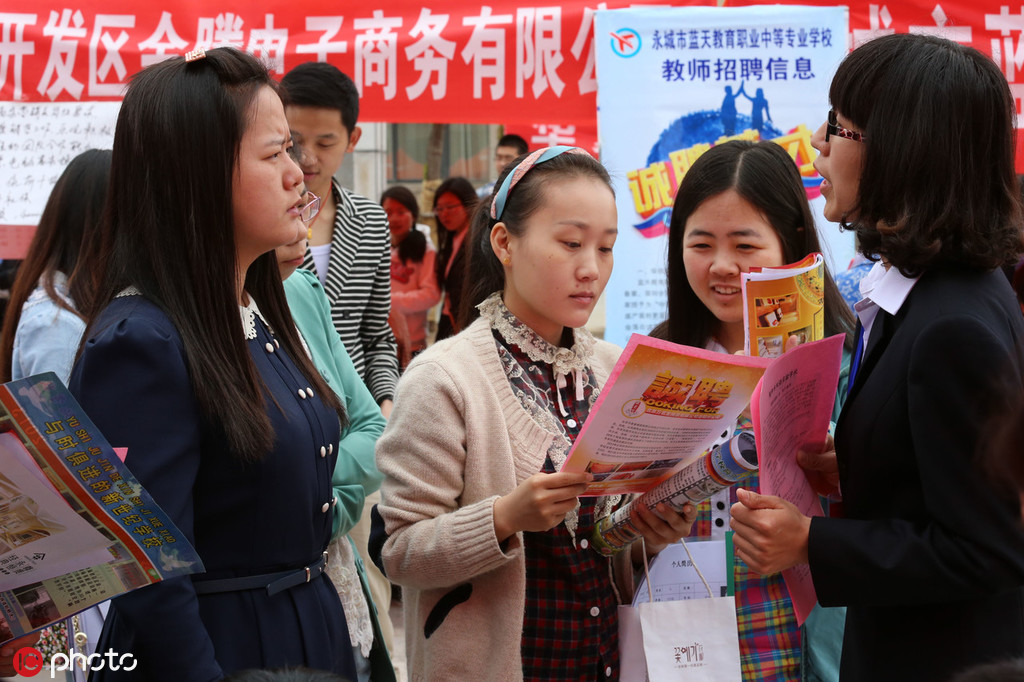
The population of college graduates is projected to reach a record high this year, turning an already tough job market into a pressure cooker and intensifying the scramble for talent nationwide.
To many new graduates, mega cities such as Beijing, Shanghai and Guangzhou, Guangdong province, are less attractive because of their high cost of living and greater peer pressure in the job market. And so the graduates are looking elsewhere.
The trend is changing the employment landscape in China, but it's good news for second- and third-tier cities. The mega cities' loss could be their gain in the brain drain game.
A recent report by the Beijing Municipal Education Commission said that more than 231,000 college students graduated from universities in Beijing last year, but 37.5 percent of employed graduates chose to work outside the capital.
A female college student surnamed Zhang said that she chose to work in Wuhan, Hubei province, after graduating from Tsinghua University in June, 2018.
"The biggest reason driving me away from Beijing was the living cost," she said. "Though I can earn 8,000 ($1,160) or even 10,000 yuan a month in Beijing, the rent may cost me 3,000 yuan or more each month, let alone other expenses such as meals, transportation and getting together with friends."
In contrast, some so-called new first-tier cities like Chengdu, Sichuan province; Hangzhou, Zhejiang province; and Wuhan have sprung up as new attractions to college graduates for their cheaper living costs and preferential policies to newcomers.
Data cited from Zhaopin, an online recruitment platform, shows that college students slated to graduate in 2019 have higher expectations of working in these cities, than in cities like Beijing, Shanghai and Guangzhou.
According to the platform, 44 percent of new graduates this year wish to find their jobs in new first-tier cities, while only about 30 percent hope to work in Beijing, Shanghai and Guangzhou.
Yang Zheng, who graduated with a master's degree from Fudan University in Shanghai in March, said that he received three offers from companies in the city, but finally chose a high-tech enterprise in neighboring Hangzhou.
"I've spent about seven years in Shanghai, it's time to explore a new world," he said, laughing. "The most important reason I chose Hangzhou is the city's potential development in the high-tech industry, which can bring us more opportunities."
Also, these new first-tier cities have preferential policies for residence permits and financial incentives to lure more talent.
For example, Zhenjiang in Jiangsu province, promised bonuses of 150,000 and 200,000 yuan for house purchases to graduates with master's and doctoral degrees, respectively, after they work in the city for three years.
Haikou, capital of Hainan province, is attracting college students with a monthly rent subsidy of 1,500 yuan, with an 18,000-yuan allowance to graduates who decide to buy an apartment there.
Employment, especially some groups such as college graduates and demobilized military staff, remains a priority to the government.
Premier Li Keqiang said at a teleconference on May 13 that employment pressure will be felt this year by a larger number of college graduates. However, promoting employment, especially for college students, is of great importance for economic development and social stability.
To better secure the employment of graduates, government at all levels issued policies to reduce discriminatory practices these new graduates may encounter when hunting for a job.
For example, the Ministry of Human Resource and Social Security said in February that employees are not allowed to define positions based on gender or to ask for a female job-seekers' marital status, to protect women' rights in the job market.
Also, the Ministry of Education required colleges to reinforce campus recruitment activities, prohibiting discriminatory information concerning gender, nationality and college levels.
According to the ministry, the number of college graduates is projected to reach a record high of 8.34 million this year, up by 140,000 from 2018.






- Global engineering congress to be held in Shanghai
- 'Lingka' custom in Xizang evolves into new form of cultural tourism, vibrant lifestyle
- From logging to guardianship: How China protects green source of its 'mother river'
- China rescues 10 Myanmar seafarers in South China Sea
- Qingdao sees surge in travelers to S Korea under its temporary visa-free policy
- China's 2025 box office surpasses 2024's full-year gross