



Curiosity at a peak, children inspired by science week









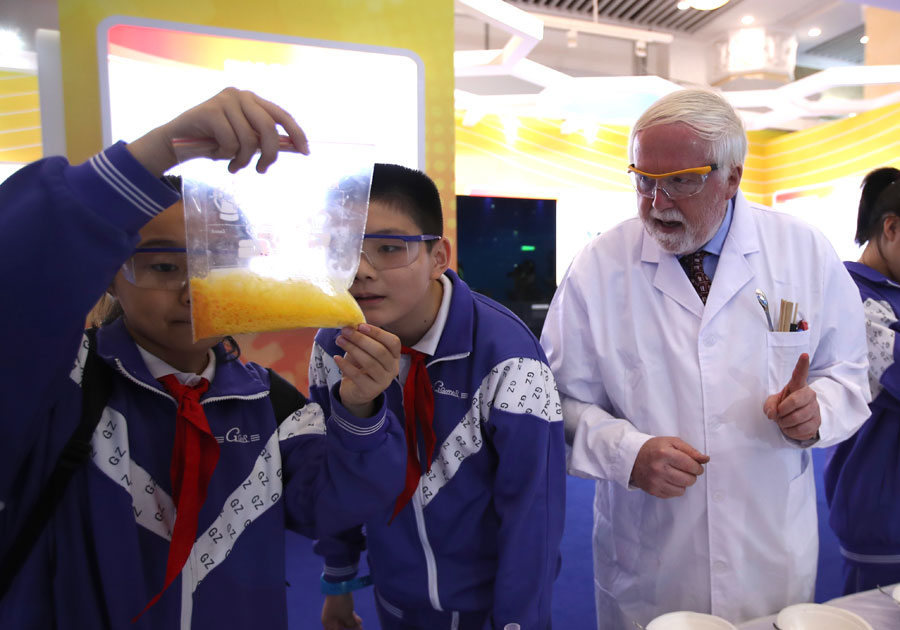
With his snow-white hair and beard, yellow-framed safety glasses, and a red tie patterned with the periodic table, David Evans looks more like a combination of Santa Clause and Bill Nye than a noted chemistry professor from the Beijing University of Chemical Technology.
But like Santa, Evans also has "magic" of his own. With flasks and beakers, the British scientist mesmerized Chinese youngsters with videos about his chemistry experiments, amassing more than 2.8 million fans on Chinese short-video streaming platform Kuaishou.
On Sunday, Evans was demonstrating his signature color-changing experiments to groups of elementary and middle schoolers at Beijing's Military Museum of the Chinese People's Revolution, the main venue of this year's National Science and Technology Week, and home to 410 science exhibitions.
Science week, first held in 2001, is the largest, longest and most participated in annual science extravaganza in China. More than 330 million visitors are expected to take part in about 21,000 exhibitions and tours from May 19 to 26.
"Science experiments can be very fun, but what's more important is to let children ask why it happened," Evans said. "Not all children who saw my videos will become scientists. But a few will go the extra mile and do their own experiments to satiate their curiosity. This is very important for scientific thought to grow."
At the lunar exploration section, Sang Ruipeng, a 12-year-old student from Beijing Xishiku Primary School, was showcasing a small robot lunar rover that he helped build and code. He said he hoped to create machines that would help humanity mine resources on the moon for future space colonization.
"The moon has plenty of Helium-3 isotopes, which can be used to provide energy for spacecraft," he said. "If something terrible happens to Earth, the moon will also likely be affected given its proximity. So we must think further, and use the moon as a starting point to travel deeper into space in search of more habitable planets."
Sang said many of the scientific achievements featured at the main venue can be very advanced and hard to understand, "but they are very interesting and inspiring, and they give me cool new ideas for improving my rover."
Zhang Qiang, a teacher from MAGO Education, a company that teaches young teens about robotics and coding, said children are naturally curious and events like science week can bring more opportunities for them to intimately interact with science.
"Building robots can teach valuable skills such as logic, hands-on ability and creativity," he said. "A nation's march toward becoming a technological powerhouse must start by empowering the children, and letting them learn and use their knowledge in meaningful ways."
Fu Jinyu, a 13-year-old student from Beijing Guangqumen Middle School, said she is "fascinated to see technologies from the textbook coming to life and benefiting people".
"The exoskeleton used to help disabled people to walk is especially cool," she said. "Our country is also becoming cleaner with new advances in green technologies, and people are also becoming richer thanks to new crops and farming methods that help lift farmers out of poverty."
Igor Perepichka, an organic chemistry professor from Northwestern Polytechnical University in Xi'an, Shaanxi province, said he recently moved to China and the exhibitions were good opportunities for him to learn about the nation's scientific development, especially China's efforts in turning research into actual products.
"It is very important to transfer knowledge and let the next generation of young kids be excited about science," he said. "After all, they will be driving scientific development in the following decades."






- China's Global Governance Initiative receives positive feedback at forum
- China's Xizang sees steady tourism growth in 2025
- First-of-its-kind pearl auction held utilizing Hainan FTP
- Agarwood exhibition steeps Shanghai museum in fragrance
- The Fujian Coast Guard conducts regular law enforcement patrol in the waters near Jinmen
- IP protection for new fields to improve














