



Driving an energy revolution









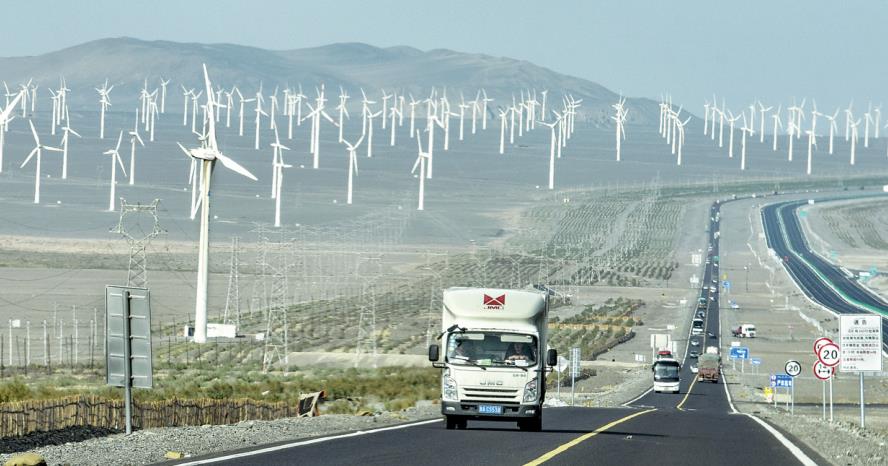
Shift to renewables reduces carbon emissions, increases electricity consumption
Increasing electric power consumption will not mean more pollution from coal burning thanks to China's shift toward a low-carbon energy and power industry.
As China has been actively promoting the percentage of renewable power in its energy mix, part of its energy revolution to ease dependence on coal - a major source of pollution and climate-warming greenhouse gas emissions - electric power sources have become more diversified in recent years with those from renewables increasing dramatically.
Public figures reveal that the surging share of renewable energy has become a clear trend, in addition to cleaner thermal power.
According to the National Energy Administration, the renewable power capacity in China, including hydro and biomass as well as solar and wind, rose 12 percent in 2018 to 728 gigawatts compared to a year earlier, with the country still rolling out new projects.
That amounted to 38.3 percent of China's total installed power capacity, up 1.7 percentage points over the previous year and about 7 percentage points higher than that at the end of 2015.
The installed capacity of hydro, wind, photovoltaic and biomass power stations in 2018 reached 352 gW, 184 gW, 174 gW, and 178.1 gW respectively, growing 2.5 percent, 12.4 percent, 34 percent and 20.7 percent year-on-year.
Power generated by renewable energy in China totaled 1.87 trillion kilowatt-hours last year, 170 billion kWh higher than the previous year. Renewable energy generated 26.7 percent of the total power, up 0.2 percentage point year-on-year.
According to Li Chuangjun, deputy director of the new energy department of the administration, the renewable energy in the country is expanding with high-quality development, while the utilization of renewables last year also improved substantially, while the curtailment rates for wind, solar and hydropower eased.
With substantial progress made by China on clean energy generation, the country aims to achieve a target curtailment rate of 5 percent or less by 2020.
Li said the government will continuously push forward facilitation of grid connection for wind and solar power, while coming up with new mechanisms to encourage the consumption of renewable energy to further decrease the curtailment rate. China plans to cut carbon emissions per unit of GDP by 60-65 percent by 2030 from 2005 levels, while investing 2.5 trillion yuan ($366 billion) in renewable energy by 2020, according to the National Energy Administration.
The country's major grid operators also vowed to speed up construction of grid networks and step up inter-provincial power trade to raise transmission capacity and ensure clean electricity generation is not wasted.
State Grid Corp of China, which runs the majority of China's electricity distribution networks, has become the world's biggest power grid with access to the largest installed capacity, with its clean power generation installed capacity reaching 550 million kW last year, 73 percent of the nation's total capacity of 700 million kW.
Insiders believe China's success is due to a combination of subsidies, policy targets and manufacturing incentives.
China has spent more on cleaning up its energy system than the United States and the EU combined. Last year alone it shelled out $132 billion, according to Bloomberg New Energy Finance.
"China's massive progress toward using more clean energy has been accelerating over the past few years, and this trend is unlikely to change in the short to medium term," said Joseph Jacobelli, an energy analyst and Asia-Pacific CEO of clean energy producer Joule Power.
"Generation from zero carbon sources as a percentage of the total early this decade was legible, and this trend will continue with renewed impetus in the next few decades."
He expected curtailment rates for clean energy would see a downward trend in the future.
Li Li, energy research director at market consultancy ICIS China, suggested that clear positioning should be offered to the best application scenarios of different types of energy, while relevant supportive policies are also essential.
"Reform of institutional mechanisms, together with industry's efforts, is just as necessary," she said.
In addition, as renewable energy is progressing toward more competitive pricing against other power sources across the globe, technological innovations have also been speeding up the cost reduction of renewable energy, she added.
Qinghai province, located on the Qinghai-Tibet Plateau, dubbed the roof of the world, was approved as one of the six provincial-level regions to spearhead clean energy development last year by the National Energy Administration, together with Zhejiang, Sichuan, Gansu, Northwest China's Ningxia Hui autonomous region and Southwest China's Tibet autonomous region.
With strong hydro and solar power capacity, the province vows to take advantage of its abundant solar power resources and harness the clean energy to make better use of renewables in the region. It has rolled out a series of industrial plans and supporting policies to facilitate the development of clean energy.
It set a new world record last year, with the province running solely on electricity generated from wind, solar and hydro power stations for nine consecutive days, a trial that is part of China's transition toward a low-carbon future to reduce reliance on fossil fuels and improve its energy consumption mix for better air quality.
Qinghai transmitted more than 10 billion kWh of electricity generated by clean energy out of the province last year, mainly to Jiangsu, Zhejiang and Gansu provinces, and it plans to expand its solar and wind capacity to 20 million kW by 2020. Han Xiaoping, chief information officer of China Energy Net Consulting, believes that increasing the use of renewable energy is the key to China's low-carbon power transition.
If the curtailment problems - which refers to electricity generation that is lower than the effective power capacity due to unfavorable conditions - can be solved, renewable energy will become better able to meet the growing electricity needs, said Han.
According to a Brookings Institution article, renewable energy will shift from meeting new electricity needs to replacing existing electricity needs that have been traditionally satisfied by thermal power production. It is expected that renewable energy will become the main power source by 2030, it said.
BP Energy Outlook 2019 also forecast that as much as 85 percent of future energy supply growth in the upcoming 20 years will come from renewables and natural gas, together accounting for the great majority of the growth in primary energy worldwide.
Renewables will become the largest power generation source across the globe by 2040, replacing coal, which will see its percentage drop from 60 percent in 2017 to 35 percent in 2040, it said.
According to BP chief economist Spencer Dale, dramatic growth in the percentage of renewables is expected in the next 20 years, accounting for 15 percent of power generation worldwide as of 2040 compared with the current 3 percent.
In China the percentage is expected to be higher, according to Dale, and the country will witness an annual growth of 8.5 percent till 2040, when it will account for 18 percent of power generation nationwide, compared with the current 3 percent, he said.



















