US shows true colors with Huawei strong-arm tactics: Opinion









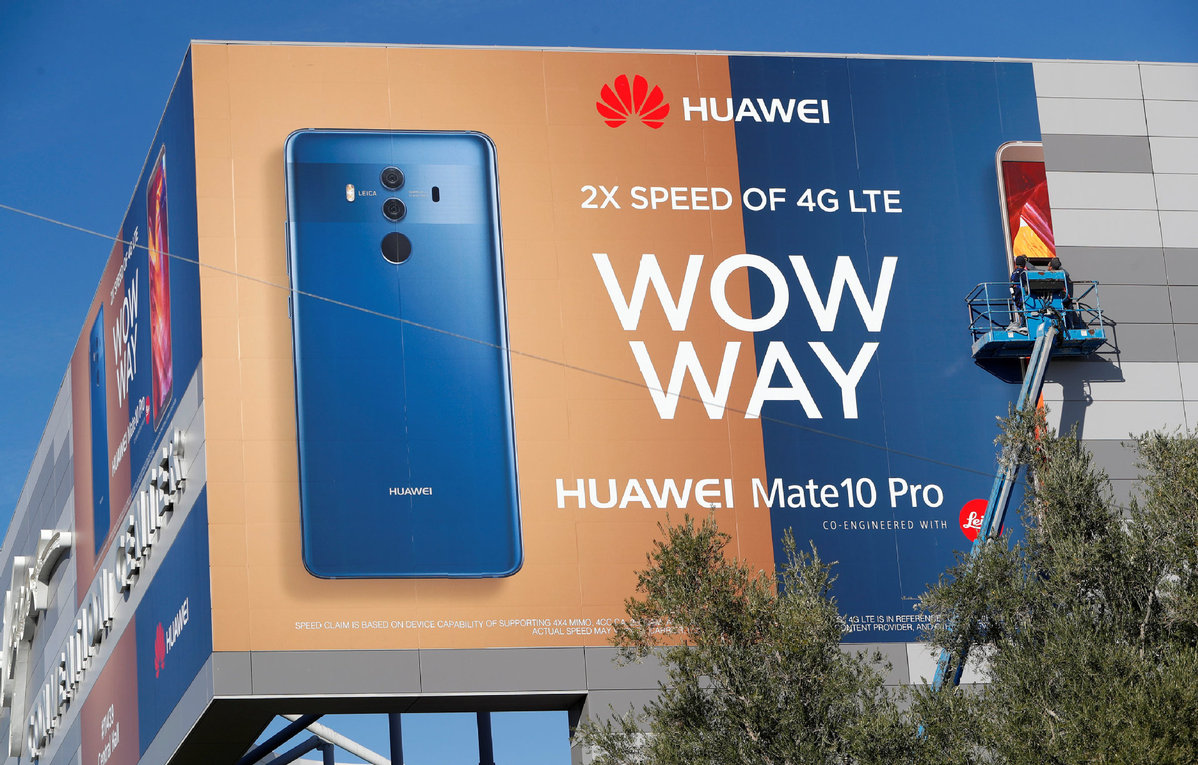
Seems like the United States doesn't just make washing machines or pork rinds — it's in the hostage-taking business, too.
At least that's what it looks like after President Donald Trump's Department of Commerce announced Shenzhen tech giant Huawei would be put on the "Entity List", a ledger of firms legally prohibited from trade with the US based on — well, based on whatever reason the president pulls out of thin air. Pretty smart way to run a global economy. But with such ire thrown a single company's way, you might be wondering what all the fuss is about. The answer is as predictable as it is simple.
Germany, Great Britain and other countries in the European Union were recently considering Huawei-based infrastructure for their 5G wireless networks. Adoption of this technology would represent a communications sea change and a big economic loss for the US, so you can guess what happened next. The US begged and pleaded for its allies to freeze the company out over "security concerns", but those pleas mostly fell on deaf ears due to lack of proof. So it's no great mystery why the US has acted this way — its traditional partners weren’t doing its bidding, thus a brute-force solution was required.
This is not without precedent. The 2018 trade ban against Chinese telecom outfit ZTE was a "Sputnik moment" for Chinese tech. Trump showed then he had no interest in playing by any set of rules but his own, and the punitive tactics against that company showed the rest of the industry it had to prepare for a similar assault. By stockpiling components and dedicating more resources to building operating systems and chipware of their own, Huawei and others took steps to protect themselves from the inevitable. Recent moves singling out Huawei show the prudence of such strategy — and not just at an enterprise level. National policy to safeguard domestic companies has proven quite wise, given the current hostile climate.
To say nothing of what this does to US tech's credibility. By following Trump's lead, Google has shown its true colors. Many lamented the company's exit from the Chinese mainland, wondering what possible reason there would be to keep a transnational colossus like Google from operating. Well, now we know — the second the US government asked it to enact an explicitly political demand, it did so without hesitation.
Imagine if the Chinese tech industry had totally relied on Google software and applications, and an order like this one came down from on high. The US could hold the entire country's smartphones hostage for as long as it liked. This takes on a new level of irony when you remember the US case against Huawei hinges on unproven claims the company is beholden to the Chinese government. After recent events it's tempting to think, "Oh, like Google?"
And I'm only half-joking there. This belligerent move gives us an opportunity to reevaluate the supposedly benevolent nature of US tech. Saturated by a media storm slandering their competitors, it's easy to forget US internet behemoths do the bidding of their government on a regular basis. Facebook conspired with the National Security Agency for its PRISM surveillance program, and Amazon built a computing cloud for the Central Intelligence Agency. Google joined PRISM around the same time as Facebook, but its relationship with intel-gathering agencies goes even deeper; it is the product of CIA and NSA research grants. So it's abundantly clear a Google or Facebook given free rein to operate would be something of a "fox in the henhouse" — albeit one that keeps its hunger in check long enough to build a customer base among the chickens.
But that's not the only wrinkle in this story. As these companies move into new markets they sap burgeoning domestic rivals of their innovative oomph. They leverage economies of scale to dominate and drive out smaller "underdogs", becoming synonymous with the services they provide. In so doing they grow into gargantuan hyper-monopolies, wielding a level of influence previously only held by large countries. Ultimately, they answer to their home nations — in this case the United States — functioning as "soft power" organs while claiming nominal autonomy. This is imperialism for the 21st century; the kind of mechanism for worldwide consolidation of capital Vladimir Lenin observed when he wrote his seminal text over 100 years ago.
There's no telling what the technological landscape might look like without this corporate oligarchy in the driver's seat. Rather than the "Big Four" US-based companies dictating what everyone else does — backed by the economic and military might of the planet's only superpower — we could see more equal partnerships sprout up among all countries, inside and outside the developed world. China has shown it's possible to build independent industry and scrape one's way out of a colonial destiny. What might a Nigeria, Bolivia or Pakistan do in similar circumstances? What kinds of new developments would we see in a tech ecosystem not under the thumb of Google, Amazon, Apple and Facebook?
Labor is only one area where an alternate state of affairs holds appeal. At present, with their concentrated resources and power these companies can siphon top workers from across the globe, leading to an international "brain drain" that dries up home countries' talent pools. This leaves those domestic sectors in the lurch, as US megacorps have "kicked away the ladder" they used to climb to the top.
We see echoes of this phenomenon in the trade "grievances" the US has brought against China; a topic for another time. But no matter how you look at it, this regime of coercion and control denies former colonial subjects their chance to rise up and become strong, sovereign nations. You'd be forgiven for thinking this practice reproduces those old exploitative relations — but of course the innocent, freedom-loving United States would never do such a thing.
Just like all other measures taken against Huawei — and China in a broader sense — this is an attempt to choke out a competitor and maintain US hegemony through the foreseeable future. It happened to Japan in the 1980s, and the playbook has changed little in the intervening years. The difference between then and now is China was watching, and learning. There won't be a present-day Plaza Accords, where China buckles to pressure and concedes key planks of the system that has had unprecedented success. And these strong-arm tactics won't work, either; fair negotiations don't happen when one party has a gun to the other's head.
China already knows what it's like to suffer under the yoke of a colonial master. No matter what the US or anyone else tries, it won't do so again.
The author is a copy editor with chinadaily.com.cn.
The opinions expressed here are those of the writer and do not necessarily represent the views of China Daily and China Daily website.