Pioneer hopes for new math reform ideas









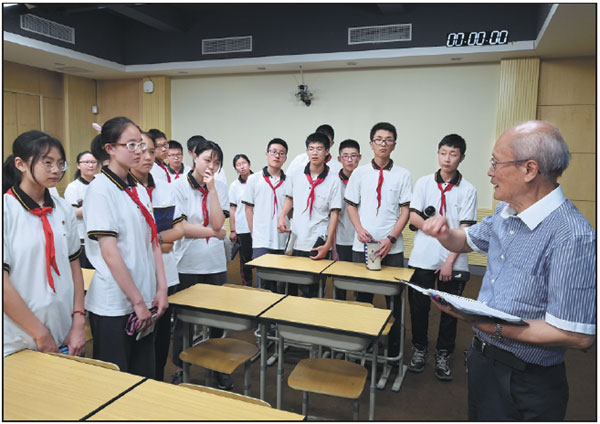
Despite the academic's achievements, he still wants continual inventive approaches to teaching the subject
Next year Gu Lingyuan will represent his Chinese peers to deliver a speech on math education reform in China in the new era at the International Congress on Mathematical Education in Shanghai. A city known for its excellence in math education, Shanghai will host the largest international conference on mathematics education.
Gu, who pioneered math education reform in Shanghai in the 1970s, has greatly contributed to the city's leading position in math teaching.
Gu, the 75-year-old former vice-dean of the Shanghai Academy of Educational Sciences, considers the chance to deliver the speech as both an honor and a responsibility.
"Education bears the responsibility of enlightening the new generation and passing down the wisdom of the old generation to them," said Gu, who remains active in quality improvement of basic math education in the city.
Since his early years as a fresh math graduate from Fudan University, Gu has understood the value of education.
Upon graduation, he was designated to teach Chinese language at primary schools in Qingpu district, a suburban region in western Shanghai.
"The region is too far away from the city center to have access to abundant and quality teaching resources and proper school management," he said.
After the college entrance examination was resumed in 1977 by late leader Deng Xiaoping, Gu arranged a math test for all high school graduates in Qingpu to assess their abilities.
"The test was on primary and middle school level math, really basic, but their performance was shockingly disappointing," he said.
Among the 4,373 people who took the test, over 23 percent received zero out of 100 marks. The average score was 11.
Gu thus submitted a report to the Shanghai authorities. During that time, he also received an offer from ShanghaiTech University for postgraduate studies.
"I was anxious about math education in Qingpu, and I was sure it needed rather long-term and arduous reform. So I chose to stay," he said.
Supported by local education authorities, Gu formed a team of five to work out a four-step strategy. The team spent the first three years investigating and researching teaching approaches, student performances and school management by observing every math class in Qingpu district.
This was followed by another year of finding suitable teaching methods for Shanghai students. Then, applying the shortlisted methods to classes and conducting teaching experiments took three more years. Gu's team eventually promoted the most effective teaching methods and learning approaches for math across the city.
"We may have been the first few Chinese examining large and varied data sets - or big data - to propose useful math teaching approaches based on data in the field of education," he said with a smile.
Great progress was made after 10 years of reform to improve math education in Qingpu, as Gu's team grew to include more than 200 math teachers, researchers and other practitioners.
More than 85 percent of students in Qingpu scored over 60 out of 100 marks in the high school entrance examination in Shanghai in 1986, which was a surge of 69 percentage points from 1979, where only 16 percent of students secured those scores. The Qingpu students' performance in high school math exams that year was also higher than the average of high school students in Shanghai at 68 percent, meaning that math exam scores in Qingpu were better than the city average.
"The reform was a remarkable success because it was rooted in real math classes, which is of great theoretical and practical value," said Xu Binyan, a professor at the teachers' education college in East China Normal University.
The reform soon rose to fame across the city. It was named as one of the national excellent education achievements by the Ministry of Education in 1990.
The reform was later spread across China in 1992.
China's basic math education reform experience was soon made known internationally when Gu shared his experience to international peers at the International Congress on Mathematical Education held in Spain in 1996.
Gu then moved on to compile an action plan for mathematics education in primary and secondary schools in Shanghai for the 21st century in 1997. The idea was centered on holistic and quality education rather than just training exam-smart students.
The plan clearly guided the development of curriculum standards in subsequent education reforms in the city.
In the past decade, Shanghai's math teaching gained recognition worldwide when the city topped the Organisation for Economic Co-operation and Development's Programme for International Student Assessment rankings in math for students age 15 and 16 in 2009 and 2012.
From 2014, groups of British and Chinese teachers visit each other's schools in the two countries every year to share math teaching expertise through a UK-China math teacher program launched by both countries.
Though he has made plenty of achievements, Gu said he never imagined that he would become a math teacher as a child.
"My first aspiration was in astronomy during middle school in the 1950s when the Soviet Union launched the world's first artificial satellite - so inspiring," Gu recalled.
He later changed his mind when his teacher in high school told him that "math was a fundamental subject for space science".
After receiving a doctorate from East Normal University in 1993, Gu also worked as a professor at the university's mathematical sciences school.
In addition to decades of work focusing on math education and training of teachers throughout Shanghai, Gu has been committed to sharing his teaching experience to young teachers at the university.
"I hope to spark new ideas among the next generation of educators," he said.




- China's Global Governance Initiative receives positive feedback at forum
- China's Xizang sees steady tourism growth in 2025
- First-of-its-kind pearl auction held utilizing Hainan FTP
- Agarwood exhibition steeps Shanghai museum in fragrance
- The Fujian Coast Guard conducts regular law enforcement patrol in the waters near Jinmen
- IP protection for new fields to improve