



Botanists bloom in efforts to save rare flowers









Working at over 4,000 meters above sea level, botanist Xue Jingqi and his colleagues felt their heads throbbing with altitude sickness.
Local Tibetans guided them as they searched carefully in rocks near Shangri-La, southwest China's Yunnan province.
Then their malaise lifted as they found rare wild peonies they had been looking for.
The team from the Chinese Academy of Agricultural Sciences carefully collected the seeds and brought them back to Beijing as part of a conservation program for endangered plants.
But in the lowland climate, almost all the seedlings died the following year.
The scientists returned to the plateau to collect new seeds, which they took to the relatively cooler Yanqing district, in northern Beijing. The seedlings blossomed after careful cultivation, but then a sudden late-spring chill killed most of them.
"It was very frustrating that years of work went for nothing, but we soon improved the program," Xue said.
The team developed an efficient breeding method that greatly shortened the peony breeding cycle.
'Giant panda of flowers'
The peony is native to China, where it has been cultivated for about 2,000 years. Admired as the "king of flowers" in China, the peony is now cultivated in more than 20 countries, including Japan, France, Britain, the United States, Italy and the Netherlands.
China has more than 1,500 peony varieties, but some of the wild varieties are endangered, and some have only one plant left, said CAAS expert Wang Shunli.
The CAAS has bred more than 20,000 wild peony seedlings and transplanted hundreds back to their native places in southwest China through an endangered plant protection program launched in 2012.
Dubbed the "giant panda of flowers", paphiopedilum is another critically endangered plant rescued by the program. This orchid was discovered in the 1970s on a few mountainsides along the Nujiang River in Yunnan province.
Orchids are very sensitive to environmental changes and human activities, so many species are in danger. Researchers from the CAAS have mastered artificial propagation and cultivation methods of some wild orchids that can effectively protect them in the wild. They have also cross-fertilized wild plants to breed new paphiopedilum varieties with a wider range of colors, said CAAS chief flower expert Ge Hong.
The flowers bred from wild varieties such as peonies and paphiopedilum are blooming at the Beijing International Horticultural Exhibition 2019.
They also have the potential to raise living standards in remote areas.
Peonies can live on less productive land, so they don't compete with other crops. Their seeds can produce oil and the stamens can be made into tea. The CAAS is working with the government of Linxia, Gansu province, to increase local farmers' incomes by planting peonies.
Plant factory masters
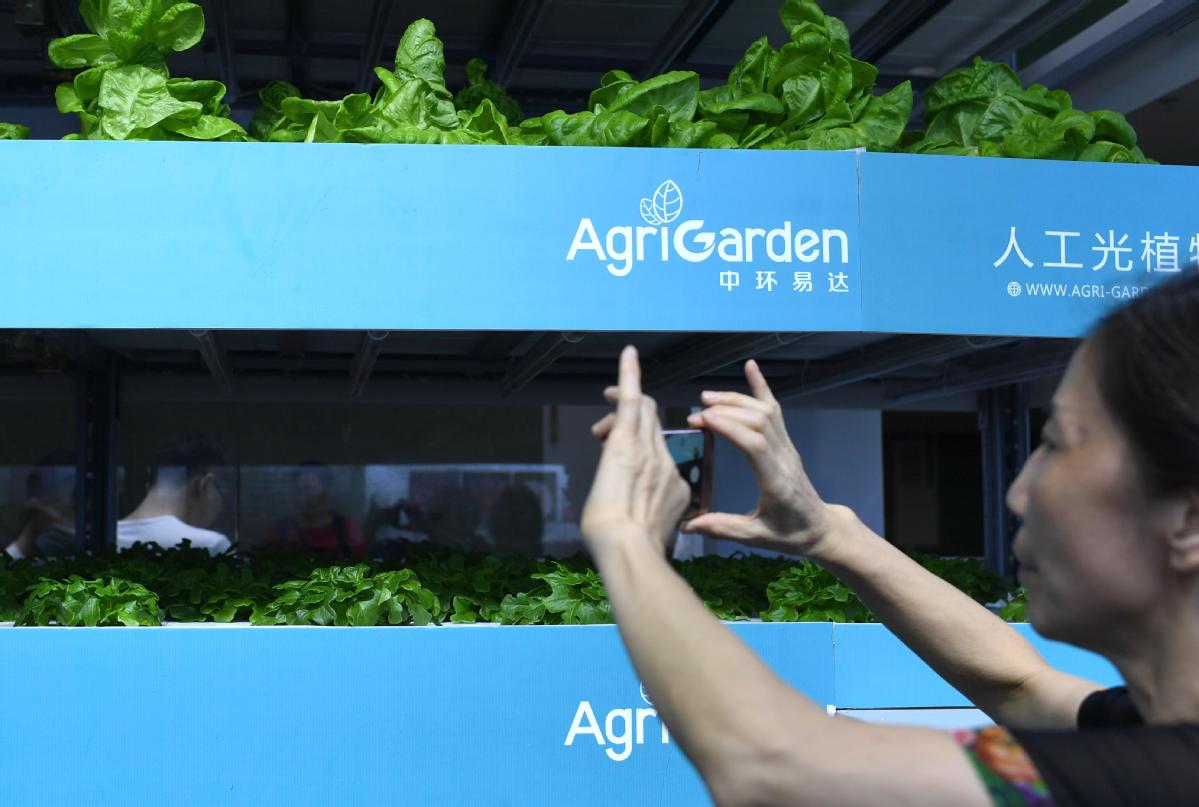
China is one of the few countries in the world to have mastered the plant factory technology, which is on display at the Beijing Expo 2019.
Vegetables growing in nutrient solutions line the shelves under red and blue lights. A computer controls the temperature, humidity, light, carbon dioxide concentration and nutrient solution.
According to Yang Qichang, director of the CAAS Facility Agricultural Environmental Engineering Research Center, his team has made breakthroughs in developing light sources, light regulation, multilayer hydroponic cultivation, intelligent environmental management and control, nutrient solution regulation and energy-saving technologies.
CAAS studies show the vitamin C content of vegetables grown in their plant factories is significantly above average while nitrite content is lower.
Researchers are trying to further reduce the energy consumption and improve its automation, said Li Kun, a member of the team.
Plant factories are developing rapidly in China. In addition to application in polar regions and on islands, mini plant factories have come into play in daily life. The technology is expected to be used in space exploration.
Xinhua


- Nation's satellite data reception coverage reaches new heights
- Central govt to help build Shanghai into a green global shipping hub
- Grand community banquet attracts 2,600 guests in Chongqing
- Giant pandas filmed enjoying their meals at Shaanxi conservation base
- Smart Dragon 3 rocket lifts off at sea with seven satellites
- Chinese researchers launch global project to explore plants' evolutionary history, unlock genetic assets











