



How to move away from 'conflict stage'









Senior Yale academic says Washington's policies not in the best interests of China-US relations
Considered Wall Street's leading expert on China, Stephen Roach, senior fellow at Yale University and former chair of Morgan Stanley Asia, has spent more than two decades researching and writing about China.
His interest in China was first kindled in the late 1990s, when he realized how different it was from other crisis-battered Asian economies at the time and identified it as the key to end the Asian financial crisis.
During his long experience with the Chinese economy, leadership, policymakers and business people, he witnessed the economy undergo dramatic changes - integrating into and impacting the world economy, engaging in structural changes, and more recently advancing in innovative and cutting-edge technologies.
Roach has also seen China and the United States develop a codependent relationship, in which the two economies need each other in multiple ways.
US consumers need low-price Chinese goods to make ends meet, the US Treasury needs China to buy US treasuries to fund the large and growing budget deficits, and US companies need China as the third-largest and most rapidly growing export market.
China, on the other hand, depends on the US as a large source of external demand for Chinese exports and depends on US financial markets to provide a benchmark for the currency.
However, over the years, after both countries, especially China, underwent changes, they've gotten into the classic "conflict stage" of codependency, as Roach described it in a recent interview with China Daily.
Almost a year ago, on July 6, 2018, the US imposed 25 percent tariffs on $34 billion worth of imports from China, a move that was soon answered by China with tariffs of the same scale.
That was the first round of tariffs exchanged by the world's two largest economies, as the Trump administration initiated this year-long trade dispute, which has extended into 25 percent tariffs on $250 billion Chinese imports from the US and various levels of retaliatory tariffs on $110 billion in US imports from China.
Not limiting its actions on tariff, the Trump administration has also targeted Chinese investments, industries, and even specific companies, with Chinese information and communications tech company Huawei, a frontrunner in the development of 5G technology, repeatedly caught in the crossfire.
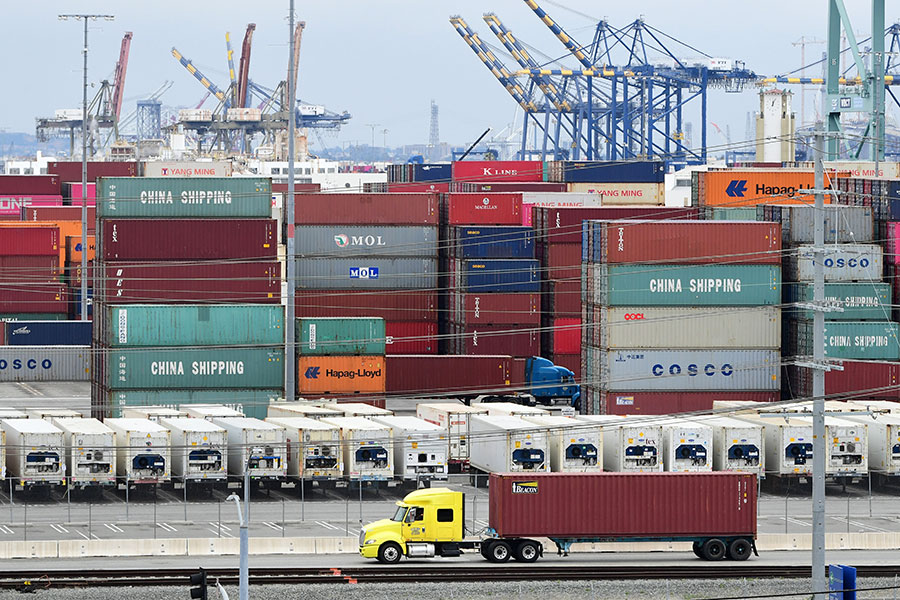
The dispute was considered by US economists and global institutions, Roach included, as negatively impacting consumers and producers in both countries and the global economy.
In his interview with China Daily, Roach called the Trump administration's policies against Chinese imports and Chinese businesses an "aggressive economic action" against China and the wrong approach for a codependent China-US relationship.
While the US trade deficit in goods with China, which reached a record-breaking $419 billion according to the US Commerce Department, has been repeatedly condemned by the Trump administration, Roach stressed it is also an important outgrowth of internal, macroeconomic factors in the US, such as the low domestic savings rate.
Net domestic savings accounted for less than 3 percent of US national income in 2018, considerably lower from the 6.3 percent average over the final three decades of the 20th century, according to data from the US Bureau of Economic Analysis.
Roach suggested that the US economy needs "healing from within" to boost its domestic saving rate, while the Trump administration's deficit-prone fiscal policy is doing anything but.
China was only part of the US multilateral trade problems caused by a low savings rate, said Roach, as the US trade gap widened in 2018 to a 10-year high of $621 billion, and it had a goods deficit with as many as 102 nations.
Simply targeting China will likely just rearrange the multilateral deficit toward higher-cost producers, which taxes the US people, said Roach, who reiterated during the interview that tariffs are bad and trade wars are easy to lose - opposite to what President Trump has noted repeatedly.
The fact that trade accounts for 27 percent of US GDP, according to the World Bank's 2017 data, is making the economy more vulnerable to a collapse in global trade today compared to that in 1930, when trade accounted for just 11 percent of US GDP. Significantly, the Smoot Hawley tariffs enacted by the US in 1930 and the broad retaliation that followed played a key role in pushing the economy from a recession to the Great Depression.
That is something he believes is overlooked today, and thus suggested the administration be more careful in "launching this assault on the trade front."
During the interview, Roach also talked about what he thinks is the true nature of the current trade dispute, a "false narrative" - or criticisms without sufficient evidence - that prevails in the US against China, and his four-point proposal for how China and the US should navigate their trade and economic relationship.










