


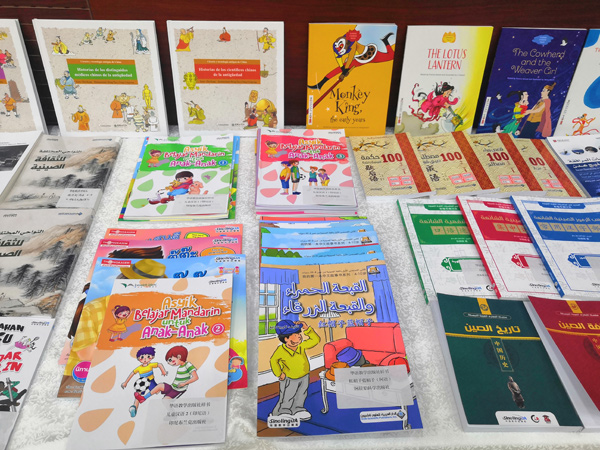
Just as readers in China get to read a large number of foreign books, many Chinese books are available in overseas markets as well. And as part of its program to push Chinese books abroad, the China International Publishing Group recently organized a related seminar on publishing Chinese books.
According to Lu Cairong, deputy director of the CIPG, there were over 20,000 kinds of books about China published in English in 2017, and that number reached 40,000 in 2018.
Besides English, books about China were also published in French, Spanish, Russian, Japanese and German. The books on China cover subjects like modern history, culture, literature, traditional medicine and language.
"This shows the international community's hunger for information about China. And this also pushes us to consider how to meet this requirement and how to make the books better," Lu says.
Professionals from the publishing industry in many countries participated in the seminar.
According to one of them, Kaushal Goyal, general manager of India's GBD Books, people in India are interested in knowing more about China's reform and opening-up, the Belt and Road Initiative and Chinese culture.
"Indians already know something about Confucius' Analects, Lao Tzu's Tao Te Ching and Sun Tzu's The Art of War but they have not heard about other Chinese philosophers like Mencius and Chuang Tzu.
Goyal says Indians know more about Jack Ma of Alibaba but less about Ren Zhengfei of Huawei, Ma Huateng of Tencent and other businesspeople in China.
Argentina's Mil Gotas Press president Guillermo Bravo says that Spanish-speaking countries have a great interest in China, but the bridge for mutual understanding is not wide enough.
Comparing the publishing scene in the two regions, Bravo says while Chinese companies are usually large and employ many people, their counterparts in Latin America are much smaller.
"But despite the difference in size, I still hope companies from both sides can cooperate more so readers will gain," says Bravo.
The delegates also offer suggestions about how Chinese books can be made more attractive to overseas readers.
According to Kim Seung-il, president of South Korea's Gyeng Ji Press, China tends to provide a lot of funding for the publication of academic books overseas as opposed to books about Chinese history, culture, the political situation and the economy that are easy to read.
"But I see that people prefer to read the latter kind of books, so I suggest that China uses half of the funds for academic books and the other half for other kinds of books."
Both Kim and Laura Prinsloo, chairperson of the Indonesian National Book Committee, say the quality of translation plays an important role in introducing China to the outside world.
Prinsloo's says: "We need to enhance our cooperation in translation projects and grant programs between Indonesian and Chinese publishers that are supported by both governments."
Representatives of Chinese publishing houses at the seminar proposed nine titles for publication abroad and sought advice from the foreign delegates.
Egyptian delegate Ahmed Mohamed Elsaid Soliman says that The Story of the Pioneers Who Created the Chinese Dream will likely work, as books about the Chinese economy are welcomed in Arab countries, and points to examples such as Zhang Weiwei's The China Wave: The Rise of A Civilizational State.
"But we want detailed and vivid stories about the Chinese economy instead of dull economic theories, so stories of entrepreneurs are a good choice," he adds.
He also likes the title My Xinjiang Friends and I, which is about the author's experience in Northwest China's Xinjiang Uygur autonomous region.
"Xinjiang is interesting for the Arabs. We hope to learn more about it."
Malaysian delegate Hasri Hasan echoes him, saying: "Malaysians also have interest in this region since both Malaysia and Xinjiang have many Muslims."
Hasan says he likes the title 10134 Kilometers Through China, a travel diary about China, since "Malaysians like traveling".
He also suggests that readers be offered some video content so that they can appreciate China more.
"These exchanges help us to seek common ground," says Goyal.








