Govt mulls methods to promote waste-sorting agenda









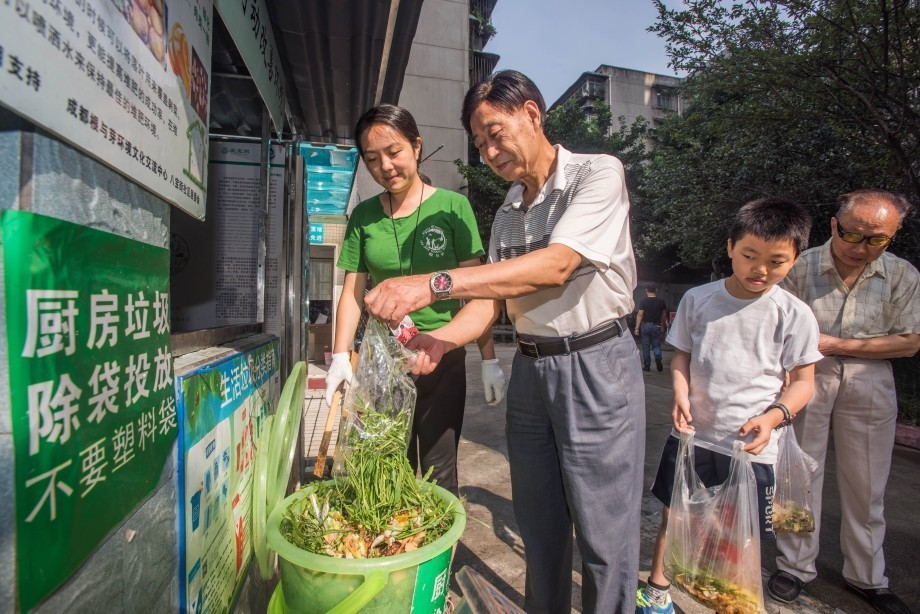
Composting
Zhang said one possible direction is on-site disposal of food waste via composting in communities, which is economically and environmentally the most cost-efficient method.
The approach could be an efficient way of ensuring greater participation, and could reduce the amount of waste that needs transporting and avoid many of the environmental risks posed by landfills and incineration, she said.
The problem is that assessment standards for property management companies in many areas impose limits on the number of flies in communities, and composting programs for food waste may attract the insects, which makes the businesses reluctant to introduce such measures, she said.
In addition, though many people are enthusiastic about planting vegetables, they are not allowed to do so in urban communities. An effective way of encouraging people to participate in garbage sorting would be to allow them to become involved in composting, and then use the compost they produce as fertilizer for plants, she added.
Wang Tianyi, CEO of China Everbright International, Asia's largest waste-to-energy company which entered the garbage-sorting business last year, said, "Garbage sorting is absolutely the correct long-term way to deal with the growing mountain of waste."
In January, the State Council unveiled a "no-waste city" pilot plan, which aims to minimize waste generation, maximize its utilization as a resource, safely dispose of solid waste and reduce the use of landfills. The pilot was introduced in 16 urban areas in May, including 11 cities such as Shenzhen, Guangdong province, and selected areas in another five.
Referring to the initiative as a "millennium project", Wang said it will require an extended period of time to be effective, so it should be promoted step by step.
Garbage sorting cannot address the current waste challenges as it will take time for people to develop the habit and adopt resource-saving, green-consumer lifestyles even as the volume of waste rises sharply as a result of greater urbanization and rising living standards, he added.
The country's high population density, with most urban residents living in apartment blocks rather than houses as in Western countries, also adds to the difficulties. "There should be long-term consideration of garbage sorting, but also the introduction of practical measures that can address current challenges," he stressed.
Wang believes that a viable choice would be to promote waste sorting, reduce levels of garbage at source and generate power via the incineration of trash incineration simultaneously.
Currently, the majority of waste is disposed of in landfills, which is less effective than incineration. If the use of landfills was reduced, while incineration was increased in the first stage, the country could then halt the two approaches successively as it sees adequate amount of waste being sorted and recycled, he said.
Wang said it's possible that Everbright International will not have a waste-to-energy business in the future, and it will simply concentrate on garbage sorting.
In spite of the challenges, Joyce Msuya, deputy executive director of the UN Environment Programme, said she is optimistic about China's garbage-sorting campaign.
She noted that with regard to air pollution, China has done well in three areas: the active participation of citizens; the introduction of excellent environmental supervision: and enforcement of the relevant laws.
"Building on the experience of air pollution, I think there are quite a lot of options to explore for the future of waste management in the circular economy," she said. "I'm quite optimistic."




- Why do China's cultural and creative products go viral?
- Aviation sci-fi park Nantianmen to open in 2027
- Chinese researchers make breakthrough in green cooling technology
- Former head of national forestry and grassland body under investigation
- A new lease of life: Providing dialysis access in rural China
- China's grain output hits new high in 2025