How significant is the 'Truce of Osaka'?









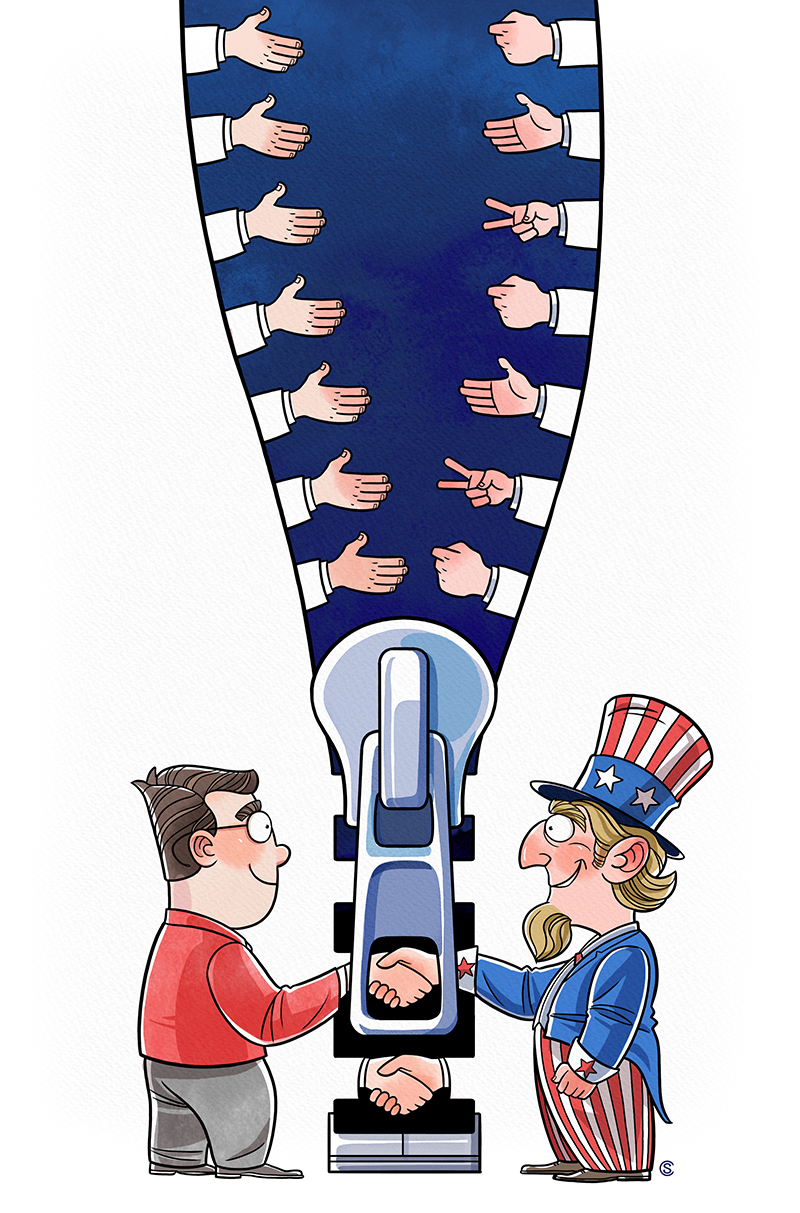
Call it the "Truce of Osaka". Presidents Donald Trump and Xi Jinping agreed, as expected, on the sidelines of the G20 Summit in Osaka on Saturday to stand down from the escalation of economic conflict between the United States and China. That is certainly good news. While it beats the alternative of expanded tariffs and company-specific sanctions, it leaves one obvious unanswered question: what comes next?
Reading between the lines, three tentative answers emerge.
First, there appears to be a return to the negotiations framework that fell apart in early May. According to the Trump administration, this "bilateral plus structural" framework was fairly advanced-90 percent complete as per US Treasury Secretary Steven Mnuchin-and provides a reasonable template of what to expect once negotiations resume.
Here, "bilateral" refers to multi-year efforts to narrow the outsize merchandise trade imbalance, which totaled $419 billion in 2018, while "structural" refers to seven memorandums of understanding on systemic conflicts between the two nations. These memoranda will focus on tensions in agriculture, services, technology, intellectual property, technology transfer, non-tariff barriers.
The bilateral part of this framework is easy. Widely popularized as the "soybean strategy", it features a Chinese commitment, to purchase US agricultural products. According to President Trump, the US will quickly follow up with a "list of (other) things we want them to buy."
Bilateral solution can't fix US trade deficits
Two aspects of the bilateral trade approach are worth stressing. One, the "open wallet" approach has in the past been a fairly standard Chinese practice to address US trade and currency concerns. Two, the US has a multilateral trade problem: trade deficits with 102 nations in 2018, which cannot be fixed with a bilateral solution.
For a US economy that suffers from a chronic deficiency of domestic saving-a shortfall that will only worsen in the face of a widening federal budget deficit over the next decade-a China-centric bilateral effort will most likely backfire by shifting US imports to higher-cost foreign producers.
Bilateral solutions, though, are always inherently political. The "Truce of Osaka" is no exception in this regard.
The structural piece of this framework is a significantly tougher aspect of the US-China conflict to resolve, and the Osaka agreement doesn't offer much encouragement that a breakthrough is imminent. If anything, President Trump's statement that the "US does not feel rushed to do a deal" points to protracted negotiations over the multiplicity and complexity of structural issues that divide two very different systems.
The same conclusion can be drawn from a pre-Osaka Chinese white paper published on June 2, China's Position of the China-US Economic and Trade Consultations, which underscores that "China will not compromise on major issues of principle".
These issues include China's commitment to indigenous innovation, the important role played by State-owned enterprises, and the country's strategic focus on emerging industries such as artificial intelligence, fintech, e-commerce, and health science technologies.
This in mind, the conflict looks intractable. China's non-negotiable principles strike at the heart of what the Trump administration considers existential threats to America's future economic prosperity.
In the words of Trump's most hawkish China adviser, Peter Navarro, "China has targeted America's industries of the future… If China successfully captures these emerging industries, America will have no economic future." Structural conflict is therefore likely to endure well into the upcoming 2020 US presidential election campaign. This aspect of the conflict is both strategic and political for both sides, and Osaka did little to change this part of the calculus.
Case of Huawei hangs over the talks
The case of Huawei underscores a second conclusion from the "Truce of Osaka": industry-or company-specific sanctions are likely to remain an important tool in America's policy arsenal to deal with China. In his post-Osaka news conference, President Trump expressed great satisfaction in Mexico's new efforts at border security and stressed that without the threats of tariffs this progress wouldn't have occurred.
This illustrates how trade policy can be "weaponized", such as in the earlier case of ZTE or now with Huawei. While Trump conceded that US technology companies' concerns on supply-chain sourcing to Huawei may have played a role in this decision, he stressed that his options remain open.
By taking Huawei off the front burner for the time being, saving the issue until the "very end" of these negotiations, the threat of an ever-present use of tariffs or sanctions hangs over the US-China conflict.
One of the last questions in President Trump's post-Osaka news conference focused on an issue I have long written about: the nature of the US-China relationship (see my 2014 book, Unbalanced the Codependency of America and China).
Trump endorsed the idea that China and the US could be "strategic partners", stressing the two nations can be "great for each other"-provided, of course that America's openness is matched by China.
Significantly, President Xi at the G20 Summit addressed this issue in an earlier speech, which highlighted a new set of initiatives in this area. These included China's new Foreign Investment Law, an updated negative list that narrows trade barriers in agriculture, mining, manufacturing, and services, six new free trade zones, and tariff reductions aimed at further encouraging imports.
Curiously, there were no follow-up questions to President Trump that asked him to react to China's latest initiatives-a missed opportunity for dialogue on a key issue dividing the two nations.
There were no major breakthroughs at Osaka. But it could have been a lot worse. Tariffs could have been increased and Huawei could have been squeezed further. While that didn't happen, the challenges ahead remain formidable, and the political considerations remain daunting for both sides.
Converting mistrust back into trust is an important first step on the road to a strategic partnership. The "Truce of Osaka" was a small step in that direction.
The author is former chairman of Morgan Stanley Asia and the firm's chief economist. He is now a senior fellow at Yale University's Jackson Institute for Global Affairs.
The views don't necessarily represent those of China Daily.