He takes on global killers









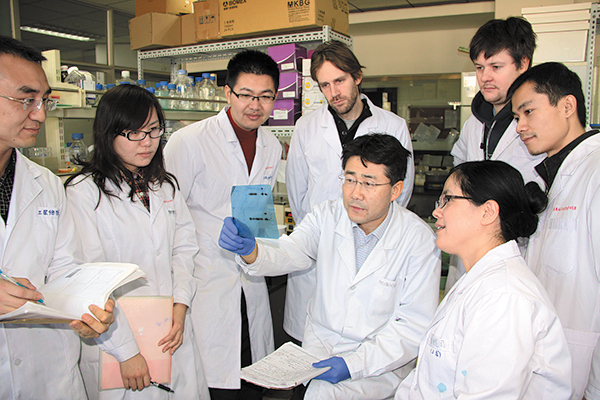
When it comes to fighting deadly viruses that have plagued the planet in recent years, China can count on Gao Fu, an academician at the Chinese Academy of Sciences, Li Yingxue reports.
Viruses like HIV, HPV, Ebola and Zika are only able to replicate themselves by hijacking the reproductive apparatus of cells and making them reproduce the virus' genetic structure instead.
Gao Fu, also known as George Gao, an academician at the Chinese Academy of Sciences, studies how viruses invade cells. By understanding how a virus and a cell, or an immune cell and an infected cell (that you would find in a tumor) interact - how they recognize and conduct a "dialogue" with one another - means that this communication can be interrupted and new therapy to prevent the targeting of healthy cells can be developed.
But the 57-year-old scientist jokes about his work, saying: "My study, on the surface, is superficial."
In April, Gao was elected as a foreign associate by the National Academy of Sciences in the United States, together with Professor Yan Ning, "in recognition of their distinguished and continuing achievements in original research".
His research interests include the molecular mechanism of inter-species transmission of pathogens, molecular virology and molecular immunology.
From vet to a doc
Growing up in Ying county, Shanxi province, Gao studied veterinary medicine at Shanxi Agricultural University from 1979 to 1983.
"But I never wanted to be a vet," says Gao.
Inspired by the story of French biologist Louis Pasteur, he decided to switch to microbiology for his postgraduate studies. So, from the second semester in his freshman year, Gao started to learn about microbiology by himself.
He completed his master's at Beijing Agricultural University and stayed on as a teaching assistant and lecturer in virology until 1991.
In the same year, Gao got the chance to study for his doctoral degree at Oxford University and did his post-doctorate work at both Oxford and Harvard universities.
Gao's parents had received little education, but his family has nine doctorates across different fields of study.
"My family was poor, and my parents had to raise six kids, but my mom insisted that all the siblings study," says Gao.
He returned to China in 2004, as a professor and director-general of the Institute of Microbiology at the Chinese Academy of Sciences. The reluctant vet had indeed changed course.
In 2013, the Middle East respiratory syndrome coronavirus began to spread, and within weeks Gao's team found out how it invades cells, which provided insights to develop a vaccine and an effective therapeutic agent.
In the same year, when H7N9 bird flu hit China, Gao's team figured out that poultry farms were the source of the avian influenza A(H7N9) virus.
According to Song Hao, who was Gao's doctoral student from 2011 and is now a member of Gao's team, Gao follows the news of all viruses in the world and is a stickler for detail.
"That's why we can react so fast when a virus starts to spread, because we begin researching the virus from the moment it appears," says Song.
On Sept 16, 2014, Gao led the 63-member China Mobile Laboratory Testing Team to the front line of the fight against the Ebola outbreak in Sierra Leone.
Two weeks after arriving, Gao got a fever. He could have been infected by Ebola, but Gao was not worried. From his experience, he estimated that there was a slim chance he was infected because of all the precautions he had taken.
He recovered a few days later, but the story was not revealed until four years later.
From September to November 2014, when Ebola was spreading in Sierra Leone, Gao led the team that monitored 1,635 blood samples and treated 274 patients.
Speaking about those days, Gao recalls that he once witnessed an Ebola-infected young man stumbling to his death on the street.
Gao's team discovered how the Ebola virus enters cells and infects humans, making a breakthrough in the battle against the virus. The research, published by the scientific journal Cell, provides a theoretical basis for the prevention and control of Ebola and offers a new direction for drug development.
"People like us who study infectious diseases are always on the front line of natural disasters, because the plague always comes after the disaster, and our duty is to prevent it," Gao says.
Additionally, Gao is either a foreign associate or corresponding fellow of numerous scientific bodies and medical organizations, including the Third World Academy of Sciences, the African Academy of Sciences, the American Academy of Microbiology, the European Molecular Biology Organization and the Royal Society of Edinburgh, among others.
Promoting science
As well as being a scientist, Gao has other duties. He is the director of the Chinese Center for Disease Control and Prevention (often referred to as the China CDC), the dean of the Savaid Medical School of the University of Chinese Academy of Sciences and the vice-president of the National Natural Science Foundation of China.
As to his multiple roles, Gao says: "Engaging in both science and management can help to understand and see things from microcosmic and macroscopic perspectives."
When Gao gives talks on management, he often uses an example from his microbiology research.
"Science builds logical relationships. So, you need to find the problem, design experiments and prove the problem," says Gao.
"Similarly, management also needs you to create logical relationships, through which we can make the work more efficient."
Managing the China CDC and the science foundation lets Gao see the public health issues from an international perspective and he also learns what's happening in his field around the world.
Gao uses his day for management and his night for lab work.
Before he sleeps, he walks 10,000 steps each day, and it is a time for him to think.
Popularization of science is also one of Gao's interests. In December, Gao and viral immunology specialist Liu Huan published a book titled Influenza Virus - An Unavoidable Enemy, which recounts the history and spread of the influenza virus.
"I've had the idea to write a book about the influenza virus for years, but I couldn't find a good writer to cooperate with," says Gao.
He once read a science article by Liu and realized that the author was the man he was looking for.
"He has the ability to turn science into stories, and I had the structure of how to introduce the virus to the public in my mind," says Gao, who worked with Liu for eight months to complete the book.
The book has sold 60,000 copies and is being printed for the sixth time.
Wang Longde, president of the Chinese Preventive Medicine Association, says that the book is not only about the flu and medical developments pertaining to it, but also popularizes scientific knowledge and looks at the future of public health.
Gao's latest book - a Chinese translation of The Creativity Crisis by Roberta Ness, a US expert in women's health research - was published in April.
Gao read the original book in 2015 and thought its discussion about creativity and caution in scientific study is a good guide for scientific and technological innovation in China.
"Chinese scientists are facing two problems - one is bottlenecks in core technology compared with the rest of the world, and the other is a lack of subversive technological change which is also a problem for the whole world," says Gao.
"So, the book can offer us some thoughts about how to solve these problems."
Last year marked the 100th anniversary of the 1918 influenza pandemic, also known as the Spanish flu, which infected 500 million people around the world and caused the death of nearly 5 percent of the world's population at the time.
During a symposium on the Spanish flu held in Shenzhen in November, Gao suggested World Flu Day to be observed on Nov 1 to build momentum for influenza control.
When Gao gave a speech recently at the graduation ceremony for the postgraduate students of the China CDC, he said that he hoped the students would not only work toward disease prevention and control, but would also help the public understand their work.
"Everybody must try to find his or her niche in society and in the world," says Gao.