



US soybean farmers hope to export more









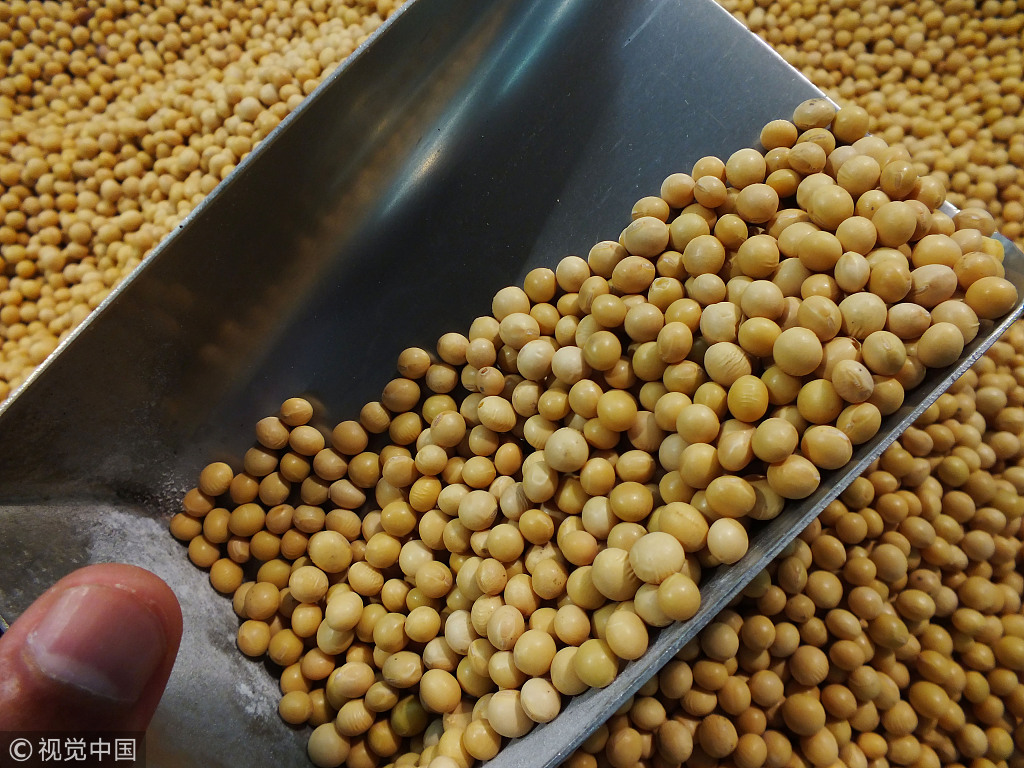
China tariff panel will review bids for relief, as sales have plunged during trade dispute
US soybean farmers are optimistic that a trade deal can be reached with China, but commodity futures were down in Monday's trading on the Chicago Board of Trade despite news that Beijing is exploring the resumption of purchases from American farmers.
China's Customs Tariff Commission will review applications filed by Chinese companies to waive tariffs filed by Chinese companies, the Xinhua News Agency reported. But world soybean supply remains high, and China's stockpiles are adequate, suggesting no immediate increase in sales for American farmers, according to analysts.
"I think both sides are putting in an effort to reach an agreement," West Higginbothom, a member of the Arkansas Soybean Promotion Board, told China Daily. "As a farmer, you have to be optimistic that both sides will come to the table and resolve the issue, and I think we'll see a positive outcome. I think we can reach a deal and become great trading partners in the future."
But a trader remained cautious.
"I don't think the announcement will have significant impact on soybean or corn prices because China doesn't need a lot of either. The market was underwhelmed by the news," Bryce Knorr, senior grain market analyst at Farm Futures in Chicago, told China Daily. "There are still burdensome supplies of soybeans around the world. China's announcement is unlikely to have a significant impact on soybean prices until the world supplies become more manageable."
Soybeans futures were down as much as 11.75 cents Monday. August soybean meal was down $2.60 a ton.
At the G20 meeting in Osaka, Japan, last month, US President Donald Trump and China's President Xi Jinping agreed to restart trade talks that had reached an impasse in May.
Trump said he would not impose new tariffs, and US officials said China agreed to purchase American agricultural products. On July 11, Trump said China had not followed through on what he said was its agreement to purchase US farm goods, but last week, Trump said US Treasury Secretary Steve Mnuchin had a productive meeting with his Chinese counterpart.
The world's two largest economies have been embroiled in a trade dispute since July 2018. Prior to then, China purchased about 60 percent of US soybean production in deals valued at about $12.4 billion.
In May, Trump raised tariffs on Chinese imports valued at $200 billion to 25 percent from 10 percent and threatened to impose tariffs on another $300 billion worth of goods.
China responded by imposing tariffs totaling $60 billion on US goods. The tit-for-tat has disrupted markets for cars, technology, consumer electronics, clothing and agriculture.
"I think anytime you see lifting of trade tensions after a long period of what can only be described as a trade war, the result will be positive," Knorr said. "We'll see how it plays out. Right now, China doesn't need a lot of corn, and it may not need a lot of soybeans."
China, the world's largest importer of soybeans, turned to Brazil after the US tariffs. But the protein content of Brazilian soybeans fell less than one percentage point in 2018, the government in Sao Paulo reported, and the country lost sales to China.
Brazilian food processor Caramuru Alimentos told Reuters earlier this month that it turned down a potential sale to China because it could not guarantee minimum protein levels demanded by the importer. That could benefit American farmers in the future.
To meet China's demand, US farmers shifted to soybeans from traditional crops such as wheat. Between 1995 and 2018, acres planted to soybeans increased 43 percent, while land planted to wheat fell 31 percent, according to the US Department of Agriculture.
Weather in the Midwest has been unusually hot and dry as a high-pressure system settled over the region last week, but the forecast calls for cooler temperatures and rain. That means there is unlikely to be long-term damage to the soybean crop.










