



Shanghai's STAR Market on steady path









Prices of stocks on new tech-focused board likely to diverge, say experts
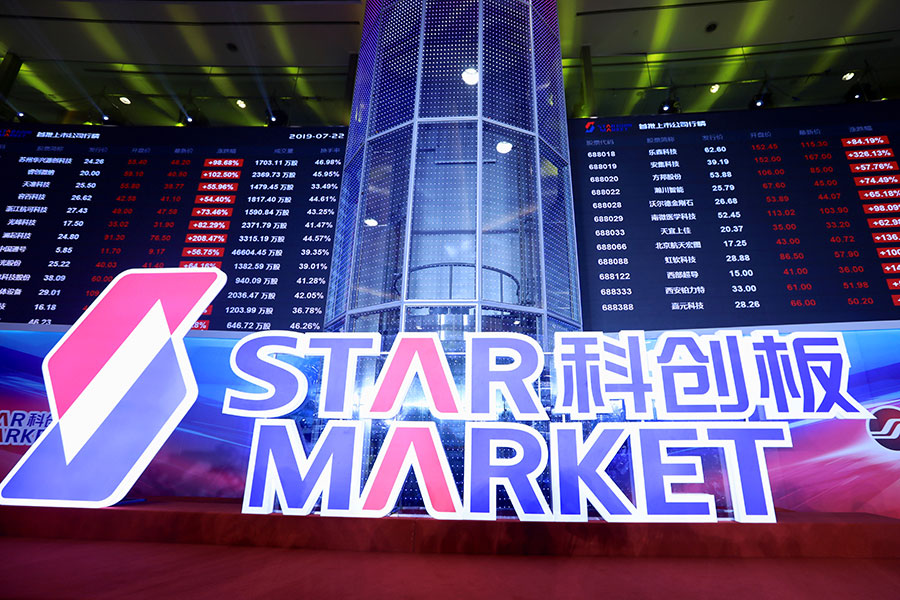
Stocks on Shanghai's STAR Market extended their gains on Thursday, and analysts said prices of stocks on the new tech-focused board may diverge with lower volatility in the near future.
The whole A-share market may be on an upward trend in the third quarter, they added, given fading concerns that the new board may strain the liquidity of other submarkets and the expected bottoming out of economic growth.
After a spectacular average gain of 140 percent on Monday and a retreat on Tuesday, the first 25 stocks on the STAR Market posted consecutive gains broadly in the following two trading days.
On Thursday, stocks on the STAR Market ended up by 5.5 percent on average, versus 11 percent on Wednesday, with 23 of them registering gains and three of them rising by more than 10 percent, according to financial information provider Wind Info.
The value of shares that changed hands on the new board was around 29 billion yuan ($4.2 billion) on Thursday, down from the more than 48 billion yuan on Monday.
"Trading of the STAR Market has been relatively rational, without signs of notable excessive speculation," said Wang Maobin, investment department chair at the University of International Business and Economics in Beijing.
Behind the stable debut of the new market are innovations in fundamental market rules, including enabling investors to short-sell stocks from their first trading day and the 10-minute halt of trading when intraday gains or losses hit 30 percent and 60 percent, according to Wang.
President Xi Jinping announced in November that China would launch the new tech board and pilot the registration-based initial public offering system. In a high-profile meeting in February, Xi called for improvements in the fundamental rules of capital markets.
The STAR Market has been seen as the testing ground of capital market reforms. No daily limit of stock price rises or losses was imposed on the first five trading days, and after that a 20-percent daily limit was adopted, versus a 10-percent limit for other boards of the A-share market.
As the 20-percent daily limit is applied from next Monday and as investors understand more about the fundamentals of the listed stocks, the volatility of the new market is set to decrease, Wang said.
"Prices of stocks on the STAR Market are expected not to continue going up or down together but to diverge, as investors take a closer look at the listed firms' fundamentals, instead of regarding stocks on the new board as a whole," Wang said.
Li Daxiao, chief economist at Shenzhen-based Yingda Securities, said stocks of the new market may be overvalued as investors chased the small amount of listings on the new board, citing that the average price-to-earnings ratio, a common gauge of valuation, of the STAR Market has risen to more than 100.
But any bursting of a price bubble is unlikely to happen, Li said, as the number of listed firms will not increase sharply.
Although the new board may draw funds from the other submarkets, it is unlikely to weigh on the performance of the whole A-share market in the third quarter, Li added.
"The actual impact of draining liquidity is limited, but it was the uncertainty that took a toll on investor sentiment. With the smooth debut of the STAR Market, such concerns will gradually disappear," Li said.
The whole A-share market may rally in the third quarter, given expectations of the accommodative monetary environment, the influx of foreign capital, and the recovery in listed firms' financial performances as the economy stabilizes, according to Li.
On Thursday, the benchmark Shanghai Composite Index gained 0.48 percent to 2937.36 points, while the blue-chip CSI300 index rose 0.82 percent to 3851.07 points.




















