Time to redefine shared responsibilities









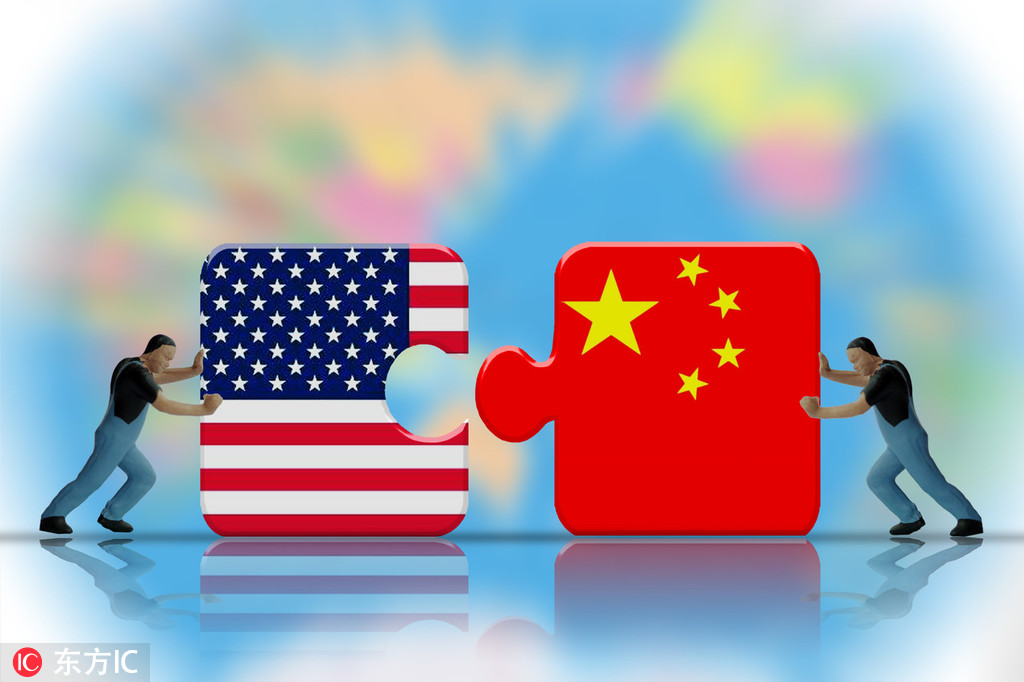
Sino-US relations have reached a crossroad. Economic and trade bonds that in the past served as the ballast in bilateral relations have now become a major source of tension. Although China and the US have resumed the trade talks, overall bilateral relations in the past few years have been defined by growing distrust and sometimes open hostility.
Many in the United States now believe China is a "revisionist power" challenging the US-led world order. Quite a number of US observers assume Washington's policy of "engagement" has failed and therefore it needs to change course before it is "too late". Some extreme views even call for decoupling the Chinese and US economies.
Policy to divert attention from US' internal issues
Although there has been no change in Beijing's policy toward Washington, except for some general statements urging strategic patience amid growing tensions, a prevailing view is that China has to prepare for a hostile US in the way of its peaceful rise. Some Chinese strategists even believe the recent US policy shift is the byproduct of the superpower's strategy of diverting attention from growing internal problems such as economic stress and social unrest by overstating the threats from outside forces.
These strategists argue against a tit-for-tat response. Other Chinese strategists, who call for more forceful countermeasures, have no illusions about the US abandoning its containment policy and see a reigning power challenging a rising power as something inevitable.
It seems Sino-US relations have reached a point of no return. Yet we still don't know where the growing strategic competition will take us. A war between China and the US is inconceivable. But in an atmosphere of growing suspicion and anxiety, competition in trade, and science and technology has risen to new heights, feeding the speculation that Beijing and Washington are already locked in a new cold war.
Ties should not be viewed through prism of hegemony
It would be a serious misreading of reality if we were to view the current bilateral relationship through the prism of hegemonic contest or ideological rivalry. We would be equally wrong to see it as clash of civilizations. Mega-trends such as increasing globalization and multi-polarization mean China and the US are part of a highly interdependent, interconnected, and yet an increasingly vulnerable, global economic system. While partial separation of the US and China in trade and technology may be possible, outright decoupling would be catastrophic for not only both countries but also the global economy as a whole.
A source of some comfort, however, is the Osaka G20 Summit. Leaders of major economies pledged to deepen cooperation to promote global economic growth and agreed to work together to build a free, fair, non-discriminatory, transparent, stable and predictable environment for trade and investment. They also reaffirmed their commitment to innovation in the digital economy to achieve sustainable global growth.
Policy coordination needed in three areas
As for China and the US, they need to coordinate their policies in at least three areas to ensure they can work with other stakeholders to protect the global economy from a variety of risks and disruptive forces.
First, they must take measures to mitigate the potentially huge impact of digital innovations on the global financial and monetary systems. The G20 Osaka Leaders' Declaration calls for monitoring the developments related to crypto-assets and urges vigilance against existing and emerging risks. For example, as Chris Hughes, co-founder of Facebook, said in a recent article in the Financial Times, if Libra-a new cryptocurrency designed to be used to send money across the world-is successful, it may shift power from developing countries' central banks to multinational corporations. This would undermine developing countries' authority over national finance and economy, and potentially disrupt the entire global financial system.
Major economies, including the US and China, cannot afford to adopt a wait-and-watch approach. Central banks and international financial institutions such as the International Monetary Fund must take action now to strengthen regulation and monitoring to prevent systemic crises which such technological innovations could create.
Strike balance between cooperation and security
Second, the two largest economies must strike a balance between science and technology cooperation and national security concerns. The history of the development of science and technology shows that human capacity for information generation determines our ability to harness different forms of energy, and is one of the most important drivers of civilization's progress.
According to Chinese government data, Sino-US science and technology cooperation produced 55,000 academic papers in 2014, up from 5,000 in 2000, and Sino-US joint science and technology programs increased more than 80 percent between 2012 and 2015. A major theme of the Osaka G20 Summit was how to promote rule-making efforts to ensure the free and orderly flow of data, especially amid growing concerns over balancing information freedom and national security.
As two leading forces propelling the development of science and technology, China and the US share the responsibility of helping foster a global consensus on a redefined balance between advancing scientific and technological knowledge through cooperation on the one hand, and safeguarding national security on the other. It is also in their common interest to prevent unjustified disruptions in the flow of information and ideas that may halt the progress of science and technology and compromise human welfare.
Unilateralism is growing concern for the world
Third, China and the US must manage the risks the weaponization of international finance and trade will give rise to. Concerns are growing over excessive unilateralism: economic sanctions, punitive tariffs, and trade restrictions. The frequent use of long-arm jurisdiction over third-party economic activities is also troubling.
The growing use of financial and monetary policies as weapons will undermine the public's confidence in the stability and predictability of the global financial and trading systems. How can governments reduce the risks and prevent the abuse of the "financial weapon of mass disruption"? International leaders need to seriously consider these issues and desist from using any "financial weapons", and instead strengthen regulations and oversight.
At this critical juncture in Sino-US relations, we can overcome the zero-sum model of competition only by re-identifying our common interests and challenges, and redefining our shared responsibilities to build a stable world economy.
The author is president of Shanghai Institutes for International Studies.
Courtesy: chinausfocus.com
The views don't necessarily represent those of China Daily.