New Long March resists challenges









A couple of months ago, while touring Jiangxi province, President Xi Jinping made reference to an old revolutionary milestone. "Now there is a new Long March, and we should make a new start," he said in response to China's mounting economic conflict with the United States.
In China, symbolism is often more important than literal interpretation of leaders' elliptical statements. Spoken in the same province where the Long March commenced in 1934, which ultimately led to the Communist Party of China's victory over Kuomintang 15 years later, Xi's reminder underscored China's greatest strength: the long view.
Slowing growth not source of fear
That strength was on display during my latest visit to China in early July. In a series of wide-ranging meetings and discussions, three conclusions stood out. Each challenges the US' bipartisan demonization of China.
First, slowing growth is not the source of fear for China's leaders that many Western policymakers seem to think it is. Yes, in historical perspective, the last GDP report was weak: quarterly growth was the slowest since the current statistical reporting system was adopted in 1992, and even worse than that recorded a decade ago, in the depths of the global financial crisis.
But the 6.2 percent rate for the second quarter of 2019 was a relatively mild deceleration of 0.5 percentage point from the relatively subdued 6.7 percent average pace of the previous eight quarters. By contrast, the slowing to 6.6 percent in the first quarter of 2009 was a far more abrupt deceleration of 5.5 percentage points from the average gain of 12.1 percent over the preceding eight quarters. A modest slowing is not a growth collapse by any stretch of the imagination.
That should not be surprising. China has more policy levers than growth headwinds. With ample room for further monetary easing, infrastructure spending and other forms of fiscal stimulus, Chinese authorities are far less concerned about a sudden growth accident than the US narrative would lead one to believe.
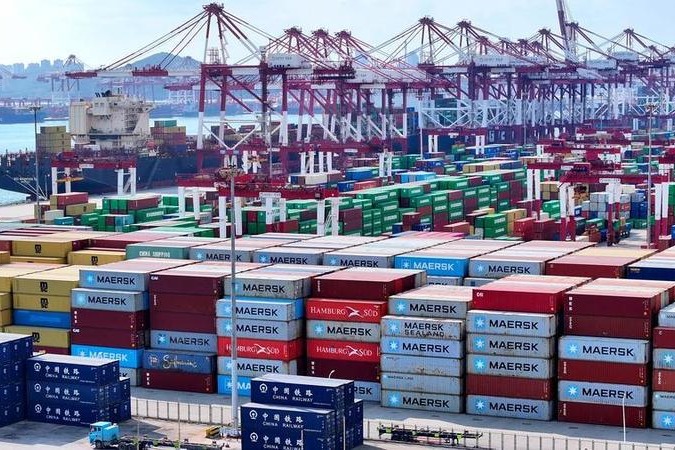
Moreover, Washington's fixation on who is winning the trade war overlooks a critically important structural shift in the Chinese economy. In 2018, net exports were just 0.8 percent of China's GDP, which represents a dramatic compression from a decade earlier, when net exports accounted for fully 7.5 percent of real GDP. While hardly an oasis in a weakening global economy, China is far less exposed to a trade shock today than it was back then. Even if it loses a trade war-a debatable proposition-the damage to China's overall economic growth would be minimal.
At the same time, the May 24 Baoshang Bank failure-a first for China in about 20 years-has triggered a worrisome outbreak of counter-party risk contagion. With bad debts ballooning in excess of 30 percent, this privately-owned Inner Mongolian mid-sized institution was apparently victimized by corrupt management. A well-coordinated takeover by China's financial regulators and the central bank appears to have contained the direct damage while sending an important moral hazard signal to undisciplined lenders. But the inter-bank borrowing market is still shaky, with spillovers to smaller banks, including those in rural areas. Ironically, China may be better able to manage trade risks than instability in its financial system.
China patient in dealing with external wildcards
The second conclusion that stood out from my recent discussions is that China is patient and methodical in dealing with external wildcards-especially US politics. Chinese officials are not about to bet on the 2020 US presidential election in formulating their strategic response to the trade conflict. Obviously, there is great interest in the outcome. But in keeping with Xi's Long March imagery, China's leadership is preparing for an enduring Cold-War-like confrontation, irrespective of who wins the election.
Significantly, many senior Chinese officials don't share the US consensus view that America's post-2020 China policy trajectory will stay its current course-irrespective of the outcome of the 2020 presidential election. Like many in the US, the Chinese find it difficult to deal with unpredictable, almost whimsical, shifts in tariffs and sanctions. Even if a new president were to remain tough on China, a coherent and well-articulated US strategy would be far more effective in framing the debate and offering hope for constructive resolution of grievances.
Third, Huawei is a big deal for China. The high-tech giant is perceived to be a national champion and emblematic of China's push toward indigenous innovation, which is central to its longer-term growth and development aspirations. By taking advantage of its "choke point" position in the Huawei supply chain, the US administration's China containment campaign is seen as seeking to stifle those aspirations.
There is no question that Huawei is feeling the heat as Washington squeezes the supply chain by putting pressure on the US' leading suppliers of semiconductor chips, other components, and software-companies such as AMD, IBM, Marvell, Intel, Google and Microsoft. According to Huawei's management, the company's earnings this year and next will be about $30 billion below projections.
While senior US officials have sent mixed signals about relaxing restrictions on Huawei, the weaponization of US trade policy has sent a clear message to China: the need to address the supply-chain vulnerability of its leading-edge technology companies is now a top policy priority.
The conventional wisdom in the West is that China will need 10 years to build a domestic chip and software industry that could fill the void created by US restrictions. The Chinese I spoke with in early July felt that the gap could be closed much sooner, possibly within two years. If anything, the US administration's threats against Huawei have served as a wake-up call to Xi's "self-reliance" campaign. The US choke-hold could be surprisingly short-lived.
Time and again, the long view in China has stood in sharp contrast to the US' short-term approach. Needless to say, this has become all the more evident during the past two and a half years of the White House's Twitter-driven policy gambits. One senior Chinese policymaker actually admitted to checking the White House's Twitter feed each morning. No surprise there. Sun Tzu put it best in his ancient treatise, The Art of War: "If you know the enemy and know yourself, you need not fear the results of a hundred battles."
The author, a faculty member at Yale University and former chairman of Morgan Stanley Asia, is the author of Unbalanced: The Codependency of American and China.
Project Syndicate
The views don't necessarily represent those of China Daily.