Peer influence among factors blamed in HK









Analysts also point to outside interference and radicals, say dialogue can break deadlock
As Hong Kong's chief executive announced the immediate creation of a platform for dialogue with the city's people, analysts reflected on how protests since mid-June had entered a downward spiral, blaming in part peer pressure, instigation by a small group of radicals, and outside influence.
One expert said dialogue will help solve the situation but will be a difficult task.
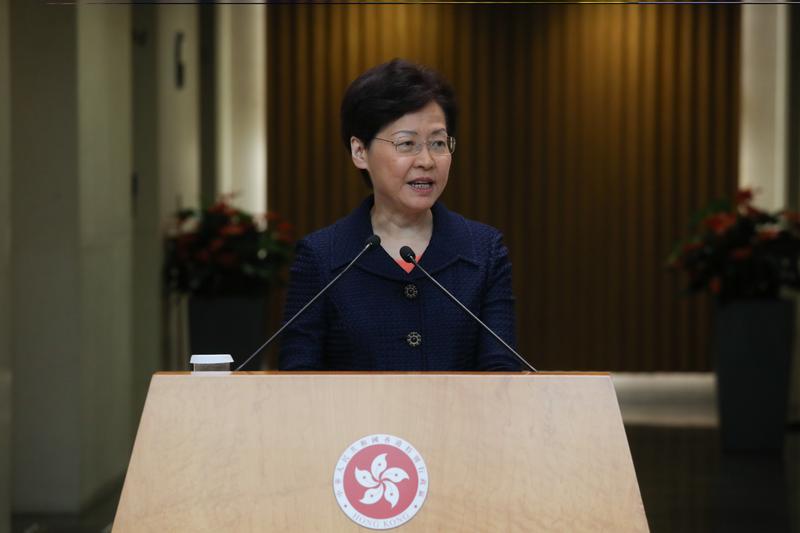
Carrie Lam Cheng Yuet-ngor, chief executive of the Hong Kong Special Administrative Region, said on Tuesday that she hoped dialogue "can be built upon a basis of mutual understanding and respect to find a way out for Hong Kong." She made the remark to reporters ahead of Tuesday's regular Executive Council meeting.
Over the past three months, demonstrations in Hong Kong have evolved from protesters marching through the streets to groups of radicals in hard hats storming the Legislative Council complex and shutting down the city's international airport for two days.
The protests that began in mid-June were sparked by opposition to a now shelved bill amending the city's extradition laws.
In February, Hong Kong's Security Bureau proposed an amendment to extradition laws that would allow fugitives to be extradited between Hong Kong and Taiwan, in response to a case in which a Hong Kong resident killed his girlfriend in Taiwan and returned to the city to escape prosecution on the island.
The legislation would give Hong Kong the power to enter one-time agreements with places like the mainland and Taiwan to transfer criminal suspects.
Ahead of the second reading of the bill in the Legislative Council, the protests escalated.
On June 15, Hong Kong leader Lam suspended the bill. The next day, Lam apologized and offered to "accept all criticism" and "serve the public".
But the demonstrations did not stop.
Paul Yeung, a Hong Kong-based researcher and commentator on public policy, said the protests against the extradition bill have morphed into demonstrations against the local government's manner of responding to public opinion. Thus the protests are continuing, though the bill has been declared "dead", he said.
Some observers say many young people who took to the streets were merely affected by peer influence, instigated by a small number of radicals, and lost their critical thinking and simply followed.
Yeung said another factor leading to the situation in Hong Kong is that the government has failed to respond in a timely manner to young people's aspirations and sentiments throughout the process.
He said channels that the Hong Kong government is to establish to communicate with local people can help break the city's current deadlock.
But he said it will be a difficult task, given the tense social atmosphere. "It is imperative to restore peace and rationality to society, with both sides showing a willingness to compromise before dialogue," he added.
Hong Kong was a British colony for more than 150 years, and part of it, Hong Kong Island, was ceded to the United Kingdom after a war in 1842. In 1898, China also leased the rest of Hong Kong-the New Territories-to the British for 99 years.
Hong Kong returned to China in 1997, under the principle of "one country, two systems", which means Hong Kong is part of China and enjoys a high degree of autonomy, except in foreign and defense affairs, as stipulated by Hong Kong's Basic Law.
Hong Kong's leader, the chief executive, is currently elected by a 1,200-member election committee.
Zheng Yongnian, research professor at the East Asian Institute of National University of Singapore, in a piece published by Singaporean newspaper Lianhe Zaobao, said Hong Kong is a wealthy city with middle-class people accounting for the majority of its population. Relatively speaking, they are rational, so it is striking that the demonstrations have turned violent in Hong Kong, Zheng said.
While maintaining the "one country, two systems" arrangement, the mainland has not become actively involved in Hong Kong affairs, as the West has said, Zheng said, but the mainland has instead been transferring gains to Hong Kong so as to help it prosper.
Because Hong Kong is an international city, it is not uncommon for foreign elements there to get involved in local issues, he wrote. As long as Hong Kong is open, these foreign elements will try hard to influence the city's development, Zheng added, saying, "This is the reality."
Whether the Hong Kong government can check the negative impact of foreign elements is of grave concern, Zheng wrote.
Lau Siu-kai, vice-president of the Chinese Association of Hong Kong and Macao Studies, the nation's leading think tank on Hong Kong affairs, said anti-China forces in the United States, its Western allies and Taiwan have colluded with Hong Kong's opposition camp and other local activists. They have taken every chance to destabilize the city in a bid to pressure the Hong Kong government, Lau said.
"Their ultimate goal is to contain China and threaten its national security," he added.
The influence from Taiwan is evident, Lau said. Media reports said dozens of Hong Kong protesters have fled to Taiwan to seek "political asylum". On Monday, the Taiwan Affairs Office of the State Council warned the Democratic Progressive Party of Taiwan to stop harboring violent Hong Kong activists who are fleeing arrest.
In an article published in the South China Morning Post, Wang Xiangwei, once the newspaper's editor in chief, wrote that "the 'grey rhino' risks long associated with Hong Kong-sky-high property prices, worsening inequality, lack of social mobility for youth, and woefully underfunded social security have underpinned waves of anti-government demonstrations over the past two decades".
He recommended that the Hong Kong government take steps to ensure land supply for public housing, raise the minimum wage and create more well-paying jobs to improve social mobility for young people.
The Hong Kong government has announced extra budget measures valued at HK$19.1 billion ($2.4 billion), including relief for small businesses, more student subsidies and benefits for low-income households.
Chief Executive Lam is expected to give a policy address in October, which is likely to include more enhancements, Wang said.
"First and foremost, Lam, with the support of Beijing, must break the stranglehold of local property tycoons on the real estate market and curb their political influence by greatly increasing land supply for development and providing more affordable housing for low-income families," Wang wrote.
"Hong Kong may pride itself as one of the freest economies in the world but, in fact, the property tycoons are calling the shots on the economy," he said.
"For better distribution of wealth," Wang suggested, "the government can also consider raising taxes on those making HK$2 million a year or more, and increasing taxes on property transactions valued at HK$10 million or more."
Zheng Yongnian of National University of Singapore noted that the mainland has taken the initiative to adjust its policy on Hong Kong, including the plan to build the Guangdong-Hong Kong-Macao Greater Bay Area.


- Deepening of Sino-Finnish ties stressed
- Over 7.3 million people recorded as registered organ donation volunteers in China
- China says Nipah outbreak poses limited risk
- PLA's aerobatic jets arrive in Singapore to take part in air show
- China's garbage sorting drive still has a long way to go in many cities
- Former Chengdu official Bao Hui under investigation