IMF: Tariffs won’t trim US-China trade deficit









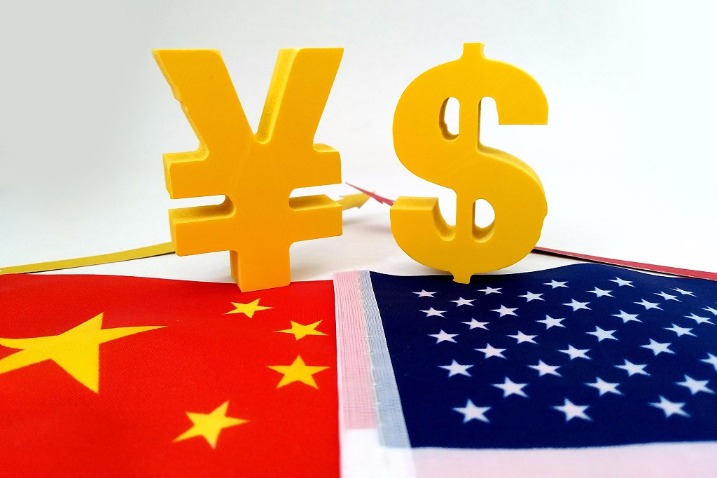
Escalating US tariffs on China will not fix the trade deficit nor will weaken the US dollar, International Monetary Fund economists said on Wednesday, as the Congressional Budget Office increased the gravity of the duties' projected effects on the country's economy.
"Higher bilateral tariffs are unlikely to reduce aggregate trade imbalances, as they mainly divert trade to other countries," IMF chief economist Gita Gopinath said in a blog "Taming the Currency Hype", co-authored by fellow IMF researchers Gustavo Adler and Luis Cubeddu.
"Instead, they are likely to harm both domestic and global growth by sapping business confidence and investment and disrupting global supply chains, while raising costs for producers and consumers."
The US administration has escalated tariffs on imports from China since early 2018, slapping 25 percent duties on $250 billion worth of Chinese goods by now, with much of the remaining $300 billion in imports targeted for new tariffs in two additional rounds scheduled for Sept 1 and Dec 15.
Meanwhile, though President Donald Trump has said the United States is "very far from a recession" as recent market activity suggested, he has called for the Federal Reserve to cut the interest rate by a full point to help the economy and weaken the US dollar.
In the blog, the IMF economists said measures such as imposing tariffs on imports from countries deemed to have undervalued currencies or weakening a country's own currency are "counterproductive policy options".
"One might think that the impact of higher tariffs on imports from China would be offset by the stronger dollar, because as the US currency strengthens, Chinese goods should become cheaper," they said. "But in reality… US importers and consumers are bearing the burden of the tariffs."
The IMF said in May that the ratcheting up of bilateral tariffs between the US and China has had limited effect on their bilateral trade balance.
Instead, macroeconomic factors — including relative aggregate demand and supply in partner countries and their underlying drivers — play a much bigger role than tariffs in determining bilateral trade balances, it said.
In Wednesday's blog, the IMF economists warned that "one should not put too much stock in the view that easing monetary policy can weaken a country's currency enough to bring a lasting improvement in its trade balance through expenditure switching".
"Monetary policy alone is unlikely to induce the large and persistent devaluations that are needed to bring that result … especially within a 12-month period," they said.
Also on Wednesday, the Congressional Budget Office, a nonpartisan agency that produces analyses for the Congress, said in a new report that Trump's tariffs are projected to shrink the US economy by 2020 by a larger margin than it estimated earlier, and further tariff hikes could stifle economic growth.
The agency expects the changes in US and foreign trade policies since January 2018 to reduce the level of real US GDP by about 0.3 percent by 2020, 0.1 percentage point more than the agency expected earlier this year, according to the agency's report "An Update to the Budget and Economic Outlook: 2019 to 2029".
"Tariffs reduce domestic GDP chiefly by raising domestic prices, which reduces the purchasing power of US consumers and increases the cost of business investment," it said. "In CBO's projections, the tariffs also reduce real income for the average US household by 0.4 percent by 2020."
In particular, real investment is now expected to be 1.3 percent lower by 2020 in response to the tariffs, compared with 0.4 percent lower in CBO's January projections, according to the report.
"The larger projected reduction in investment also reflects recent studies showing that a larger share of the cost of the tariffs than previously estimated is passed along to US importers," it said.