



1970s ping-pong did produce a diplomat









The curtain went down. The spotlight was on. Jan Berris, whose hair was in two braids to match her Chinese counterpart, walked briskly onto the stage of the auditorium to announce the next program. The audience waited with bated breath, having just been delighted by a riotous lion's dance.
It was December 1972 in Chicago. The Shenyang Acrobatic Troupe from northeastern China was touring the US. And the braids, most popular among Chinese young women at the time, were meant to be a nod to the guests.
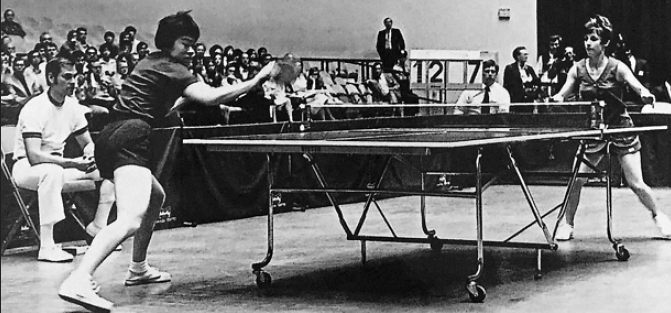
Barely eight months before, the Chinese Table Tennis Team had come to the states, touring and playing friendly matches with their US counterparts. The visit itself was reciprocal because in April the previous year, the US Table Tennis Team had been invited to visit China, the first American delegation since 1949.
Dubbed "ping-pong diplomacy", these mutual gestures symbolized a thaw in what was once seen as a perennially frozen bilateral relationship.
In a fateful twist of events, the games also set Berris, a promising young diplomat stationed in the US consulate in Hong Kong, on a different career path. Berris is today the vice-president of the New York-based National Committee on US-China Relations, a nonprofit organization founded by those who saw "the potentials not the limitations" in the two countries' futures.
"In June 1971, I was invited by a former professor of mine who was the chairman of the National Committee to join the organization and help prepare for the coming visit of the Chinese ping-pong team," said Berris, who was with the Chinese players during their entire stay in the US.
"That trip was so successful that the Chinese decided to send the acrobatics. Chicago was their first stop," said Berris, the project's coordinator, who also found time to be part of the troupe's performance as the stage announcer. "There I was, announcing the second act when all of a sudden I saw, out of the corner of my eye, that one of our security officers was running to the back of the auditorium. The bright stage lights were on so I couldn't see clearly, but I could tell that there was some sort of commotion. The minute I walked off stage, I said to our stage director: 'Don't pull up the curtain.'"
It turned out that someone in the audience had thrown tear gas toward the stage ?a the auditorium, filled with the burning, acrid smell, had to be cleared and everyone had to get out.
"My National Committee colleagues and I went backstage to talk to the head of the Chinese delegation. We basically explained the situation and said: 'It's up to you as to whether you want to continue the show or not. If the answer is yes, we'll wait for an hour before bringing back the audience; if it's no, we'll just miss this one performance and will begin again tomorrow,'" recalled Berris. "After conferring briefly, they said: 'Yes, we want to do it.'"
"It was a freezing-cold night in Chicago, yet the majority of the audience chose to stay instead of going home and having their ticket money refunded," she continued. "When they were finally allowed back into the theater, there was only a faint whiff of the tear gas there. But it was a lot stronger up on the stage, where the acrobats were doing some very difficult tasks that required plenty of energy and therefore air into one's body. They got a lot of credit from the audience and the media which reported on it afterwards."
The incident, not entirely unexpected given all the "misperceptions the two people had harbored towards each other", nonetheless allowed Berris to see the commonalities.
"There's a phrase in the American theater: 'The show must go on.' The Chinese decision was very much in that flavor," said Berris, who has a BA in Chinese studies from the University of Michigan and whose Chinese name, Bai Lijuan, translates into "white jasmine".
However, this "jasmine" was no fragile flower, but a workaholic and multitasker who over the past half century has brought hundreds of Chinese delegations to the US, in addition to traveling to China more than 160 times, taking with her various groups from governors, mayors and a Supreme Court justice, to business leaders, scholars and tennis players.
"I was driven by a strong desire to bring people together," said Berris, who reputedly drove her staff crazy in those early days by insisting that they carry electric tea kettles so that the Chinese delegation members would always be able to have hot water in their rooms. She also went to great lengths to make sure that the hotel chef knew how to make xifan, or Chinese rice soup, the way the Chinese would like to have it, with no butter or salt.
In February, 1979, one month after China and the US normalized their relationship, Deng Xiaoping, the then vice-premier, visited a number of US cities. Berris was tasked by the State Department to coordinate Chinese press activities throughout the trip.
In Simonton, Texas, while watching a rodeo show, the Chinese leader symbolically donned a cowboy hat, wowing the world press that was present, including more than 30 journalists from China.
"It was a real surprise. … Deng had the intuition to sense what would play well for the American public, and had the confidence to do it, " said Berris, who was also responsible for organizing and running the 1980 delegation of provincial leaders to the United States, headed by Xi Zhongxun, the late father of Chinese President Xi Jinping, and then governor of Guangdong province.
"He was a very thoughtful man," said Berris, who calls herself "a stronger believer in engagement and exchanges", and who, at a farewell party at the end of Deng's visit, arranged for a Chinese journalist to sing the song Getting to Know You from the 1950s American musical film The King and I, joined on stage by the American security personnel involved in the landmark visit.
"Up till recently, there have always been people on both sides who felt that a strong, stable relationship between the two countries was paramount," she said. "Unfortunately, that coalition is fraying, and the relationship, at least on the governmental level, is spiraling downward at a dizzying rate. But I still believe in the importance of the relationship and that there are things that both sides could and should do.
"What we are trying to do here at the National Committee is to work against this narrative that has somehow grown up, that engagement has been counterproductive and has not been positive for the United States," she said. "Engagement is essential for all of us. It must be done in a reciprocal, mutually beneficial and constructive way. But this idea of decoupling, of minimizing the amount of contact between the two peoples, is a path toward disaster."
Talking about the Chinese ping-pong players of the 1972 visit, Berris said: "They didn't conform to Americans' image of Communists, they didn't act like that. They were fun, playful, just as enthusiastic as any group of young people might be."
When it was time to say goodbye, Berris found herself futilely fighting back tears, despite the presence of a big swarm of reporters.
"The next year, when I visited China, people would come up to me and say: 'Are you that crying girl?'"










