Elderly care boosts 'silver economy'









BEIJING - Traveling has become an indispensable part of the life of Zhang Xuemin, a 66-year-old retiree. Having already made two trips this year - one to Taiwan and the other to Shanxi - he is now planning another tour.
After retiring from a factory in Beijing, Zhang and his wife spent 30,000 yuan (about $4,241) to 40,000 yuan each year on traveling. Their annual pensions add up to about 72,000 yuan.
"We don't worry too much about spending money on things we want, because we have pensions and medical insurance, which make us feel secure," said Zhang.
China's senior citizens like Zhang are behind the development of the "silver economy" in the rapidly aging country as the government attaches greater importance to elderly care.
"As we respond proactively to population aging, we will adopt policies and foster a social environment in which senior citizens are respected, cared for, and live happily in their later years," Xi Jinping, general secretary of the Communist Party of China Central Committee, has said. "We will provide integrated elderly care and medical services, and accelerate the development of old-age programs and industries."
Under Xi's leadership, the country has seen a raft of measures put in place in the past few years to meet the stronger demand for elderly care and improve the quality of life of its seniors.
By the end of 2018, China had a population of 249 million aged 60 or above, larger than any other country and accounting for 17.9 percent of the national population.
Official estimates show the number is expected to peak at 487 million around 2050, or over a third of the total population.
As part of its efforts to address the challenge of old-age care, China has raised the basic pension for retirees from enterprises, government agencies and public institutions for 15 consecutive years.
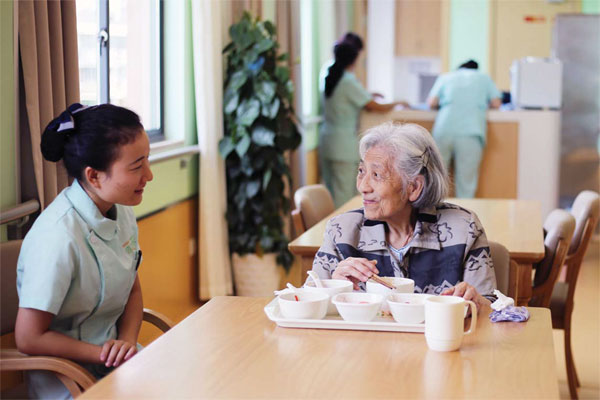
It has also stepped up the supply of nursing homes, eased market access for private and foreign investors, and offered tax exemptions on community-based elderly care services.
By the end of 2018, China had 163,800 elderly care institutions and facilities, nearly half of which were built with private investment, offering 7.46 million beds for senior citizens. Community-based services and facilities covered all urban areas and over half of rural communities.
Enterprises are moving fast to tap into the potential demand. Taikang Insurance Group, one of the country's major insurers, has invested in and put elderly care institutions into operation in four cities, including Beijing and Shanghai. China Life, another major insurer, has similar projects.
The market space is broad. China's elderly care industries are expected to have a market value of 7.7 trillion yuan in 2020 and 22.3 trillion yuan in 2030, according to estimates from the Qianzhan Industry Research Institute.
"As the aging process accelerates and people's lives continue to improve, high-quality elderly care services are needed more than ever," said a research report released by Guolian Securities.
Compared with staying in nursing homes, over 84 percent of Chinese senior citizens prefer to stay at home and receive elderly-care services in their own communities, according to a research jointly carried out by a national association, the China Research Center on Aging, and internet company Tencent.
The old-age industries have expanded fast and attracted a large amount of social capital, but there should be a more effective supply of targeted and customized services and products, said Wang Lili, a researcher with the CRCA.
Zhu Leishu, 86, has a voice-activated alarm connected with a video camera installed in front of her television at home. If ever she calls for help, a community guidance center and her family members will be alerted.
"I used to worry about living alone. Now my family members and I are relieved, thanks to these smart devices," Zhu said.
Such smart elderly care facilities, emerging as a result of fast applications of internet technology, are forming a new area of business growth as they meet the demand of senior citizens living at home. The government plans to help develop over 100 leading enterprises in the smart health and elderly care industry by 2020.
The spread of digital technology has also brought a shift in senior citizens' consumption patterns, with more and more of them switching to online shopping.
The number of users aged 50 and above on Taobao and Tmall, online marketplaces of e-commerce giant Alibaba, had expanded 1.6 times over the previous three years, according to a report from Alibaba released in October 2018.
Seniors showed greater enthusiasm for buying smartphones, smartwatches and SLR cameras online than those aged between 45 and 60, said a report from online retail platform Suning.com.
Tourism is another sector to benefit. In 2018, those born in the 1950s spent the most on traveling among all age groups, with their average expenditure on a single package tour reaching 3,115 yuan, data from online travel agency Ctrip showed.
And some want more than package tours. Zhang, the Beijing retiree who has been traveling with agencies, plans to try a self-guided tour next time. "Traveling makes me feel young again," he said.