



Food Security in China









Editor's note: China's State Council Information Office on Monday issued a white paper titled "Food Security in China". Full text below:
Contents
Preamble
I. China's Achievements in Ensuring Food Security
II. Food Security in China
III. Opening Up and International Cooperation
IV. Prospects and Policies
Conclusion
Preamble
The people are the foundation of a country; food is the primary need of the people. As food decides national prosperity and the people's wellbeing, food security is a major prerequisite for national security. Since the founding of the People's Republic of China (PRC) in 1949, China has always prioritized food security in state governance. Despite a weak agricultural foundation and extreme poverty, the Communist Party of China (CPC) has led an unremitting campaign of hard work over the past 70 years that has made China basically self-sufficient in food supply. China now has enough food to feed its nearly 1.4 billion population, and has remarkably improved the people's nutrition and life quality. China's food security is a success of worldwide significance.
Since the CPC's 18th National Congress in 2012, the CPC Central Committee with Xi Jinping as its core has treated food security as a top state issue. The central leadership has introduced a food security policy of "ensuring basic self-sufficiency of grain and absolute security of staple food". The Chinese government has established a national strategy on food security featuring self-sufficiency based on domestic grain production, guaranteed food production capacity, moderate imports, and technological support. Abiding by the principle of basic food self-sufficiency based on domestic grain production, China practices the strictest farmland protection system and a strategy of sustainable farmland use and innovative application of agricultural technology to increase farmland productivity. Through supply-side structural reform and institutional innovation in agriculture, China has raised grain productivity, modernized grain circulation, improved food-supply structure, and achieved steady development in the grain industry. Step by step, China has established a food security guarantee system at a very high level characterized by quality, efficiency and sustainability. China's food security has a stronger guarantee, along a steadier and wider path with Chinese characteristics.
Food security is an essential guarantee for world peace and development, a significant foundation for a global community of shared future, and an influential factor for the development and future of humanity. As the world's largest developing country, and a major country that shoulders its responsibilities, China has always been a positive force in safeguarding world food security. China has been an active part of global food security governance, enhancing international exchanges and cooperation, supporting the multilateral trade system, and implementing the United Nations 2030 Agenda for Sustainable Development. In this sense, China has made a positive contribution to improving global food security and promoting common development.
The Chinese government is publishing this white paper to provide a full picture of how food security operates in China, in order to increase the international community's understanding in this important field.
I. China's Achievements in Ensuring Food Security
With one fifth of the world population, China accounts for a quarter of total global food production. China is self-reliant in securing its own food supply; its people now have not only enough to eat, but also a greater range of choices. Compared to past times when they were underfed, this historical change has been made possible by the Chinese themselves through hard work and development. It is also a key contribution to world food security.
1. Steady growth in food output
-Per capita food output remains above the world average. Currently China's per capita food output is around 470 kg, growing by 14 percent from 414 kg since 1996 when China published its first white paper on food-The Grain Issue in China, and by 126 percent from 209 kg in 1949, when the PRC was founded. This is higher than the world average.
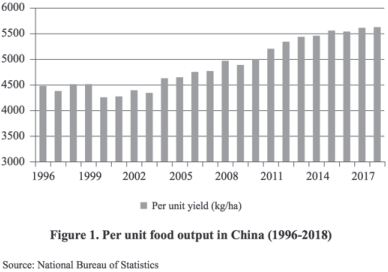
-Per unit yield has significantly increased. The average food yield per hectare is as follows:
? more than 5,000 kg in 2010;
? 5,621 kg in 2018, an increase of 1,138 kg, or 25 percent, over 1996.
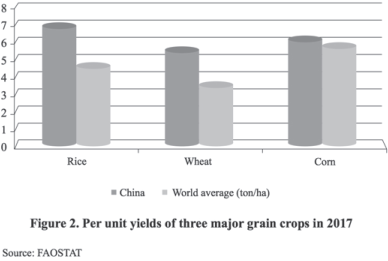
The yields per hectare for rice, wheat and corn in 2017 are as follows:
? 6,916.9 kg, up 11.3 percent over 1996, 50.1 percent higher than the world average;
? 5,481.2 kg, up 46.8 percent over 1996, 55.2 percent higher than the world average;
? 6,110.3 kg, up 17.4 percent over 1996, 6.2 percent higher than the world average.
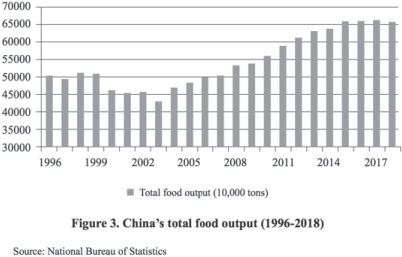
-Total food output has seen a steady increase. China's total food output surpassed
? 550 million tons in 2010,
? 600 million tons in 2012,
? 660 million tons in 2015,
? 650 million tons for four years from 2015.
In 2018 the figure was near 660 million tons, up 30 percent over 1996(500 million tons), the year China published its first white paper on food security, 116 percent over 1978 (300 million tons), the year of the launch of China's reform and opening up, and by nearly 600 percent over 1949 (110 million tons), the year the PRC was founded.
Over the years food output each year has fluctuated within a range of plus or minus 6 percent, with the exception of a few years.
2. Self-sufficiency in grain supply
-China is self-sufficient in grain supply. In 2018 the grain output was 610 million tons, accounting for more than 90 percent of total food output, and growing by 160 million tons over 1996. Currently China supplies 95 percent of its own needs for grain, laying down a solid material foundation for maintaining national food security, promoting socioeconomic development, and safeguarding long-term peace and stability.
-China ensures absolute security of staple grains. In 2001-2018, soybean accounted for 75.4 percent of imported grains, and the two main staple grains of rice and wheat together accounted for less than 6 percent. In recent years, with rice and wheat output meeting domestic needs, China is fully self-sufficient in food supply, and the main driver of food imports and exports is to satisfy the need for variety. China makes sure it relies on itself for food supply.
3. Greater food reserve capacity
-Food storage is further modernized. In 2018 the storage capacity of qualified grain warehouses was 670 million tons, and that of simple warehouses was 240 million tons. Total effective warehouse capacity grew by 31.9 percent over 1996. The total tank capacity for edible oils was 28 million tons, a sevenfold increase over 1996. China has built new modern grain storage facilities and renovated old ones, further increasing storage capacity. With the facilities' functions also improved, China has secured a continued increase in its food storage capacity, generally reaching world advanced levels.

-Logistics capacity has increased markedly. In 2017, the total volume of food transported reached 480 million tons, including 230 million tons of interprovincial transport. All major channels of food logistics have been integrated to form a multimodal transport network composed of highways, railways and waterways. Food logistics now involves more unprocessed grain, bulk grain, and finished grain products transported by container. The efficiency of food logistics has seen steady improvement.
-Grain reserves and emergency response systems are improving. The government has sufficient and quality food reserves, with secured storage. Emergency food reserves for 10-15 days are available in large and medium-sized cities and areas prone to price fluctuation. A network of emergency reserves, processing and distribution is in place, with outlets to supply sub-districts and communities in urban and rural areas. These play an important role in response to natural disasters such as earthquakes, sleet, snowstorms, and typhoons, as well as public emergencies.
4. Improved nutrition for residents
-More choices for meals. Per capita shares of various foods in 2018 and their increase over 1996 are as follows:
? oil, 24.7 kg, growing by 6.5 kg (35.7 percent up);
? pork, beef and mutton, 46.8 kg, growing by 16.6 kg (55 percent up);
? aquatic products, 46.4 kg, growing by 19.5 kg (72.5 percent up);
? milk, 22.1 kg, growing by 17 kg (333.3 percent up);
? vegetables, 505.1 kg, growing by 257.7 kg (104.2 percent up); and
? fruits, 184.4 kg, growing by 117.7 kg (176.5 percent up).


The per capita direct consumption of staple grains has decreased, and the consumption of non-grain foods such as meat and fish, ligneous foods, vegetables, and fruits has increased. The Chinese have more choices in what they eat and have a healthier diet.
-Improved nutrition. Data from the National Health Commission shows that the average daily energy intake of a standard person in China is 2,172 kcal, and the intakes of protein, fat and carbohydrate are 65g, 80g and 301g. Chinese citizens have an adequate supply of dietary energy, with sufficient intake of the three major nutrients-proteins, fat and carbohydrates. The proportion of carbohydrate intake has fallen, and those of fat and quality protein intake have risen.
5. Food for the poor
-Poor people in China no longer need to worry about food. The Chinese government has always attached great importance to eliminating hunger and poverty. Since the 18th National Congress of the CPC, in particular, it has explored ways to develop the rural economy, increase farmers' incomes, and eliminate hunger and poverty. Remarkable results have been achieved in targeted poverty alleviation and eradication. According to China's current poverty standards, as of the end of 2018 there remained 16.6 million people living in poverty in China. This represented a reduction of 82.39 million compared to 2012, and the incidence of poverty was down from 10.2 percent to 1.7 percent. The government has helped 750 million people out of poverty since 1978, when a staggering 770 million people were struggling for the means to live. According to the World Bank's poverty line of 1.9 US dollars per person per day, China has contributed more than 70 percent of the global poverty reduction effort. China has lifted more people out of poverty than any other country, and is the first country to reach the poverty reduction goal in the UN's Millennium Development Goals.
-Nutrition for key groups in poverty has improved markedly. In 2018 the per capita disposable income of residents in impoverished rural areas reached 10,371 yuan, an actual increase of 1.7 percentage points higher than that of rural areas in general. This increase in income has enabled poor areas to acquire more food, and the intake of grains among poor groups has grown steadily. The government has carried out extensive nutrition improvement programs in poor areas for young students, infants, children, pregnant women, and the elderly, as a result of which there have been noticeable improvements in their nutrition and health.





