Climate change, 'faulty' farming hit beekeepers









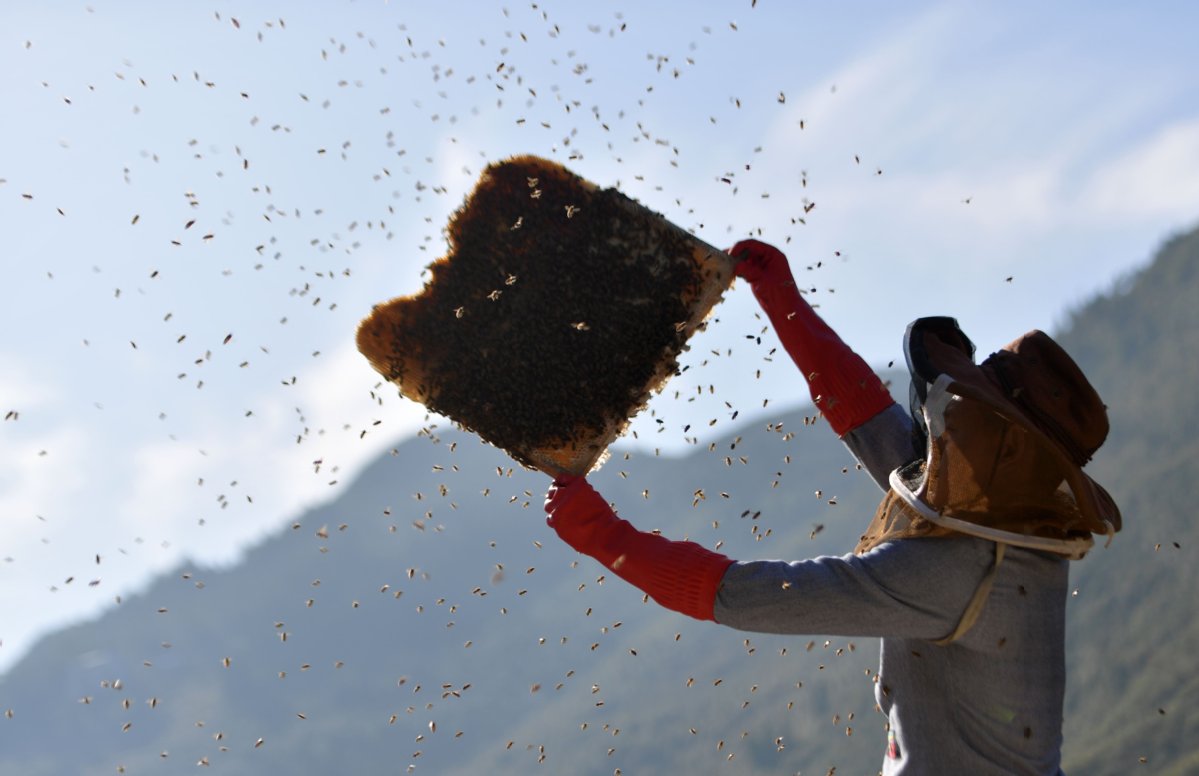
To cope with the challenges facing the apiculture industry worldwide, environmentalists recommend turning to other forms of pest control and educating farmers on better practices such as organic farming. Responses to climate change impact on bee colonies can also cover increasing crop diversity and better management of habitat conservation and restoration, they said.
"In many other places, such as the United States and Europe, people are giving more importance to bees and have taken measures to help them flourish," Hou Chunsheng said.
"Although more and more people are growing increasingly conscious of the ecological function of bees, most people in China are still unaware of the importance of the insects. Besides producing honey, bees are vital to biodiversity. For example, many plants cannot bear fruit without pollination by bees, which will result in the starvation of many kinds of wild animals that feed only on fruits."
"To cope with diseases which threaten the survival of bees, authorities should carry out more disease prevention and control measures on bees raised for commercial use. For example, authorities should conduct inspections on bee colonies before they are transferred to another area to be raised or to forage, so that the colonies with diseases will not move to other areas and spread those diseases," Hou said.
Thankfully for many apiculturists, there are some bright spots appearing among the bee colonies in China.
"There are two major species of raised bees in China, the indigenous species and a species introduced from Italy. The latter has dominated bee colonies in some places, but in recent years many places, especially more remote areas, have seen an increasing number of farmers raising the indigenous species, because it is more adapted to the local environment and can forage on some plants that the Italian species cannot," Hou said.
In many underdeveloped areas in the country's central and western areas, local governments have been encouraging farmers to raise bees for honey, which has become an important means of poverty alleviation," he said. "As a result, beekeeping has contributed to the protection of bees in many places and many bee colonies have remained stable and even grown."
Zhang Qiang, a veteran apiculturist who helps train other beekeepers in the capital's Miyun district, said that the bees are soldiering on but more can be done to support the cottage industry in the area.
"It's not just concerns about changes in the natural environment affecting the bees," said Zhang, 53, who has been rearing honeybees for more than three decades. "Beekeeping is hard work and most of us in these parts do it to make ends meet. Training more people and getting them interested can help grow the sector to meet demand."
To that effect, Xu Xiang, another researcher at the Institute of Apicultural Research, said technical guidance and training are being offered to beekeepers in 22 counties and cities in the rural areas of China in recent years as part of the poverty alleviation measures.
"Many mountainous areas boast well-preserved natural environments and ecologies, and are suitable for beekeeping. Raising bees require less investment and cost, and is environmentally friendly; it has become an important industry in many impoverished areas, such as Longnan in Gansu province, and Ningshan in Shaanxi province," Xu said.
"Many villagers in these areas have actually significantly increased their income by selling the honey produced by their bees in big cities via e-commerce platforms."
Beijing housewife Cheng Lihui, who buys a mix of imported and domestic honey products regularly for her family members, said she often picks up tubs of the local produce whenever they venture out to the suburbs.
"Honey is a healthy food on its own and a more natural choice than simple sugar as a sweetener. It is collected by bees, the bounty of the natural environment," she said.
"I hope our local beekeepers and their bees can successfully meet the challenges."