



LPR reform confirms domestic orientation of monetary policy









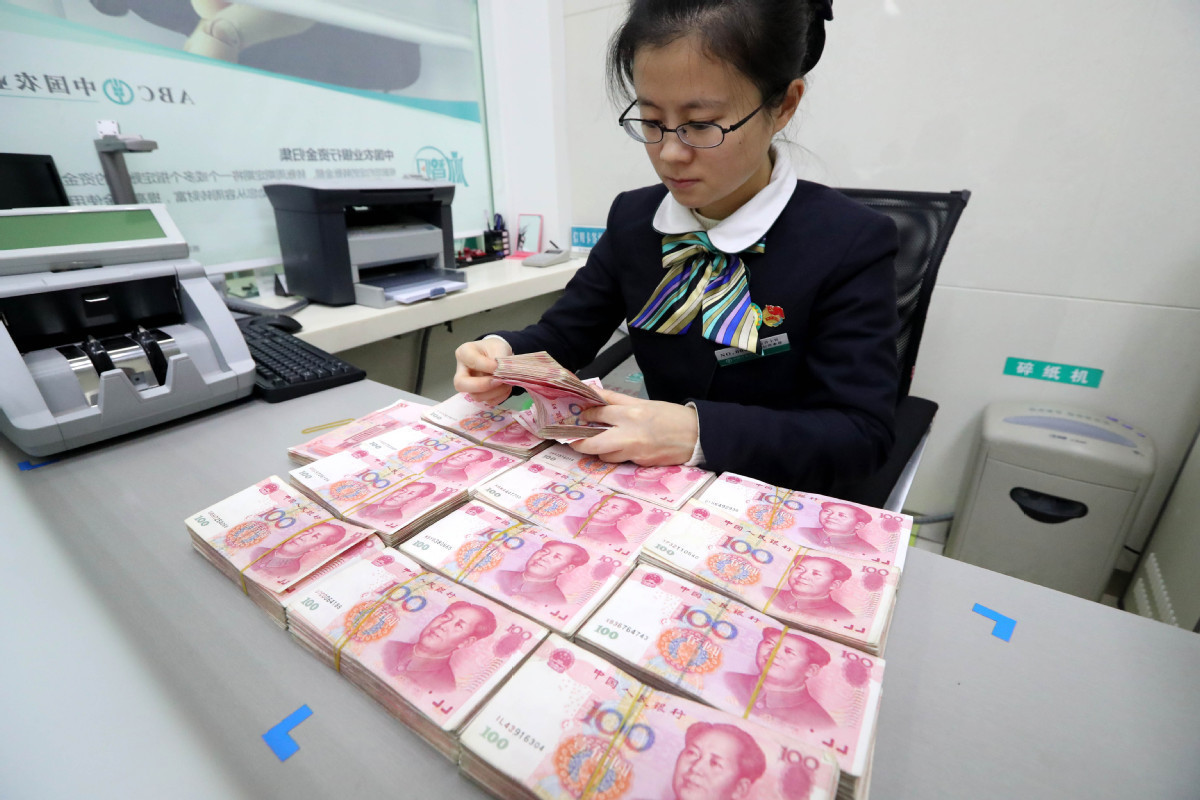
On Aug 17, the People's Bank of China, the central bank, announced it will re-benchmark the loan prime rate or LPR on the basis of one-year medium-term lending facility or MLF rate (previously on the basis of benchmark lending rate).
The LPR will be quoted on the 20th of each month. In August and September, the LPR was lowered by 6 basis points and 5 basis points, respectively. This was widely perceived as an important step forward in the interest rate liberalization, and also a new form of rate cuts.
The LPR reform is an important effort to address the interest rate segmentation problem - that is, the coexistence and divergence between two sets of interest rates.
One set of interest rates relates to banks' loan pricing, which is based on the benchmark lending rate announced by the PBOC.
The other set of interest rates relates to funding cost in the financial market - that is, in money market and bond yields, which are largely affected by the central bank's open market operations and various lending facilities.
By artificially bridging between the LPR and MLF interest rates, the LPR reform aims to reduce (or remove) the non-synchronism between the two sets of interest rates.
The LPR reform also provides the opportunity window for banks to lower the average lending rate to corporates as called for by policymakers, especially to private companies and small and micro enterprises. Indeed, the LPR has been lowered by 11 basis points in the past two months and a further small reduction is likely, we think. Nonetheless, the room for rate cuts is limited.
Despite the call for reduction in bank lending rate, the PBOC also sent a very clear signal that benchmark deposit rates will stay unchanged, so the rate cut is asymmetric and any further rate cut will be at the cost of banks' net interest margin or NIM compression.
Average NIM for Chinese banks was about 2.2 percent before the LPR reform, roughly in line with its 10-year average and slightly above the average of international peers (around 2 percent).
Therefore, among the current wave of central bank easing, the PBOC's rate cut is perhaps the weakest version as it is implicit (reduction in the LPR but not the policy rate), gradual (unit change is only 5 basis points) and limited.
This suggests that the PBOC monetary policy decision is mainly domestic-oriented, rather than in response to common global shocks.
Rate cuts can be justified by the downward pressure on the economy, a joint force of: i) business cycle slowdown due to weakening profitability and investment incentive; ii) long-term structural slowdown accompanied by economic transformation; iii) the turnaround of the financial cycle since 2017 from expansionary to prudent regulation; and iv) the uncertainty and volatility related to a changing US-China relationship. Rate cuts can be part of counter-cyclical macro policy, supporting domestic demand via lower funding cost for the real economy.
Meanwhile, from a financial stability perspective, a rate cut is also helpful to reduce the interest repayment burden of debt outstanding, buying extra time to push forward structural reforms and prevent the occurrence of systemic risks.
But domestic considerations also limit the room for rate cuts. On the one hand, funding cost is not the main constraint to domestic demand. Instead, fiscal policy will take the front seat in the current round of policy easing, including a large-scale tax cut this year and fiscal support for infrastructure activity and consumption.
On the other hand, from a financial stability perspective, excessive rate cuts not only run the risk of re-igniting asset price inflation, but also compromise the incentive for key structural reform.
For example, a much lower interest rate will mitigate the debt service burden and hence weaken the incentive to address the soft budget constraint for State-owned enterprises and local government entities, which is key to resolving China's debt concern in the long run.
Domestic orientation of monetary policy also implies that the PBOC will choose a combination of independent monetary policy, increasing yuan flexibility and capital outflow restrictions in the "impossible trinity" (or trilemma, which refers to the notion that it is impossible for a country to have a stable currency, an independent monetary policy and the free movement of capital - the absence of capital controls - at the same time).
A more flexible exchange rate is the primary reaction to changing expectations on US-China trade tension risks.
Since May 2018, the yuan has depreciated against the US dollar (from 6.33 to 7.15) and the exchange rate volatility has also increased. The depreciation trend coincides with the escalation of US-China trade tariff risks.
It is worth mentioning that, despite faster depreciation and higher exchange rate volatility in 2018-19 (versus 2015-16), the implied capital outflow is much lower (peak monthly outflow was around $20 billion per month in 2018-19, versus over $100 billion per month in 2015-16) and forex reserves have been stable.
This could be attributed to the following factors: i) increasing flexibility in exchange rate and less direct intervention by utilizing forex reserves; ii) the divergence in central bank policies and increases in interest-rate differentials (RMB versus USD), which provide fundamental support; iii) accelerated pace of capital account openness to attract inflows from global institutional investors and stricter restrictions on capital outflows from domestic investors.
The LPR reform is by no means an end to interest rate reform, and the PBOC's monetary policy operations still need to be improved, we believe.
First, financial market interest rate is not equivalent to market-based interest rate. For the latter, risk-based pricing is the key. Currently, the LPR is heavily influenced by the central bank's window guidance.
Second, financial market reform and monetary policy reform must be advanced simultaneously with the reform in real economy, most importantly SOE reform and fiscal reform to remove the soft budget constraint and ensure their operations are truly market-oriented and competition is fair and rule-based.
Last, the dual-track capital account approach is a realistic choice in the near term, but can hardly be sustainable. The asymmetric capital account liberalization could accumulate capital outflow pressure into the future and affect currency stability, and the risk should not be ignored.
The writer is chief China economist at J.P. Morgan.



















