



New blueprint details greater integration of Yangtze River Delta cities









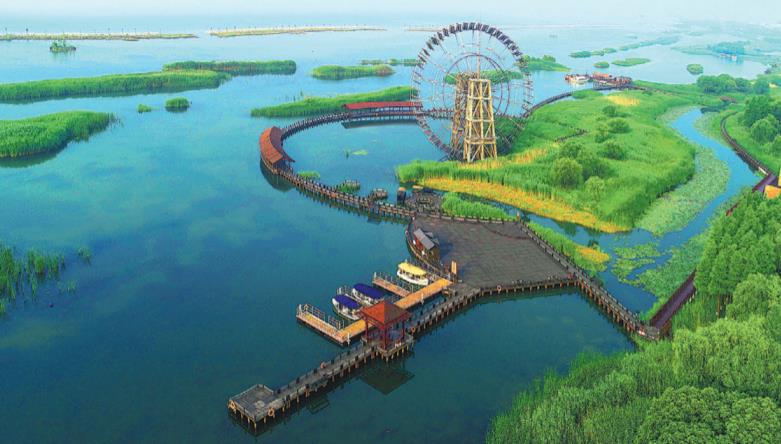
The Yangtze River Delta, one of China's most robust economic zones, is aiming for greener development and closer integration of its cities, as stipulated in a government blueprint that was released on Tuesday.
The National Development and Reform Commission on Tuesday posted on its website the full master plan of the demonstration zone for eco-friendly and integrated development of the Yangtze River Delta, including various environmental and cross-regional collaboration targets.
Spanning 2,300 square kilometers, the demonstration zone sits in the middle of the delta and consists of Qingpu district of Shanghai, Wujiang district of Suzhou in Jiangsu province and Jiashan county of Jiaxing in Zhejiang province.
Guard the green
According to the plan, over 95 percent of the zone's main water bodies should reach National IV standard and the water quality of the Taipu River — the canal connecting Taihu Lake and Huangpu River — should be maintained at National III standard, which means that it can be used for aquaculture or consumption, by 2025.
In addition, the green coverage rate in the zone should reach 42 percent while the length of greenway should exceed 500 kilometers.
"The mission of this zone is to strengthen environmental protection and to promote eco-friendly growth for a higher-quality integrated development," said Ma Chunlei, the director of the zone's executive committee, which was formed on Nov 1 to coordinate efforts across administrative divisions. Ma is also the deputy secretary-general of the Shanghai municipality.
Many environment restoration projects in the area are already in progress or in the pipeline, according to the administrators of the different local governments.
Yu Xufeng, governor of Qingpu district, said the district has established strict regulations for environmental protection and started relocating industrial factories currently situated in the protection zone for National II standard water bodies.
Xu Mingyang, governor of Jiashan county, said a lake restoration and river-linking project with a total investment of 2.04 billion yuan will be implemented for the 55 lakes in the county.
Li Ming, governor of Wujiang district, said the district has already deployed officers from Qingpu and Jiashan to conduct joint patrols along the rivers.
Removing the barriers
The closer integration of the area, which includes joint spatial planning, cross-regional transportation and administrative approval and the sharing of public services, are among the other key points mentioned in the plan.
A unified spatial planning of the zone, which is being jointly carried out by experts from Shanghai, Zhejiang and Jiangsu provinces, will focus on water system, ecology and environment, infrastructure and transportation, cultural and tourist sites, and industrial development.
Many dead-end roads at the border of the two provinces will also become connected.
"It used to take 1.5 hours to travel from Jiashan to Qingpu, but now it only takes 50 minutes," said Xu. "It will be more convenient for people to travel in this area after we open up more dead ends."
Shanghai metro line 17 will be extended westward to connect with Suzhou metro line 10, according to Li. Two high-speed railways, the Shanghai-Suzhou-Huzhou line which runs from east to west, and the Nantong-Suzhou-Jiaxing-Ningbo line which runs from north to south, will be constructed.
Administrative barriers will also be brought down. Unified systems for business registration, expertise certificate approval, credit system and tax management will be created so as to improve the flow of talents and businesses to the zone.
"We are explorers trying to design an integrated mechanism across administrative divisions," said Ma.
"If it works, our experience could be used as a model for the whole delta."
Innovation without pollution
To ensure that economic growth and environmental protection go hand in hand, the plan encourages the development of industries that have a low environmental impact.
To make better use of the natural and cultural resources such as the rivers, lakes and ancient water towns, the zone should promote eco-tourism, sports as well as health and wellness industries, according to the plan. The setting up of enterprises related to green finance, the information industry and new energy would also be encouraged.
One of the companies that fit this bill is Huawei Technology Co, which had earlier this year built a R&D center in Qingpu district.
"The center has generated 200 million yuan in taxes for this district and we estimate that this figure will exceed 1 billion next year," said Yu, the governor of Qingpu district.
The district will also push forward the development of the China Beidou Technology Innovation Base in the west Hongqiao area in Shanghai and attract companies in artificial intelligence and integrated circuits manufacturing, said Yu.
Jiashan county, on the other hand, will focus on smart sensors and hydrogen energy.
"In terms of the smart sensor industry, we have signed eight projects with a total investment of 13 billion yuan," said Xu,the governor of Jiashan county.
"The Huawei R&D center will pull a lot of companies onto its supply chain in the area and we want to seize this opportunity."
The county has also built a hydrogen full cell technology park and started operations of the first hydrogen-powered bus line in Zhejiang province, according to Xu.
"My vision for the area is that people work in innovation centers adorned with beautiful lakes at day, and rest in the nearby water towns at night," said Ma.
"Green is the background color of this zone."



















