



Beijing to levy fines on people who fail to properly sort waste
New measures also require reduced use of disposables by service providers









Beijing residents who fail to meet garbage classification standards will face fines up to 200 yuan ($28.50) if they refuse to rectify, starting May 1 after a newly revised regulation was passed by the capital's legislative body on Wednesday.
The capital will use four garbage classification standards: kitchen waste, recyclables, hazardous waste and other waste, according to the newly amended regulation passed by the Standing Committee of Beijing Municipal People's Congress. Citizens and companies in Beijing may face punishment if they fail to sort domestic garbage.
The use of ultrathin plastic bags will be banned, while the use of disposable supplies will be restricted in the capital, the regulation said.
According to the regulation, any individual or working unit will be held responsible for the proper sorting and disposal of garbage they produce. Those who fail to follow the rules can be fined up to 200 yuan if the offender is an individual, or between 1,000 yuan and 50,000 yuan for an offending work unit.
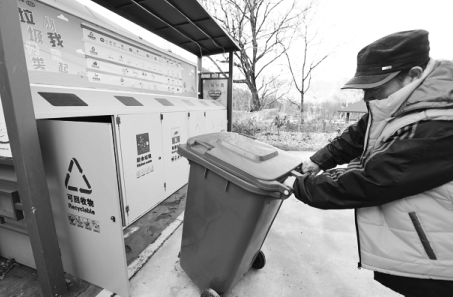
The regulation specifies that each residence community or village in Beijing should set up at least one recyclable garbage container. Special trash sorting containers for recyclables and hazardous waste also need to be set up.
The revised regulation follows a previous rule designating a specific garbage classification person responsible for a community's or village's trash sorting. At the same time, an instructor to guide the domestic garbage classification will also be designated to supervise the units and individuals for domestic garbage sorting.
The person responsible for garbage classification must report to the local urban management authorities if residents fail to sort trash and refuse to rectify, according to the regulation.
The revised regulation also adds rules to reduce the use of disposable supplies that government offices and institutions use.
Hotels, restaurants or other service providers can only provide disposable items to customers who ask for them.
For public office spaces, the regulation specifies that urban management authorities need to formulate standards for trash containers' colors, graphics, standards and locations.
Some large-scale waste products such as used furniture, household appliances or construction waste need to be placed in designated locations.
Supermarkets, shopping malls and farmers markets that use ultrathin plastic bags will face fines up to 10,000 yuan if they refuse to rectify their behaviors.
Chang Jiwen, deputy director of the Institute for Resources and Environment at the Development Research Center of the State Council, applauded the revised regulation and said public awareness will be enhanced as a result.
"The use of disposable supplies has been a headache for the city's environment, and the legislation will urge residents to better protect it," he said.
Beijing has carried out trash sorting since early 1998, when the Dachengxiang community in Xicheng district became the first neighborhood to classify garbage. At the end of 2011, the city published China's first domestic waste management regulation, which took effect on March 1, 2012.
However, the implementation of trash sorting in Beijing hasn't gone well in the past decade, since mere encouragement is not enough for citizens to change their habits, said Hao Zhilan, director of the urban construction and environmental protection committee at Beijing People Congress.
The previous regulations didn't give specific fines for households, companies or institutions that failed to sort their garbage properly.
In 2018, Beijing collected 9.3 million metric tons of household waste, according to local authorities.


Today's Top News
- Booking a stronger future
- Missile deployment proof that Japan poses threat to peace
- Highlights of NPC press conference on China's diplomacy
- Need for reshaping academic structure
- Shared Journey: Chinese new energy vehicles in Europe: competition or co-creation?
- Deep sea needs down-to-earth scientific research





